
Données techniques
| Formule | C18H17FN4O |
||||||||||||||
| Poids moléculaire | 324.35 | Numéro CAS | 934162-61-5 | ||||||||||||
| Solubilité (25°C)* | In vitro | DMSO | 64 mg/mL (197.31 mM) | ||||||||||||
| Water | Insoluble | ||||||||||||||
| Ethanol | Insoluble | ||||||||||||||
| In vivo (Ajouter les solvants au produit individuellement et dans l'ordre.) |
|
||||||||||||||
|
* <1 mg/ml signifie légèrement soluble ou insoluble. * Veuillez noter que Selleck teste la solubilité de tous les composés en interne, et la solubilité réelle peut différer légèrement des valeurs publiées. Ceci est normal et est dû à de légères variations d'un lot à l'autre. * Expédition à température ambiante (les tests de stabilité montrent que ce produit peut être expédié sans aucune mesure de refroidissement.) |
|||||||||||||||
Préparation des solutions mères
Activité biologique
| Description | A-966492 est un nouvel inhibiteur puissant de PARP1 et PARP2 avec des Ki de 1 nM et 1,5 nM, respectivement. | ||||||
|---|---|---|---|---|---|---|---|
| Cibles |
|
||||||
| In vitro | A-966492 is one of the most potent PARP inhibitors. This compound displays excellent potency against the PARP-1 enzyme with a Kiof 1 nM and an EC50 of 1 nM in a whole cell assay. It significantly enhances the efficacy of TMZ in a dose-dependent manner. In addition, this chemical is orally bioavailable across multiple species, crosses the blood−brain barrier, and appears to distribute into tumor tissue. It represents a promising, structurally diverse benzimidazole analogue and is being further characterized preclinically. |
||||||
| In vivo | A-966492 also demonstrates good in vivo efficacy in a B16F10 subcutaneous murine melanoma model in combination and in an MX-1 breast cancer xenograft model both as a single agent and in combination. In addition, this compound has excellent pharmaceutical properties and has demonstrated in vivo efficacy in preclinical mouse tumor models in combination with TMZ, as well as single agent activity in a BRCA1-deficient MX-1 tumor model. It is further characterized in Sprague−Dawley rats, beagle dogs, and cynomolgus monkeys, with this chemical demonstrating oral bioavailabilities of 34−72% and half-lives of 1.7−1.9 hours. In vivo, it demonstrates significant enhancement of the efficacy of TMZ in a murine B16F10 syngeneic melanoma model, with the combination groups showing superior efficacy. |
||||||
| Caractéristiques | Un analogue de benzimidazole prometteur et structurellement diversifié qui est en cours de caractérisation préclinique. |
Protocole (de référence)
| Test kinase : |
|
|---|---|
| Test cellulaire : |
|
| Étude animale : |
|
Références
|
Validation du produit par le client
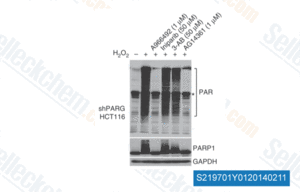
-
Données de [ Nat Methods , 2013 , 10(10), 981-4 ]
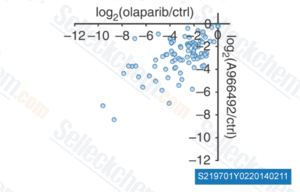
-
Données de [ Nat Methods , 2013 , 10(10), 981-4 ]
Selleck's A-966492 A été cité par 15 Publications
| Response of Breast Cancer Cells to PARP Inhibitors Is Independent of BRCA Status [ Journal of Clinical Medicine, March 30, 2020, 940] | PubMed: 32235451 |
| Selectivity profile of the poly(ADP-ribose) polymerase (PARP) inhibitor, A-966492 [ bioRxiv, March 23, 2017, nan] | |
| PARP1 Suppresses the Transcription of PD-L1 by Poly(ADP-Ribosyl)ating STAT3 [ Cancer Immunology Research, January 2019, 136-149] | PubMed: 30401677 |
| Histone Parylation factor 1 contributes to the inhibition of PARP1 by cancer drugs [ Nat Commun, 2021, 12(1):736] | PubMed: 33531508 |
| Pharmacological Poly (ADP-Ribose) Polymerase Inhibitors Decrease Mycobacterium tuberculosis Survival in Human Macrophages [ Front Immunol, 2021, 12:712021] | PubMed: 34899683 |
| CRISPR screening identifies novel PARP inhibitor classification based on distinct base excision repair pathway dependencies [ bioRxiv, 2021, 10.1101/2020.10.18.333070] | PubMed: None |
| Response of Breast Cancer Cells to PARP Inhibitors Is Independent of BRCA Status [ Journal of Clinical Medicine, 2020, 940] | PubMed: 32235451 |
| Response of Breast Cancer Cells to PARP Inhibitors Is Independent of BRCA Status. [ J Clin Med, 2020, 30;9(4)] | PubMed: 32235451 |
| [ Cancer Immunol Res, 2019, ] | PubMed: 30401677 |
| PARP1 Suppresses the Transcription of PD-L1 by Poly(ADP-Ribosyl)ating STAT3 [ Cancer Immunology Research, 2019, 136-149] | PubMed: 30401677 |
POLITIQUE DE RETOUR
La politique de retour inconditionnelle de Selleck Chemical garantit une expérience d'achat en ligne fluide à nos clients. Si vous n'êtes en aucun cas satisfait de votre achat, vous pouvez retourner tout article dans les 7 jours suivant sa réception. En cas de problèmes de qualité du produit, qu'il s'agisse de problèmes liés au protocole ou au produit, vous pouvez retourner tout article dans les 365 jours suivant la date d'achat initiale. Veuillez suivre les instructions ci-dessous lors du retour des produits.
EXPÉDITION ET STOCKAGE
Les produits Selleck sont transportés à température ambiante. Si vous recevez le produit à température ambiante, soyez assuré que le service d'inspection de la qualité de Selleck a mené des expériences pour vérifier que le placement à température normale pendant un mois n'affectera pas l'activité biologique des produits en poudre. Après réception, veuillez stocker le produit conformément aux exigences décrites dans la fiche technique. La plupart des produits Selleck sont stables dans les conditions recommandées.
NON DESTINÉ À UN USAGE HUMAIN, VÉTÉRINAIRE DIAGNOSTIQUE OU THÉRAPEUTIQUE.