
Données techniques
| Formule | C16H21NO3 |
||||||||||||||
| Poids moléculaire | 275.34 | Numéro CAS | 61413-54-5 | ||||||||||||
| Solubilité (25°C)* | In vitro | DMSO | 55 mg/mL (199.75 mM) | ||||||||||||
| Ethanol | 55 mg/mL (199.75 mM) | ||||||||||||||
| Water | Insoluble | ||||||||||||||
| In vivo (Ajouter les solvants au produit individuellement et dans l'ordre.) |
|
||||||||||||||
|
* <1 mg/ml signifie légèrement soluble ou insoluble. * Veuillez noter que Selleck teste la solubilité de tous les composés en interne, et la solubilité réelle peut différer légèrement des valeurs publiées. Ceci est normal et est dû à de légères variations d'un lot à l'autre. * Expédition à température ambiante (les tests de stabilité montrent que ce produit peut être expédié sans aucune mesure de refroidissement.) |
|||||||||||||||
Préparation des solutions mères
Activité biologique
| Description | L'inhibiteur sélectif de la PDE4, Rolipram, a inhibé de manière similaire les activités immunopurifiées des PDE4B et PDE4D, avec des valeurs d'IC50 d'environ 130 nM et 240 nM respectivement ; un agent anti-inflammatoire. | ||||
|---|---|---|---|---|---|
| Cibles |
|
Protocole (de référence)
Références
|
Validation du produit par le client

-
Données de [ , , Mol Cancer Ther, 2014, 13(10):2463-73. ]
-
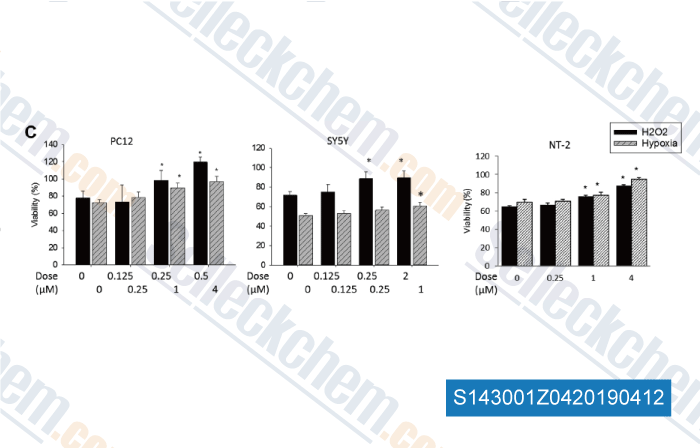
Données de [ , , Biomed Pharmacother, 2018, 99:947-955 ]
-
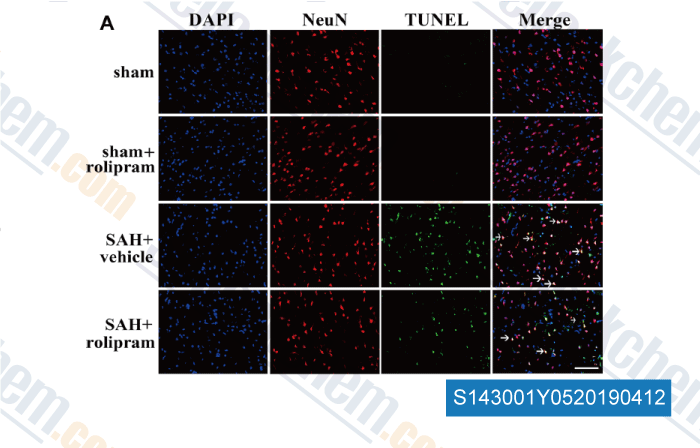
Données de [ , , J Sex Med, 2016, 13(12):1834-1843 ]
-
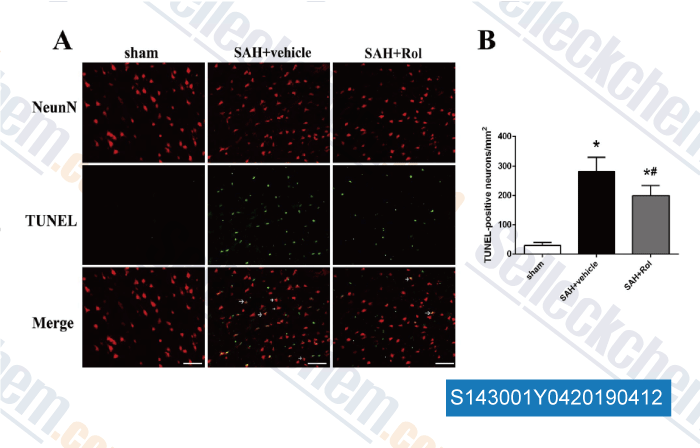
Données de [ , , Neurochem Res, 2018, 43(4):785-795 ]
Selleck's Rolipram A été cité par 18 Publications
| P2RY14 cAMP signaling regulates Schwann cell precursor self-renewal, proliferation, and nerve tumor initiation in a mouse model of neurofibromatosis [ Elife, 2022, 11e73511] | PubMed: 35311647 |
| Purinergic Signaling in Neurofibromatosis Type 1: Characterizing the Role of P2RY14 in Neurofibroma Development [ ProQuest, 2022, 30509631] | PubMed: None |
| Roflupram protects against rotenone-induced neurotoxicity and facilitates α-synuclein degradation in Parkinson's disease models [ Acta Pharmacol Sin, 2021, 10.1038/s41401-021-00768-4] | PubMed: 34531546 |
| Rolipram Prevents the Formation of Abdominal Aortic Aneurysm (AAA) in Mice: PDE4B as a Target in AAA [ Antioxidants (Basel), 2021, 10(3)460] | PubMed: 33809405 |
| Release of adenosine-induced immunosuppression: Comprehensive characterization of dual A2A/A2B receptor antagonist [ Int Immunopharmacol, 2021, 96:107645] | PubMed: 33894488 |
| The protective effect of the PDE-4 inhibitor rolipram on intracerebral haemorrhage is associated with the cAMP/AMPK/SIRT1 pathway [ Sci Rep, 2021, 11(1):19737] | PubMed: 34611179 |
| MicroRNA-30d-5p ameliorates lipopolysaccharide-induced acute lung injury via activating AMPKα [ Immunopharmacol Immunotoxicol, 2021, 43(4):431-442] | PubMed: 34157933 |
| Roflupram exerts neuroprotection via activation of CREB/PGC-1α signalling in experimental models of Parkinson's disease. [ Br J Pharmacol, 2020, 177(10):2333-2350] | PubMed: 31972868 |
| Roflupram, a novel phosphodiesterase 4 inhibitor, inhibits lipopolysaccharide-induced neuroinflammatory responses through activation of the AMPK/Sirt1 pathway [ Int Immunopharmacol, 2020, S1567-5769(20)33643-2] | PubMed: 33243606 |
| The diacylglycerol kinase α (DGKα)/Akt/NF-κB feedforward loop promotes esophageal squamous cell carcinoma (ESCC) progression via FAK-dependent and FAK-independent manner [ Oncogene, 2019, 38(14):2533-2550] | PubMed: 30532074 |
POLITIQUE DE RETOUR
La politique de retour inconditionnelle de Selleck Chemical garantit une expérience d'achat en ligne fluide à nos clients. Si vous n'êtes en aucun cas satisfait de votre achat, vous pouvez retourner tout article dans les 7 jours suivant sa réception. En cas de problèmes de qualité du produit, qu'il s'agisse de problèmes liés au protocole ou au produit, vous pouvez retourner tout article dans les 365 jours suivant la date d'achat initiale. Veuillez suivre les instructions ci-dessous lors du retour des produits.
EXPÉDITION ET STOCKAGE
Les produits Selleck sont transportés à température ambiante. Si vous recevez le produit à température ambiante, soyez assuré que le service d'inspection de la qualité de Selleck a mené des expériences pour vérifier que le placement à température normale pendant un mois n'affectera pas l'activité biologique des produits en poudre. Après réception, veuillez stocker le produit conformément aux exigences décrites dans la fiche technique. La plupart des produits Selleck sont stables dans les conditions recommandées.
NON DESTINÉ À UN USAGE HUMAIN, VÉTÉRINAIRE DIAGNOSTIQUE OU THÉRAPEUTIQUE.