
Données techniques
| Formule | C20H22F3N5O |
||||||
| Poids moléculaire | 405.42 | Numéro CAS | 1025065-69-3 | ||||
| Solubilité (25°C)* | In vitro | DMSO | 81 mg/mL (199.79 mM) | ||||
| Ethanol | 81 mg/mL (199.79 mM) | ||||||
| Water | Insoluble | ||||||
| In vivo (Ajouter les solvants au produit individuellement et dans l'ordre.) |
|
||||||
|
* <1 mg/ml signifie légèrement soluble ou insoluble. * Veuillez noter que Selleck teste la solubilité de tous les composés en interne, et la solubilité réelle peut différer légèrement des valeurs publiées. Ceci est normal et est dû à de légères variations d'un lot à l'autre. * Expédition à température ambiante (les tests de stabilité montrent que ce produit peut être expédié sans aucune mesure de refroidissement.) |
|||||||
Préparation des solutions mères
Activité biologique
| Description | SGI-1776 free base est un nouvel inhibiteur compétitif de l'ATP de Pim1 avec une IC50 de 7 nM dans un essai sans cellules, 50 et 10 fois plus sélectif que Pim2 et Pim3, également puissant contre Flt3 et Haspin. SGI-1776 induit l'apoptose et l'autophagy. | ||||||||
|---|---|---|---|---|---|---|---|---|---|
| Cibles |
|
||||||||
| In vitro | In addition to Pim, SGI-1776 also potently targets FLT3 (IC50 = 44nM). Treatment of AML cells with SGI-1776 results in a concentration-dependent induction of apoptosis. Importantly, SGI-1776 is also cytotoxic in AML primary cells, irrespective of FLT3 mutation status and results in Mcl-1 protein decline. Treatment of CLL cells with SGI-1776 results in a concentration-dependent induction of apoptosis. SGI-1776 induces apoptosis in CLL and that the mechanism involves Mcl-1 reduction. Apoptosis induction coupled with the inhibition of RNA synthesis is observed in CLL cells treated with SGI-1776. SGI-1776 exhibites cytotoxic activity in vitro with a median relative IC50 of 3.1 mM. SGI-1776 induces tumor growth inhibition meeting criteria for intermediate EFS T/C activity in 1 of 39 evaluable models. In contrast, SGI-1776 induces complete responses of subcutaneous MV4;11. |
||||||||
| In vivo | Consistent with cell line data, xenograft model studies with mice bearing MV-4-11 tumors shows efficacy with SGI-1776. SGI-1776 has shown preclinical activity against leukemia and solid tumor cell line models with IC50 values of 0.005–11.68 mM. SGI-1776 induces significant differences in EFS distribution in vivo in 9 of 31 solid tumor xenografts and in 1 of 8 of the evaluable ALL xenografts. |
Protocole (de référence)
| Test kinase : |
|
|---|---|
| Test cellulaire : |
|
| Étude animale : |
|
Références
|
Validation du produit par le client
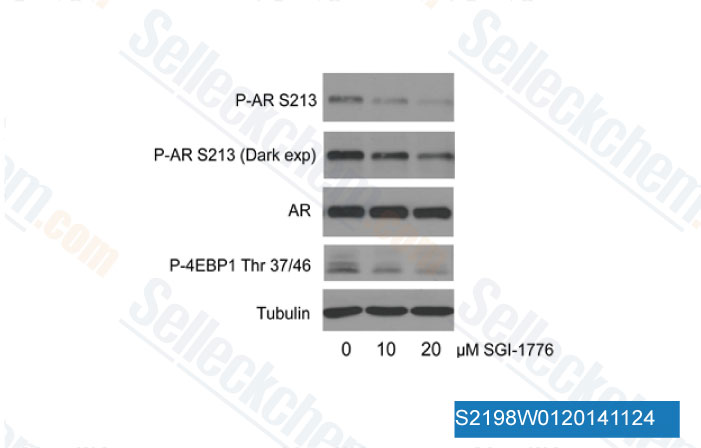
-
Données de [ Oncogene , 2013 , 32(34), 3992-4000 ]
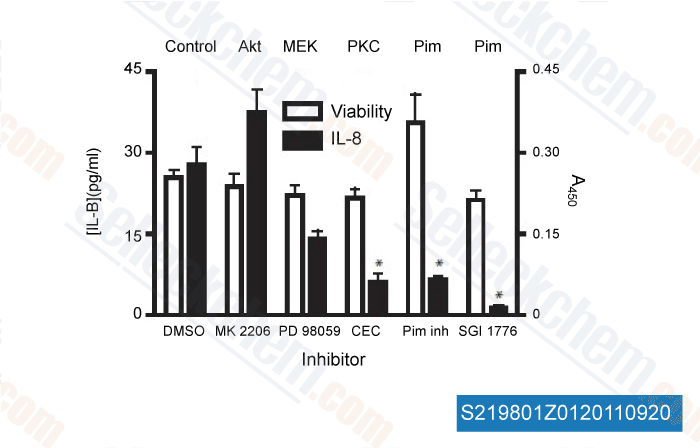
-
Données de [ Sci Signal , 2011 , 4, rs9 ]
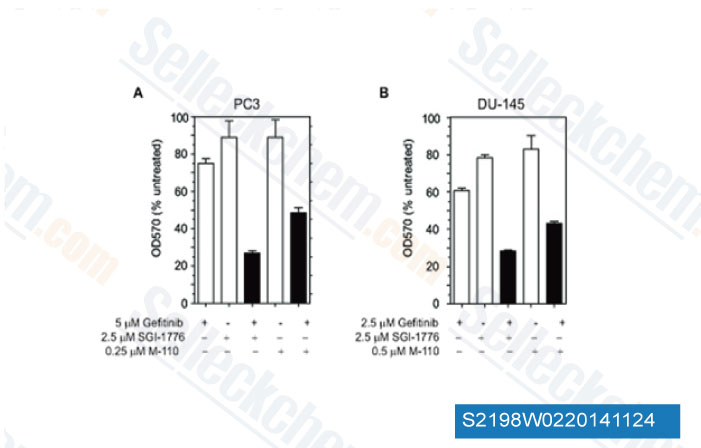
-
Données de [ Oncotarget , 2011 , 2(12), 1134-44 ]
Selleck's SGI-1776 free base A été cité par 43 Publications
| PIM1 kinase promotes EMT-associated osimertinib resistance via regulating GSK3β signaling pathway in EGFR-mutant non-small cell lung cancer [ Cell Death Dis, 2024, 15(9):644] | PubMed: 39227379 |
| New Fusarochromanone Derivatives from the Marine Fungus Fusarium equiseti UBOCC-A-117302 [ Mar Drugs, 2024, 22(10)444] | PubMed: 39452852 |
| CDK9 inhibition induces epigenetic reprogramming revealing strategies to circumvent resistance in lymphoma [ Mol Cancer, 2023, 22(1):64] | PubMed: 36998071 |
| Neoprzewaquinone A Inhibits Breast Cancer Cell Migration and Promotes Smooth Muscle Relaxation by Targeting PIM1 to Block ROCK2/STAT3 Pathway [ Int J Mol Sci, 2023, 24(6)5464] | PubMed: 36982538 |
| Structure Activity Relationship Studies around DB18, a Potent and Selective Inhibitor of CLK Kinases [ Molecules, 2022, 27(19)6149] | PubMed: 36234686 |
| Targeting Echinococcus multilocularis PIM kinase for improving anti-parasitic chemotherapy [ PLoS Negl Trop Dis, 2022, 16(10):e0010483] | PubMed: 36190997 |
| Preclinical Immunopharmacologic Assessment of KPL-404, a Novel, Humanized, Non-Depleting Antagonistic Anti-CD40 Monoclonal Antibody [ Int J Gynecol Pathol, 2022, 10.1097/PGP.0000000000000882] | PubMed: 35443252 |
| Inhibition of PIM Kinases in DLBCL Targets MYC Transcriptional Program and Augments the Efficacy of Anti-CD20 Antibodies [ Cancer Res, 2021, 81(23):6029-6043] | PubMed: 34625423 |
| Inhibition of PIM Kinases in DLBCL Targets MYC Transcriptional Program and Augments the Efficacy of Anti-CD20 Antibodies [ Cancer Res, 2021, canres.1023.2021] | PubMed: 34625423 |
| PIM1 phosphorylation of the androgen receptor and 14-3-3 ζ regulates gene transcription in prostate cancer [ Commun Biol, 2021, 4(1):1221] | PubMed: 34697370 |
POLITIQUE DE RETOUR
La politique de retour inconditionnelle de Selleck Chemical garantit une expérience d'achat en ligne fluide à nos clients. Si vous n'êtes en aucun cas satisfait de votre achat, vous pouvez retourner tout article dans les 7 jours suivant sa réception. En cas de problèmes de qualité du produit, qu'il s'agisse de problèmes liés au protocole ou au produit, vous pouvez retourner tout article dans les 365 jours suivant la date d'achat initiale. Veuillez suivre les instructions ci-dessous lors du retour des produits.
EXPÉDITION ET STOCKAGE
Les produits Selleck sont transportés à température ambiante. Si vous recevez le produit à température ambiante, soyez assuré que le service d'inspection de la qualité de Selleck a mené des expériences pour vérifier que le placement à température normale pendant un mois n'affectera pas l'activité biologique des produits en poudre. Après réception, veuillez stocker le produit conformément aux exigences décrites dans la fiche technique. La plupart des produits Selleck sont stables dans les conditions recommandées.
NON DESTINÉ À UN USAGE HUMAIN, VÉTÉRINAIRE DIAGNOSTIQUE OU THÉRAPEUTIQUE.