
Données techniques
| Formule | C13H13N3O3 |
||||||||||
| Poids moléculaire | 259.26 | Numéro CAS | 191732-72-6 | ||||||||
| Solubilité (25°C)* | In vitro | DMSO | 51 mg/mL (196.71 mM) | ||||||||
| Water | Insoluble | ||||||||||
| Ethanol | Insoluble | ||||||||||
| In vivo (Ajouter les solvants au produit individuellement et dans l'ordre.) |
|
||||||||||
|
* <1 mg/ml signifie légèrement soluble ou insoluble. * Veuillez noter que Selleck teste la solubilité de tous les composés en interne, et la solubilité réelle peut différer légèrement des valeurs publiées. Ceci est normal et est dû à de légères variations d'un lot à l'autre. * Expédition à température ambiante (les tests de stabilité montrent que ce produit peut être expédié sans aucune mesure de refroidissement.) |
|||||||||||
Préparation des solutions mères
Activité biologique
| Description | Lenalidomide est un inhibiteur de la sécrétion de TNF-α avec un IC50 de 13 nM dans les PBMC. Le Lenalidomide (CC-5013) est un ligand de l'ubiquitine E3 ligase cereblon (CRBN), et il provoque une ubiquitination sélective et la dégradation de deux facteurs de transcription lymphoïdes, IKZF1 et IKZF3, par l'ubiquitine ligase CRBN-CRL4. Le Lenalidomide favorise l'expression de la caspase-3 clivée et inhibe l'expression du VEGF et induit l'apoptose. | ||||||
|---|---|---|---|---|---|---|---|
| Cibles |
|
||||||
| In vitro | Lenalidomide strongly induces IL-2 and sIL-2R production. This compound-induced tyrosine phosphorylation of CD28 on T cells is followed by a down-stream activation of NF-κB. This compound and pomalidomide inhibits autoubiquitination of CRBN in HEK293 T cells expressing thalidomide-binding competent wild-type CRBN, but not thalidomide-binding defective CRBN(YW/AA). Overexpression of CRBN wild-type protein, but not CRBN(YW/AA) mutant protein, in KMS12 myeloma cells, amplifies pomalidomide-mediated reductions in c-myc and IRF4 expression and increases in p21(WAF-1) expression. Long-term selection for this compound resistance in H929 myeloma cell lines is accompanied by a reduction in CRBN, while in DF15R myeloma cells resistant to both pomalidomide and this chemical, CRBN protein is undetectable. This chemical prevents induction of defects by down-regulating tumor cell inhibitory molecule expression. It prevents induction of tumor-induced T cell lytic synapse dysfunction. This compound treatment blocks CLL cell-induced T cell actin synapse dysfunction, mimicks antibody blockade, and down-regulates expression of CLL inhibitory ligands and their receptors on T cells. This treatment prevents tumor-induced immune suppression in FL, DLBCL, HL, MM, SCC, and OC and down-regulates immunosuppressive ligand expression on all tumor cells examined. CTL killing function significantly increases following antibody blockade of CLL inhibitory ligands or this chemical treatment compared to control treatments. Treatment of autologous CLL-T cell co-cultures with this agent reverses impaired CD8+ T cell lytic synapse formation and granzyme B trafficking. |
||||||
| In vivo | The induction of angiogenesis by bFGF is significantly inhibited by oral treatment of Lenalidomide in a dose-dependent manner. This compound significantly decreases the percentage of vascularized area from 5.16% (control group) to 2.58% (50 mg/kg). It significantly reduces the calculated total MVL from 21.07 (control) to 8.11 (50 mg/kg). This chemical significantly inhibites HUVEC migration through the fibronectin-coated membranes towards 0.1 ng/mL of bFGF at 100 μM, 1 ng/mL of VEGF at concentrations of 10 μM and 100 μM. |
Protocole (de référence)
| Test kinase : |
|
|---|---|
| Étude animale : |
|
Références
|
Validation du produit par le client
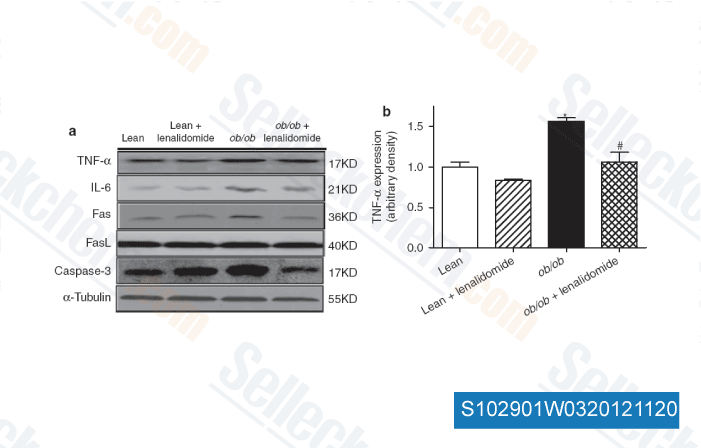
-
Données de [ Obesity , 2012 , 20, 2174-85 ]

-
, , Harvard Medical School

-
, , Harvard Medical School

-
Données de [ , , Clin Cancer Res, 2011, 17(10): 3259–71 ]
Selleck's CC-5013 (Lenalidomide) A été cité par 190 Publications
| Dual targeting PD-L1 and 4-1BB to overcome dendritic cell-mediated lenalidomide resistance in follicular lymphoma [ Signal Transduct Target Ther, 2025, 10(1):29] | PubMed: 39828715 |
| IKAROS levels are associated with antigen escape in CD19- and CD22-targeted therapies for B-cell malignancies [ Nat Commun, 2025, 16(1):3800] | PubMed: 40268897 |
| A patient-derived T cell lymphoma biorepository uncovers pathogenetic mechanisms and host-related therapeutic vulnerabilities [ Cell Rep Med, 2025, S2666-3791(25)00102-8] | PubMed: 40147445 |
| Haploinsufficiency of miR-143 and miR-145 reveal targetable dependencies in resistant del(5q) myelodysplastic neoplasm [ Leukemia, 2025, 39(4):917-928] | PubMed: 40000845 |
| The Prolonged Half-Life of the p53 Missense Variant R248Q Promotes Accumulation and Heterotetramer Formation with Wild-Type p53 to Exert the Dominant-Negative Effect [ Cancer Research, 2025, 1978-1996] | PubMed: 40163352 |
| The Prolonged Half-Life of the p53 Missense Variant R248Q Promotes Accumulation and Heterotetramer Formation with Wildtype p53 to Exert the Dominant-Negative Effect [ Cancer Res, 2025, 10.1158/0008-5472.CAN-24-1136] | PubMed: 40163352 |
| Enhancing T cell cytotoxicity in multiple myeloma with bispecific αPD-L1 × αCD3 T cell engager-armed T cells and low-dose bortezomib therapy [ Biomed Pharmacother, 2025, 184:117878] | PubMed: 39891948 |
| Rapid and high-throughput screening of proteolysis targeting chimeras using a dual-reporter system expressing fluorescence protein and luciferase [ BMC Biol, 2025, 23(1):51] | PubMed: 39985000 |
| KAT/3BP: A Metabolism-Targeting Agent with Single and Combination Activity in Aggressive B-Cell Lymphomas [ Cancers (Basel), 2025, 17(12)2034] | PubMed: 40563683 |
| Reposition of lenalidomide as a radiation protector based on LINCS gene expression signatures and its preclinical validation [ Sci Rep, 2025, 15(1):12955] | PubMed: 40234645 |
POLITIQUE DE RETOUR
La politique de retour inconditionnelle de Selleck Chemical garantit une expérience d'achat en ligne fluide à nos clients. Si vous n'êtes en aucun cas satisfait de votre achat, vous pouvez retourner tout article dans les 7 jours suivant sa réception. En cas de problèmes de qualité du produit, qu'il s'agisse de problèmes liés au protocole ou au produit, vous pouvez retourner tout article dans les 365 jours suivant la date d'achat initiale. Veuillez suivre les instructions ci-dessous lors du retour des produits.
EXPÉDITION ET STOCKAGE
Les produits Selleck sont transportés à température ambiante. Si vous recevez le produit à température ambiante, soyez assuré que le service d'inspection de la qualité de Selleck a mené des expériences pour vérifier que le placement à température normale pendant un mois n'affectera pas l'activité biologique des produits en poudre. Après réception, veuillez stocker le produit conformément aux exigences décrites dans la fiche technique. La plupart des produits Selleck sont stables dans les conditions recommandées.
NON DESTINÉ À UN USAGE HUMAIN, VÉTÉRINAIRE DIAGNOSTIQUE OU THÉRAPEUTIQUE.