
pour la recherche uniquement
4-Aminobutyric acid (GABA) GABA Receptor Agoniste
Réf. Catalogue: S4700
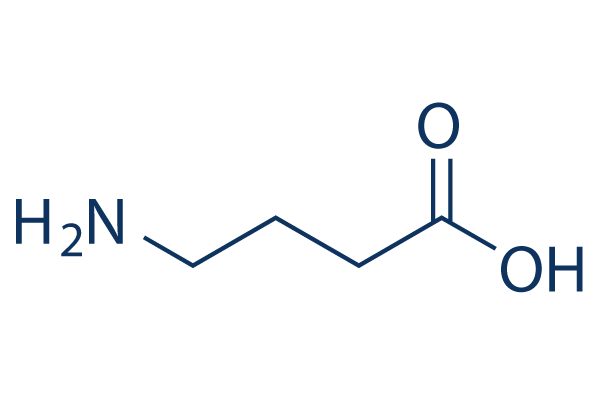
Structure chimique
Poids moléculaire: 103.12
Contrôle Qualité (Quality Control)
| Cibles apparentées | Adrenergic Receptor AChR 5-HT Receptor COX Calcium Channel Histamine Receptor Dopamine Receptor TRP Channel Cholinesterase (ChE) GluR |
|---|---|
| Autre GABA Receptor Inhibiteurs | Dihydromyricetin CGP52432 Pentylenetetrazol Oxiracetam Ginkgolide A (+)-Borneol (-)-Borneol Fluralaner Emamectin Benzoate Nefiracetam |
Informations chimiques, stockage et stabilité (Chemical Information, Storage & Stability)
| Poids moléculaire | 103.12 | Formule | C4H9NO2 |
Stockage (À compter de la date de réception) | |
|---|---|---|---|---|---|
| N° CAS | 56-12-2 | Télécharger le SDF | Stockage des solutions mères |
|
|
| Synonymes | 4-Aminobutanoic acid, GABA, Gamma-aminobutyric acid, Piperidic acid | Smiles | C(CC(=O)O)CN | ||
Solubilité (Solubility)
|
In vitro |
Water : 21 mg/mL
DMSO
: Insoluble
Ethanol : Insoluble |
Calculateur de molarité
|
In vivo |
|||||
Calculateur de formulation in vivo (Solution claire)
Étape 1 : Saisir les informations ci-dessous (Recommandé : Un animal supplémentaire pour tenir compte des pertes pendant l'expérience)
Étape 2 : Saisir la formulation in vivo (Ceci est seulement le calculateur, pas la formulation. Veuillez nous contacter d'abord s'il n'y a pas de formulation in vivo dans la section Solubilité.)
Résultats du calcul :
Concentration de travail : mg/ml;
Méthode de préparation du liquide maître DMSO : mg médicament prédissous dans μL DMSO ( Concentration du liquide maître mg/mL, Veuillez nous contacter d'abord si la concentration dépasse la solubilité du DMSO du lot de médicament. )
Méthode de préparation de la formulation in vivo : Prendre μL DMSO liquide maître, puis ajouterμL PEG300, mélanger et clarifier, puis ajouterμL Tween 80, mélanger et clarifier, puis ajouter μL ddH2O, mélanger et clarifier.
Méthode de préparation de la formulation in vivo : Prendre μL DMSO liquide maître, puis ajouter μL Huile de maïs, mélanger et clarifier.
Note : 1. Veuillez vous assurer que le liquide est clair avant d'ajouter le solvant suivant.
2. Assurez-vous d'ajouter le(s) solvant(s) dans l'ordre. Vous devez vous assurer que la solution obtenue, lors de l'ajout précédent, est une solution claire avant de procéder à l'ajout du solvant suivant. Des méthodes physiques telles que le vortex, les ultrasons ou le bain-marie chaud peuvent être utilisées pour faciliter la dissolution.
Mécanisme d'action (Mechanism of Action)
| Targets/IC50/Ki |
GABA receptor
|
|---|---|
| In vitro |
γ-Aminobutyric acid (GABA) functions primarily as an inhibitory neurotransmitter in the mature central nervous system. The addition of this compound into the cell culture medium promoted the proliferation of GABRP-expressing PDAC cells, but not GABRP-negative cells, and GABAA receptor antagonists inhibited this growth-promoting effect by GABA. The HEK293 cells constitutively expressing exogenous GABRP revealed the growth-promoting effect of GABA treatment. GABA treatment in GABRP-positive cells increased intracellular Ca2+ levels and activated the mitogen-activated protein kinase/extracellular signal-regulated kinase (MAPK/Erk) cascade. It exerts antidiabetic effects by acting on both the islet β-cells and immune system. Unlike in adult brain or islet α-cells in which GABA exerts hyperpolarizing effects, in islet β-cells, it produces membrane depolarization and Ca2+ influx, leading to the activation of PI3K/Akt-dependent growth and survival pathways.
|
| In vivo |
4-Aminobutyric acid (GABA) is the principal inhibitory neurotransmitter in the adult brain that has a parallel inhibitory role in the immune system. GABAergic medications are used to treat anxiety, alcohol withdrawal, epilepsy, and to induce sedation, and anesthesia. It is neuroprotective in animal models of stroke. This compound decreases inflammatory cytokine production in peripheral macrophages. It decreases T cell autoimmunity and the development of inflammatory responses in the nonobese diabetic mouse model of type 1 diabetes. In the adult brain, GABA induces a fast inhibition in neurons mainly through the GABAA receptor (GABAAR). It is produced by pancreatic β-cells. GABA released from β-cells can act on GABAAR in the α-cells, causing membrane hyperpolarization and hence suppressing glucagon secretion. GABA-treated mice showed higher circulating insulin, lower glucagon, nearly normal glycemia, improved metabolic conditions, and maintained close to normal glucose tolerance during a period of 53 d after STZ injections.
|
Références |
|
Informations sur l'essai clinique (Clinical Trial Information)
(données du https://clinicaltrials.gov, mis à jour le 2025-07-30)
| Numéro NCT | Recrutement | Conditions | Promoteur/Collaborateurs | Date de début | Phases |
|---|---|---|---|---|---|
| NCT04062890 | WITHDRAWN | Hyperinsulinism; Insulin Resistance; Insulin Sensitivity; Glucose Intolerance; Hypertension |
University of Arizona |
2030-04-15 | PHASE2 |
| NCT03328455 | NOT_YET_RECRUITING | Healthy Aging |
University of Nevada, Reno |
2027-12-01 | |
| NCT07457736 | RECRUITING | Healthy Adult Participants |
Yale University |
2026-01-28 | EARLY_PHASE1 |
| NCT07549490 | NOT_YET_RECRUITING | Acute Pain |
National Center for Complementary and Integrative Health (NCCIH) |
2026-09-09 | |
| NCT06852469 | RECRUITING | Stress Disorders, Post-Traumatic |
VA Office of Research and Development |
2025-07-01 | PHASE4 |
| NCT04144439 | RECRUITING | Epilepsy |
Sherief Abd-Elsalam |
2018-07-01 | PHASE4 |

Les produits sont destinés à la recherche uniquement. Ne pas utiliser chez l'homme. Nous ne vendons pas aux patients.
©Copyright 2013 Selleck Chemicals. Tous droits réservés.