
pour la recherche uniquement
5-Acetylsalicylic acid Immunology & Inflammation related Produit chimique
Réf. Catalogue: S4789
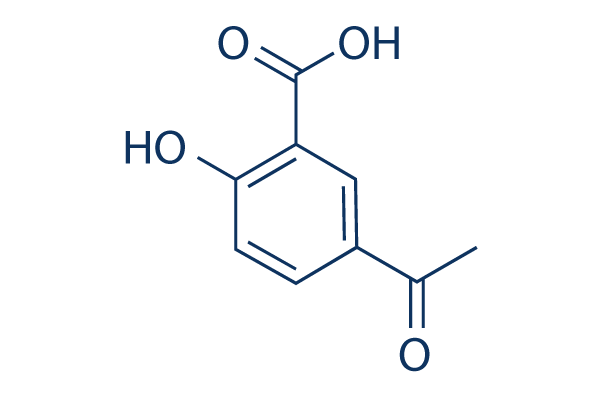
Structure chimique
Poids moléculaire: 180.16
Contrôle Qualité (Quality Control)
- Cité dans Nature Medicine pour sa qualité supérieure
- COA
- SDS
- Fiche technique
| Cibles apparentées | PD-1/PD-L1 CXCR STING AhR CD markers Interleukins Anti-infection Antioxidant COX Histamine Receptor |
|---|---|
| Autre Immunology & Inflammation related Inhibiteurs | Cl-amidine Bestatin (Ubenimex) Bindarit (AF 2838) Tempol Tranilast Sinomenine GI254023X (GI4023) Geniposidic acid CORM-3 Oxymatrine |
Informations chimiques, stockage et stabilité (Chemical Information, Storage & Stability)
| Poids moléculaire | 180.16 | Formule | C9H8O4 |
Stockage (À compter de la date de réception) | |
|---|---|---|---|---|---|
| N° CAS | 13110-96-8 | Télécharger le SDF | Stockage des solutions mères |
|
|
| Synonymes | 5-acetyl-2-hydroxybenzoic acid | Smiles | CC(=O)C1=CC(=C(C=C1)O)C(=O)O | ||
Solubilité (Solubility)
|
In vitro |
DMSO
: 36 mg/mL
(199.82 mM)
|
Calculateur de molarité
|
In vivo |
|||||
Calculateur de formulation in vivo (Solution claire)
Étape 1 : Saisir les informations ci-dessous (Recommandé : Un animal supplémentaire pour tenir compte des pertes pendant l'expérience)
Étape 2 : Saisir la formulation in vivo (Ceci est seulement le calculateur, pas la formulation. Veuillez nous contacter d'abord s'il n'y a pas de formulation in vivo dans la section Solubilité.)
Résultats du calcul :
Concentration de travail : mg/ml;
Méthode de préparation du liquide maître DMSO : mg médicament prédissous dans μL DMSO ( Concentration du liquide maître mg/mL, Veuillez nous contacter d'abord si la concentration dépasse la solubilité du DMSO du lot de médicament. )
Méthode de préparation de la formulation in vivo : Prendre μL DMSO liquide maître, puis ajouterμL PEG300, mélanger et clarifier, puis ajouterμL Tween 80, mélanger et clarifier, puis ajouter μL ddH2O, mélanger et clarifier.
Méthode de préparation de la formulation in vivo : Prendre μL DMSO liquide maître, puis ajouter μL Huile de maïs, mélanger et clarifier.
Note : 1. Veuillez vous assurer que le liquide est clair avant d'ajouter le solvant suivant.
2. Assurez-vous d'ajouter le(s) solvant(s) dans l'ordre. Vous devez vous assurer que la solution obtenue, lors de l'ajout précédent, est une solution claire avant de procéder à l'ajout du solvant suivant. Des méthodes physiques telles que le vortex, les ultrasons ou le bain-marie chaud peuvent être utilisées pour faciliter la dissolution.
Mécanisme d'action (Mechanism of Action)
| In vitro |
5-Acetylsalicylic acid (5-ASA) is initially shown to downregulate the inducible cyclooxygenase/prostaglandin E2 (COX-2/PGE2) signalling in mucosa inflammatory cells. Generally 5-ASA decreases the nuclear factor κB (NF-κB) activity induced by TNF-α, modulating the NF-κB inhibitor, IκBα, as well as the NF-κB transcriptional activity induced by IL-1, although it does prevent neither IL-1-induced IκBα degradation nor IL-1-induced nuclear translocation of NF-κB family members. 5-ASA is also found to increase β-catenin expression/phosphorylation and the expression of μ-protocadherin in intestine cells while reducing the expression of Wnt/β-catenin target genes and the activity of the protein phosphatase 2A. 5-ASA enhances PPAR-γ expression/activity in intestine cells and promotes its translocation from the cytoplasm to the nucleus -- this is followed by the induction of the tumour suppressor gene PTEN, the activation of caspases 8 and 3, and the inhibition of antiapoptotic proteins. It induces membranous expression of E-cadherin and increases cell adhesion through inhibition of p-21 activated kinase-1 and modulation of N-glycosylation; Also interferes with the mitogen activated protein kinase and phosphatidylinositol-4,5-bisphosphate 3-kinase/Akt pathways.
|
|---|---|
| In vivo |
5-ASA is rapidly adsorbed and extensively acetylated to N-acetyl-5-ASA by the N-acetyltransferase 1 enzyme in intestinal epithelial cells and the liver. It is generally well tolerated and the most common side effects include headache, nausea, and abdominal pain.
|
Références |
Informations sur l'essai clinique (Clinical Trial Information)
(données du https://clinicaltrials.gov, mis à jour le 2024-05-22)
| Numéro NCT | Recrutement | Conditions | Promoteur/Collaborateurs | Date de début | Phases |
|---|---|---|---|---|---|
| NCT02246686 | Terminated | Colitis Ulcerative |
Bayer |
2014-11 | Phase 2 |
| NCT02125292 | Completed | Healthy |
Shire|Takeda |
2014-06-02 | Phase 1 |
| NCT02077777 | Completed | Colorectal Cancer |
SOFAR S.p.A. |
2012-10 | Phase 2 |
| NCT01678300 | Completed | Ulcerative Colitis |
Beth Israel Deaconess Medical Center |
2012-08 | -- |

Les produits sont destinés à la recherche uniquement. Ne pas utiliser chez l'homme. Nous ne vendons pas aux patients.
©Copyright 2013 Selleck Chemicals. Tous droits réservés.