
pour la recherche uniquement
Tivozanib VEGFR Inhibiteur
Réf. Catalogue: S1207
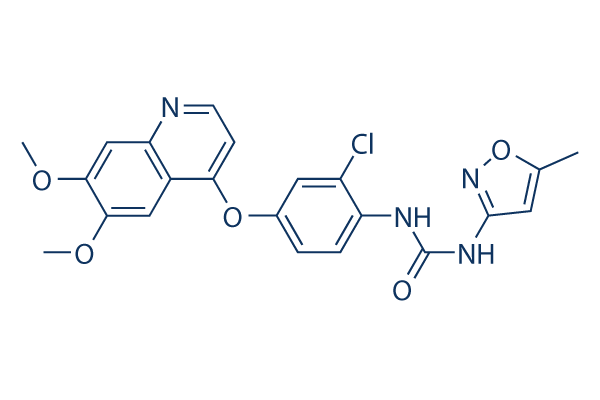
Structure chimique
Poids moléculaire: 454.86
Contrôle Qualité (Quality Control)
| Cibles apparentées | EGFR FGFR PDGFR c-Met Src MEK CSF-1R FLT3 HER2 c-Kit |
|---|---|
| Autre VEGFR Inhibiteurs | SAR131675 SU 5402 Cediranib (AZD2171) Vatalanib (PTK787) 2HCl Anlotinib (AL3818) Dihydrochloride Linifanib (ABT-869) Apatinib (YN968D1) Apatinib (YN968D1) mesylate Ki8751 Semaxanib (SU5416) |
Culture cellulaire, traitement et concentration de travail
(Cell Culture, Treatment & Working Concentration)
| Lignées cellulaires | Type d'essai | Concentration | Temps d'incubation | Formulation | Description de l'activité | PMID |
|---|---|---|---|---|---|---|
| MCF7 cells | Proliferation assay | Antiproliferative activity against human MCF7 cells, IC50=0.38 μM | 24583357 | |||
| DAOY | qHTS assay | qHTS of pediatric cancer cell lines to identify multiple opportunities for drug repurposing: Primary screen for DAOY cells | 29435139 | |||
| SJ-GBM2 | qHTS assay | qHTS of pediatric cancer cell lines to identify multiple opportunities for drug repurposing: Primary screen for SJ-GBM2 cells | 29435139 | |||
| BT-37 | qHTS assay | qHTS of pediatric cancer cell lines to identify multiple opportunities for drug repurposing: Primary screen for BT-37 cells | 29435139 | |||
| NB-EBc1 | qHTS assay | qHTS of pediatric cancer cell lines to identify multiple opportunities for drug repurposing: Primary screen for NB-EBc1 cells | 29435139 | |||
| U-2 OS | qHTS assay | qHTS of pediatric cancer cell lines to identify multiple opportunities for drug repurposing: Primary screen for U-2 OS cells | 29435139 | |||
| Saos-2 | qHTS assay | qHTS of pediatric cancer cell lines to identify multiple opportunities for drug repurposing: Primary screen for Saos-2 cells | 29435139 | |||
| SK-N-SH | qHTS assay | qHTS of pediatric cancer cell lines to identify multiple opportunities for drug repurposing: Primary screen for SK-N-SH cells | 29435139 | |||
| LAN-5 | qHTS assay | qHTS of pediatric cancer cell lines to identify multiple opportunities for drug repurposing: Primary screen for LAN-5 cells | 29435139 | |||
| Rh18 | qHTS assay | qHTS of pediatric cancer cell lines to identify multiple opportunities for drug repurposing: Primary screen for Rh18 cells | 29435139 | |||
| OHS-50 | qHTS assay | qHTS of pediatric cancer cell lines to identify multiple opportunities for drug repurposing: Primary screen for OHS-50 cells | 29435139 | |||
| RD | qHTS assay | qHTS of pediatric cancer cell lines to identify multiple opportunities for drug repurposing: Primary screen for RD cells | 29435139 | |||
| Rh41 | qHTS assay | qHTS of pediatric cancer cell lines to identify multiple opportunities for drug repurposing: Primary screen for Rh41 cells | 29435139 | |||
| A673 | qHTS assay | qHTS of pediatric cancer cell lines to identify multiple opportunities for drug repurposing: Confirmatory screen for A673 cells) | 29435139 | |||
| SK-N-MC | qHTS assay | qHTS of pediatric cancer cell lines to identify multiple opportunities for drug repurposing: Confirmatory screen for SK-N-MC cells | 29435139 | |||
| TC32 | qHTS assay | qHTS of pediatric cancer cell lines to identify multiple opportunities for drug repurposing: Confirmatory screen for TC32 cells | 29435139 | |||
| SK-N-SH | qHTS assay | qHTS of pediatric cancer cell lines to identify multiple opportunities for drug repurposing: Confirmatory screen for SK-N-SH cells | 29435139 | |||
| Cliquez pour voir plus de données expérimentales sur la lignée cellulaire | ||||||
Informations chimiques, stockage et stabilité (Chemical Information, Storage & Stability)
| Poids moléculaire | 454.86 | Formule | C22H19ClN4O5 |
Stockage (À compter de la date de réception) | |
|---|---|---|---|---|---|
| N° CAS | 475108-18-0 | Télécharger le SDF | Stockage des solutions mères |
|
|
| Synonymes | AV-951, KRN-951 | Smiles | CC1=CC(=NO1)NC(=O)NC2=C(C=C(C=C2)OC3=C4C=C(C(=CC4=NC=C3)OC)OC)Cl | ||
Solubilité (Solubility)
|
In vitro |
DMSO
: 20 mg/mL
(43.96 mM)
Water : Insoluble Ethanol : Insoluble |
Calculateur de molarité
|
In vivo |
|||||
Calculateur de formulation in vivo (Solution claire)
Étape 1 : Saisir les informations ci-dessous (Recommandé : Un animal supplémentaire pour tenir compte des pertes pendant l'expérience)
Étape 2 : Saisir la formulation in vivo (Ceci est seulement le calculateur, pas la formulation. Veuillez nous contacter d'abord s'il n'y a pas de formulation in vivo dans la section Solubilité.)
Résultats du calcul :
Concentration de travail : mg/ml;
Méthode de préparation du liquide maître DMSO : mg médicament prédissous dans μL DMSO ( Concentration du liquide maître mg/mL, Veuillez nous contacter d'abord si la concentration dépasse la solubilité du DMSO du lot de médicament. )
Méthode de préparation de la formulation in vivo : Prendre μL DMSO liquide maître, puis ajouterμL PEG300, mélanger et clarifier, puis ajouterμL Tween 80, mélanger et clarifier, puis ajouter μL ddH2O, mélanger et clarifier.
Méthode de préparation de la formulation in vivo : Prendre μL DMSO liquide maître, puis ajouter μL Huile de maïs, mélanger et clarifier.
Note : 1. Veuillez vous assurer que le liquide est clair avant d'ajouter le solvant suivant.
2. Assurez-vous d'ajouter le(s) solvant(s) dans l'ordre. Vous devez vous assurer que la solution obtenue, lors de l'ajout précédent, est une solution claire avant de procéder à l'ajout du solvant suivant. Des méthodes physiques telles que le vortex, les ultrasons ou le bain-marie chaud peuvent être utilisées pour faciliter la dissolution.
Mécanisme d'action (Mechanism of Action)
| Targets/IC50/Ki |
VEGFR2
(Cell-free assay) 6.5 nM
VEGFR3
(Cell-free assay) 15 nM
EphB2
(Cell-free assay) 24 nM
VEGFR1
(Cell-free assay) 30 nM
PDGFRα
(Cell-free assay) 40 nM
PDGFRβ
(Cell-free assay) 49 nM
c-Kit
(Cell-free assay) 78 nM
Tie-2
(Cell-free assay) 78 nM
EphB4
(Cell-free assay) 480 nM
FGFR1
(Cell-free assay) 530 nM
c-Met
(Cell-free assay) 550 nM
Abl
(Cell-free assay) 620 nM
|
|---|---|
| In vitro |
AV-951 is a novel quinoline-urea derivative. AV-951 blocks VEGF-dependent activation of mitogen-activated protein kinases and proliferation of endothelial cells.
|
| Essai kinase |
Tests de kinases
|
|
Des tests de kinases sans cellule sont réalisés en quadruplicata avec 1 μM d'ATP pour déterminer les valeurs de CI50 d'AV-951 contre une variété de récepteurs recombinants et de tyrosine kinases non récepteurs, y compris VEGFR1, VEGFR2, VEGFR3, c-Kit, PDGFRβ, Flt-3 et FGFR1.
|
|
| In vivo |
In vivo studies show that AV-951 also decreases the micro vessel density and suppresses VEGFR2 phosphorylation levels in tumor xenografts, especially at a concentration of 1mg/kg (p.o. administration). AV-951 shows almost complete inhibition of tumor xenografts growth (TGI>85%) in athymic rats. Another study in rat peritoneal disseminated tumor model shows that AV-951 could prolong the survival of the tumor-bearing rats with the MST of 53.5 days. AV-951 displays antitumor activity against many human tumor xenografts including lung, breast, colon, ovarian, pancreas and prostate cancer.
|
Références |
|
Informations sur l'essai clinique (Clinical Trial Information)
(données du https://clinicaltrials.gov, mis à jour le 2026-09-02)
| Numéro NCT | Recrutement | Conditions | Promoteur/Collaborateurs | Date de début | Phases |
|---|---|---|---|---|---|
| NCT06661720 | RECRUITING | Clear Cell Renal Cell Carcinoma; Renal Cell Carcinoma (RCC); Stage II Renal Pelvis Cancer AJCC v8; Stage III Renal Pelvis Cancer AJCC v8 |
Alliance for Clinical Trials in Oncology |
2025-03-14 | PHASE3 |
| NCT04645160 | RECRUITING | Cholangiocarcinoma; Bile Duct Neoplasm; Biliary Tract Malignancy |
National Cancer Institute (NCI) |
2022-03-04 | PHASE1; PHASE2 |
| NCT07218692 | NOT_YET_RECRUITING | Advanced Clear Cell Renal Cell Carcinoma; Advanced Renal Cell Carcinoma; Advanced Sarcomatoid Renal Cell Carcinoma; Metastatic Clear Cell Renal Cell Carcinoma; Metastatic Renal Cell Carcinoma; Metastatic Sarcomatoid Renal Cell Carcinoma; Recurrent Renal Cell Carcinoma; Stage III Renal Cell Cancer AJCC v8; Stage IV Renal Cell Cancer AJCC v8 |
City of Hope Medical Center |
2026-08-11 | PHASE2 |
| NCT05000294 | RECRUITING | Bile Duct Cancer; Gall Bladder Cancer; Breast Cancer; Neuroendocrine Tumors; Ovarian Cancer; Pancreatic Adenocarcinoma; Soft Tissue Sarcoma; Vulvar Cancer; Prostate Cancer |
University of Florida |
2021-12-07 | PHASE1; PHASE2 |
| NCT06053658 | RECRUITING | Renal Cell Carcinoma |
M.D. Anderson Cancer Center |
2024-01-05 | PHASE2 |
| NCT04987203 | COMPLETED | Renal Cell Carcinoma |
AVEO Pharmaceuticals, Inc. |
2021-09-09 | PHASE3 |
Foire aux questions (Frequently Asked Questions)
Question 1:
Would you please provide a little bit more detail regarding how to prepare it for in vivo treatment and the storage condition?
Réponse :
For in vivo formula, we recommend to use 2% DMSO+30% PEG 300+ddH2O up to 1mg/mL. Once dissolved in solution, please make small aliquots and store them at -80C up to 6 months without repeated thawing and refreezing.

Les produits sont destinés à la recherche uniquement. Ne pas utiliser chez l'homme. Nous ne vendons pas aux patients.
©Copyright 2013 Selleck Chemicals. Tous droits réservés.