
pour la recherche uniquement
Irinotecan (CPT-11) Topoisomerase I Inhibitor
Réf. Catalogue: S1198
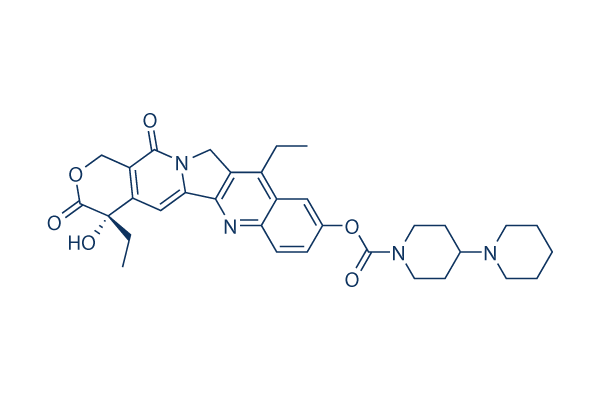
Structure chimique
Poids moléculaire: 586.68
Contrôle Qualité (Quality Control)
| Cibles apparentées | HDAC PARP ATM/ATR DNA-PK WRN DNA/RNA Synthesis PPAR Sirtuin Casein Kinase eIF |
|---|---|
| Autre Topoisomerase Inhibiteurs | Camptothecin (CPT) Betulinic acid (S)-10-Hydroxycamptothecin Beta-Lapachone Ellagic acid Amonafide Voreloxin (SNS-595) hydrochloride Hydroxy Camptothecine Cu(II)-Elesclomol 7-Ethylcamptothecin |
Culture cellulaire, traitement et concentration de travail
(Cell Culture, Treatment & Working Concentration)
| Lignées cellulaires | Type d'essai | Concentration | Temps d'incubation | Formulation | Description de l'activité | PMID |
|---|---|---|---|---|---|---|
| HCT116 | cytotoxicity assay | 10 μM | DMSO | ID50=540 nM | ||
| VM46 | cytotoxicity assay | 10 μM | DMSO | ID50=220 nM | ||
| MCF-7ADR | cytotoxicity assay | 10 μM | DMSO | ID50>500 nM | ||
| L1210 | cytotoxicity assay | IC50=1.2 µM | ||||
| RPMI8402 | cytotoxicity assay | 100 μM | IC50=570 nM | |||
| A-549 | cytotoxicity assay | ~20 μM | DMSO | IC50=6.528 μM | ||
| LOVO | cytotoxicity assay | ~20 μM | DMSO | IC50=9.015 μM | ||
| MCF7 | cytotoxicity assay | ~20 μM | DMSO | IC50=17.403 μM | ||
| LS174T | Growth inhibitory assay | DMSO | IC50=1.16 μM | |||
| KB3-1 | cytotoxicity assay | IC50=0.68 μM | ||||
| KBV-1 | cytotoxicity assay | IC50=40 μM | ||||
| KBH5.0 | cytotoxicity assay | IC50=7.4 μM | ||||
| Hep G2 | Growth inhibitory assay | ~10 μM | DMSO | IC50=5.94 μM | ||
| Hep 3B | Growth inhibitory assay | ~10 μM | DMSO | IC50=4.73 μM | ||
| Hep 2.2. | Growth inhibitory assay | ~10 μM | DMSO | IC50>10 μM | ||
| A549 | cytotoxicity assay | DMSO | IC50=4.61 μM | |||
| MDA-MB-435 | cytotoxicity assay | DMSO | IC50=1.14 μM | |||
| LOVO | cytotoxicity assay | DMSO | IC50=4.99 μM | |||
| MDA-MB-435 | cytotoxicity assay | DMSO | IC50=17 μM | |||
| NCI60 | Growth inhibitory assay | DMSO | GI50=14.1254 μM | |||
| H460 | cytotoxicity assay | DMSO | IC50=0.015 μM | |||
| PC-3 | cytotoxicity assay | DMSO | IC50=0.22 μM | |||
| HT29 | cytotoxicity assay | DMSO | IC50=0.004 μM | |||
| SK-MEL-2 | cytotoxicity assay | DMSO | IC50=0.1 μM | |||
| A375 | cytotoxicity assay | DMSO | IC50=0.004 μM | |||
| Malme-3M | cytotoxicity assay | DMSO | IC50=0.2 μM | |||
| DU 145 | cytotoxicity assay | DMSO | IC50=0.2 μM | |||
| LNCaP | cytotoxicity assay | DMSO | IC50=0.009 μM | |||
| IGROV-1 | cytotoxicity assay | DMSO | IC50=0.03 μM | |||
| KB | cytotoxicity assay | ~20 μM | DMSO | IC50=9.83 μM | ||
| KB-vin | cytotoxicity assay | ~20 μM | DMSO | IC50>20 μM | ||
| Cliquez pour voir plus de données expérimentales sur la lignée cellulaire | ||||||
Informations chimiques, stockage et stabilité (Chemical Information, Storage & Stability)
| Poids moléculaire | 586.68 | Formule | C33H38N4O6 |
Stockage (À compter de la date de réception) | |
|---|---|---|---|---|---|
| N° CAS | 97682-44-5 | Télécharger le SDF | Stockage des solutions mères |
|
|
| Synonymes | (+)-Irinotecan,CPT-11 | Smiles | CCC1=C2CN3C(=CC4=C(C3=O)COC(=O)C4(CC)O)C2=NC5=C1C=C(C=C5)OC(=O)N6CCC(CC6)N7CCCCC7 | ||
Solubilité (Solubility)
|
In vitro |
DMSO
: 25 mg/mL
(42.61 mM)
Water : Insoluble Ethanol : Insoluble |
Calculateur de molarité
|
In vivo |
|||||
Calculateur de formulation in vivo (Solution claire)
Étape 1 : Saisir les informations ci-dessous (Recommandé : Un animal supplémentaire pour tenir compte des pertes pendant l'expérience)
Étape 2 : Saisir la formulation in vivo (Ceci est seulement le calculateur, pas la formulation. Veuillez nous contacter d'abord s'il n'y a pas de formulation in vivo dans la section Solubilité.)
Résultats du calcul :
Concentration de travail : mg/ml;
Méthode de préparation du liquide maître DMSO : mg médicament prédissous dans μL DMSO ( Concentration du liquide maître mg/mL, Veuillez nous contacter d'abord si la concentration dépasse la solubilité du DMSO du lot de médicament. )
Méthode de préparation de la formulation in vivo : Prendre μL DMSO liquide maître, puis ajouterμL PEG300, mélanger et clarifier, puis ajouterμL Tween 80, mélanger et clarifier, puis ajouter μL ddH2O, mélanger et clarifier.
Méthode de préparation de la formulation in vivo : Prendre μL DMSO liquide maître, puis ajouter μL Huile de maïs, mélanger et clarifier.
Note : 1. Veuillez vous assurer que le liquide est clair avant d'ajouter le solvant suivant.
2. Assurez-vous d'ajouter le(s) solvant(s) dans l'ordre. Vous devez vous assurer que la solution obtenue, lors de l'ajout précédent, est une solution claire avant de procéder à l'ajout du solvant suivant. Des méthodes physiques telles que le vortex, les ultrasons ou le bain-marie chaud peuvent être utilisées pour faciliter la dissolution.
Mécanisme d'action (Mechanism of Action)
| Caractéristiques |
Irinotecan is a prodrug that is used to treat metastatic colorectal cancer.
|
|---|---|
| Targets/IC50/Ki |
Topo I
(LoVo, HT-29 cells) |
| In vitro |
Irinotecan is activated to SN-38 by carboxylesterases to become able to interact with its target, topoisomerase I. This compound induces similar amounts of cleavable complexes at its IC50 in LoVo cells and HT-29 cell lines. SN-38 induces a concentration-dependent formation of cleavable complexes, which is not significantly different in LoVo cells and HT-29 cell lines. Cell accumulation of this chemical is markedly different, reaching consistently higher levels in HT-29 cells than in LoVo cells. The lactone E-ring of this compound and SN-38 hydrolyses reversibly in aqueous solutions, and the interconversion between the lactone and carboxylate forms is dependent on pH and temperature. Liver is primarily responsible for the activation of this agent to SN-38. At equal concentrations of this drug and SN-38 glucuronide, the rate of beta-glucuronidase-mediated SN-38 production is higher than that formed from this compound in both tumour and normal tissue. It is also converted to SN-38 in intestines, plasma and tumor tissues. This agent is significantly more active in SCLC than in NSCLC cell lines, whereas no significant difference between histological types is observed with SN-38.
|
| In vivo |
In COLO 320 xenografts, Irinotecan induces a maximum growth inhibition of 92%. A single dose of this compound significantly increases amounts of topoisomerase I covalently bound to DNA in stomach, duodenum, colon and liver. Concomitantly, the Irinotecan-treated group shows significantly higher amounts of DNA strand breaks in colon mucosa cells compared to the control group.
|
Références |
|
Informations sur l'essai clinique (Clinical Trial Information)
(données du https://clinicaltrials.gov, mis à jour le 2026-06-18)
| Numéro NCT | Recrutement | Conditions | Promoteur/Collaborateurs | Date de début | Phases |
|---|---|---|---|---|---|
| NCT06365008 | NOT_YET_RECRUITING | Unresectable/Metastatic Gastric Cancer |
Sun Yat-Sen Memorial Hospital of Sun Yat-Sen University |
2026-06 | PHASE2 |
| NCT07521605 | NOT_YET_RECRUITING | Rectal Cancer Patients |
Guangdong Provincial People's Hospital |
2026-05-20 | PHASE2 |
| NCT07381764 | NOT_YET_RECRUITING | Metastatic Colorectal Cancer (CRC) |
Gruppo Oncologico Italia Meridionale |
2026-03-30 | PHASE2 |
| NCT07549321 | RECRUITING | High-Risk Neuroblastoma |
Renaissance Pharma Ltd. |
2026-03-30 | PHASE2; PHASE3 |
| NCT07585279 | NOT_YET_RECRUITING | Metastatic Colorectal Cancer (CRC); Liposomal Irinotecan; Second-Line |
Hebei Medical University Fourth Hospital |
2026-05-20 | PHASE2; PHASE3 |
| NCT06401330 | RECRUITING | Stage I Mixed Cell Type Kidney Wilms Tumor; Stage II Mixed Cell Type Kidney Wilms Tumor; Stage III Mixed Cell Type Kidney Wilms Tumor; Stage IV Mixed Cell Type Kidney Wilms Tumor |
Children's Oncology Group |
2025-04-15 | PHASE3 |

Les produits sont destinés à la recherche uniquement. Ne pas utiliser chez l'homme. Nous ne vendons pas aux patients.
©Copyright 2013 Selleck Chemicals. Tous droits réservés.