
pour la recherche uniquement
Itraconazole Hedgehog/Smoothened Inhibiteur
Réf. Catalogue: S2476
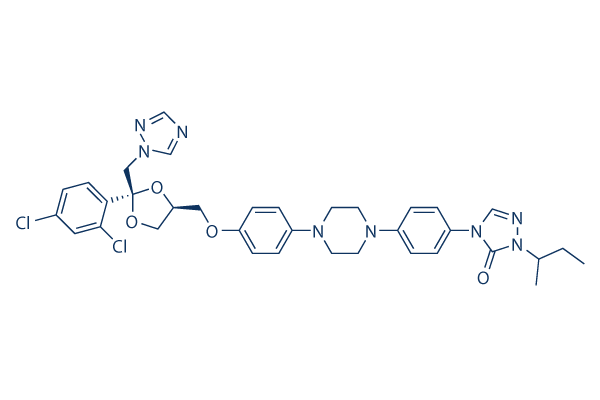
Structure chimique
Poids moléculaire: 705.65031
Contrôle Qualité (Quality Control)
| Cibles apparentées | JAK TGF-beta/Smad Wnt/beta-catenin ERK GSK-3 ROCK PKA Secretase STAT Casein Kinase |
|---|---|
| Autre Hedgehog/Smoothened Inhibiteurs | SAG (Smoothened Agonist) Hydrochloride Purmorphamine Cyclopamine (11-Deoxojervine) GANT 61 (NSC 136476) SAG (Smoothened Agonist) SANT-1 HPI-4 (Ciliobrevin A) BMS-833923 Taladegib (LY2940680) Ciliobrevin D |
Culture cellulaire, traitement et concentration de travail
(Cell Culture, Treatment & Working Concentration)
| Lignées cellulaires | Type d'essai | Concentration | Temps d'incubation | Formulation | Description de l'activité | PMID |
|---|---|---|---|---|---|---|
| human hepatocytes | Function assay | Inhibition of CYP3A4 in human hepatocytes using testosterone as substrate by HPLC/MS/MS method, IC50=0.07 μM | ||||
| human HTLA cells | Function assay | 20 mins | Inhibition of CX3CL1-stimulated CX3CR1 in human HTLA cells pre-incubated for 20 mins measured on day 4 by beta arrestin-recruitment mediated luciferase reporter gene assay, IC50=0.1 μM | |||
| LLC-PK1 epithelial cells | Function assay | Inhibition of P-glycoprotein, mouse L-mdr1a expressed in LLC-PK1 epithelial cells using calcein-AM polarisation assay, IC50=0.2 μM | ||||
| human PBMC | Cytotoxicity assay | 72 h | Cytotoxicity against human PBMC assessed as cell viability after 72 hrs by MTT assay, IC50=1.53 μM | |||
| Topp 3 cells | Function assay | Inhibition of human CYP51 expressed in Topp 3 cells by lanosterol demethylase assay, IC50=3.6 μM | ||||
| human MRC5 cells | Cytotoxicity assay | Cytotoxicity against human MRC5 cells, CC50=49.33 μM | ||||
| human HUVEC cells | Function assay | 2 μM | 24 h | Inhibition of VEGFR2 glycosylation in human HUVEC cells at 2 uM after 24 hrs by Western blot analysis | ||
| Cliquez pour voir plus de données expérimentales sur la lignée cellulaire | ||||||
Informations chimiques, stockage et stabilité (Chemical Information, Storage & Stability)
| Poids moléculaire | 705.65031 | Formule | C35H38Cl2N8O4 |
Stockage (À compter de la date de réception) | |
|---|---|---|---|---|---|
| N° CAS | 84625-61-6 | Télécharger le SDF | Stockage des solutions mères |
|
|
| Synonymes | R 51211 | Smiles | CCC(C)N1C(=O)N(C=N1)C2=CC=C(C=C2)N3CCN(CC3)C4=CC=C(C=C4)OCC5COC(O5)(CN6C=NC=N6)C7=C(C=C(C=C7)Cl)Cl | ||
Solubilité (Solubility)
|
In vitro |
DMSO
: 13 mg/mL
(18.42 mM)
Water : Insoluble Ethanol : Insoluble |
Calculateur de molarité
|
In vivo |
|||||
Calculateur de formulation in vivo (Solution claire)
Étape 1 : Saisir les informations ci-dessous (Recommandé : Un animal supplémentaire pour tenir compte des pertes pendant l'expérience)
Étape 2 : Saisir la formulation in vivo (Ceci est seulement le calculateur, pas la formulation. Veuillez nous contacter d'abord s'il n'y a pas de formulation in vivo dans la section Solubilité.)
Résultats du calcul :
Concentration de travail : mg/ml;
Méthode de préparation du liquide maître DMSO : mg médicament prédissous dans μL DMSO ( Concentration du liquide maître mg/mL, Veuillez nous contacter d'abord si la concentration dépasse la solubilité du DMSO du lot de médicament. )
Méthode de préparation de la formulation in vivo : Prendre μL DMSO liquide maître, puis ajouterμL PEG300, mélanger et clarifier, puis ajouterμL Tween 80, mélanger et clarifier, puis ajouter μL ddH2O, mélanger et clarifier.
Méthode de préparation de la formulation in vivo : Prendre μL DMSO liquide maître, puis ajouter μL Huile de maïs, mélanger et clarifier.
Note : 1. Veuillez vous assurer que le liquide est clair avant d'ajouter le solvant suivant.
2. Assurez-vous d'ajouter le(s) solvant(s) dans l'ordre. Vous devez vous assurer que la solution obtenue, lors de l'ajout précédent, est une solution claire avant de procéder à l'ajout du solvant suivant. Des méthodes physiques telles que le vortex, les ultrasons ou le bain-marie chaud peuvent être utilisées pour faciliter la dissolution.
Mécanisme d'action (Mechanism of Action)
| Targets/IC50/Ki |
CYP3A4
(human liver microsomes) 6.1 nM
|
|---|---|
| In vitro |
Itraconazole is metabolized into hydroxy-itraconazole (OH-ITZ), a known in vivo metabolite of ITZ, and two new metabolites: keto-itraconazole (keto-ITZ) and N-desalkyl-itraconazole (ND-ITZ). This compound is a substrate for CYP3A in vitro and to characterize the metabolites generated. It exhibits an unbound Km of 3.9 nM for CYP3A. Its metabolites are as potent as or more potent CYP3A4 inhibitors than ITZ itself. This compound appears to act on the essential Hh pathway component Smoothened (SMO) by a mechanism distinct from that of cyclopamine and other known SMO antagonists, and prevents the ciliary accumulation of SMO normally caused by Hh stimulation. It is active against 60 clinical isolates of Aspergillus spp. with geometric mean (GM) MICs of 0.25 mg/mL. It acts primarily by impairing the synthesis of ergosterol, resulting in a defective fungal cell membrane with altered permeability and function. This chemical is effective for a wide variety of mycotic infections and some fungal meningeal infections. It has an affinity for mammalian cytochrome P-450 enzymes as well as for fungal P-450-dependent enzyme, and thus has the potential for clinically important interactions (e.g., astemizole, terfenadine, rifampin, oral contraceptives, H2 receptor antagonists, warfarin, cyclosporine).
|
| In vivo |
Itraconazole, like other Hh pathway antagonists, can suppress Hh pathway activity and the growth of medulloblastoma in a mouse allograft model.
|
Références |
|
Applications (Applications)
| Méthodes | Biomarqueurs | Images | PMID |
|---|---|---|---|
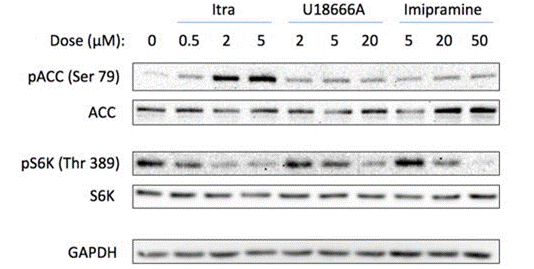
| Western blot | pACC / ACC / p-S6K / S6K GLI1 / GLI2 / p-AKT1 / AKT1 / Cyclin D1 |
|
28103683 |
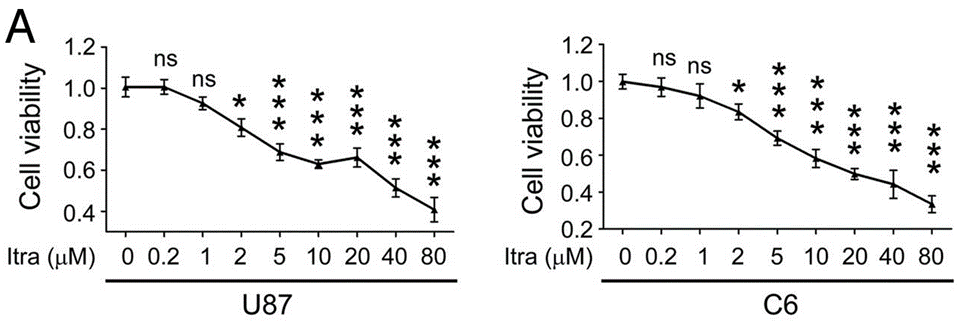
| Growth inhibition assay | Cell viability |
|
24905460 |
Informations sur l'essai clinique (Clinical Trial Information)
(données du https://clinicaltrials.gov, mis à jour le 2026-05-08)
| Numéro NCT | Recrutement | Conditions | Promoteur/Collaborateurs | Date de début | Phases |
|---|---|---|---|---|---|
| NCT07261150 | NOT_YET_RECRUITING | Histoplasmosis |
University of Minnesota |
2026-09-15 | PHASE3 |
| NCT07283497 | RECRUITING | Bronchiectasis; Fungal Infection of Upper Respiratory Tract |
Mayo Clinic |
2026-08-17 | PHASE4 |
| NCT06732388 | RECRUITING | Barrett Esophagus; Clinical Stage I Esophageal Adenocarcinoma AJCC v8; Clinical Stage IIA Esophageal Adenocarcinoma AJCC v8; Esophageal Adenocarcinoma |
National Cancer Institute (NCI) |
2026-06-23 | PHASE2 |
| NCT06400472 | RECRUITING | Ovarian Neoplasms; Endometrial Neoplasms; Uterine Cervical Neoplasms; Carcinoma, Non-Small-Cell Lung; Triple Negative Breast Neoplasms; Pancreatic Neoplasm; Colorectal Neoplasms |
Eli Lilly and Company |
2024-05-20 | PHASE1 |
| NCT05563766 | RECRUITING | Esophageal Adenocarcinoma; Esophageal Squamous Cell Carcinoma; Gastroesophageal Junction Carcinoma |
VA Office of Research and Development |
2024-10-01 | PHASE2 |
| NCT04067336 | ACTIVE_NOT_RECRUITING | Advanced Malignant Neoplasm; Acute Myeloid Leukemia; Mixed Lineage Leukemia; Mixed Lineage Acute Leukemia; Acute Leukemia of Ambiguous Lineage; Mixed Phenotype Acute Leukemia; Acute Lymphoblastic Leukemia |
Kura Oncology, Inc. |
2019-09-12 | PHASE1; PHASE2 |
Foire aux questions (Frequently Asked Questions)
Question 1:
We are finding the best vehicle to administer it to mice. We want a mild vehicle (unlike DMSO) which resembles water, PBS, saline (for i.p/ injection) or methyl cellulose (for oral).
Réponse :
We are not able to dissolve S2476 clearly without DMSO. For oral gavage, this compound can be dissolved in 1% CMC Na at 20mg/ml as a homogeneous suspension.

Les produits sont destinés à la recherche uniquement. Ne pas utiliser chez l'homme. Nous ne vendons pas aux patients.
©Copyright 2013 Selleck Chemicals. Tous droits réservés.