
pour la recherche uniquement
LY2886721 BACE Inhibiteur
Réf. Catalogue: S2156
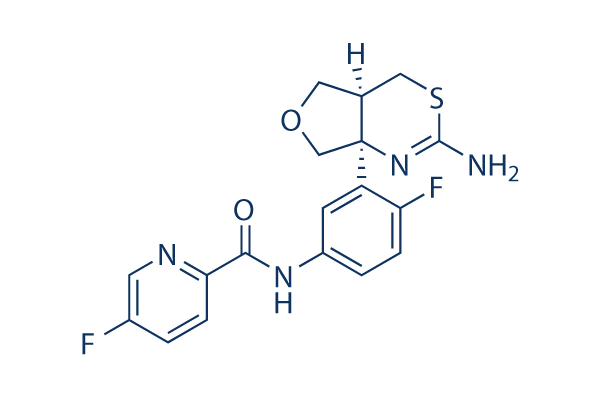
Structure chimique
Poids moléculaire: 390.41
Contrôle Qualité (Quality Control)
Informations chimiques, stockage et stabilité (Chemical Information, Storage & Stability)
| Poids moléculaire | 390.41 | Formule | C18H16F2N4O2S |
Stockage (À compter de la date de réception) | |
|---|---|---|---|---|---|
| N° CAS | 1262036-50-9 | Télécharger le SDF | Stockage des solutions mères |
|
|
| Synonymes | N/A | Smiles | C1C2CSC(=NC2(CO1)C3=C(C=CC(=C3)NC(=O)C4=NC=C(C=C4)F)F)N | ||
Solubilité (Solubility)
|
In vitro |
DMSO
: 35 mg/mL
(89.64 mM)
Water : Insoluble Ethanol : Insoluble |
Calculateur de molarité
|
In vivo |
|||||
Calculateur de formulation in vivo (Solution claire)
Étape 1 : Saisir les informations ci-dessous (Recommandé : Un animal supplémentaire pour tenir compte des pertes pendant l'expérience)
Étape 2 : Saisir la formulation in vivo (Ceci est seulement le calculateur, pas la formulation. Veuillez nous contacter d'abord s'il n'y a pas de formulation in vivo dans la section Solubilité.)
Résultats du calcul :
Concentration de travail : mg/ml;
Méthode de préparation du liquide maître DMSO : mg médicament prédissous dans μL DMSO ( Concentration du liquide maître mg/mL, Veuillez nous contacter d'abord si la concentration dépasse la solubilité du DMSO du lot de médicament. )
Méthode de préparation de la formulation in vivo : Prendre μL DMSO liquide maître, puis ajouterμL PEG300, mélanger et clarifier, puis ajouterμL Tween 80, mélanger et clarifier, puis ajouter μL ddH2O, mélanger et clarifier.
Méthode de préparation de la formulation in vivo : Prendre μL DMSO liquide maître, puis ajouter μL Huile de maïs, mélanger et clarifier.
Note : 1. Veuillez vous assurer que le liquide est clair avant d'ajouter le solvant suivant.
2. Assurez-vous d'ajouter le(s) solvant(s) dans l'ordre. Vous devez vous assurer que la solution obtenue, lors de l'ajout précédent, est une solution claire avant de procéder à l'ajout du solvant suivant. Des méthodes physiques telles que le vortex, les ultrasons ou le bain-marie chaud peuvent être utilisées pour faciliter la dissolution.
Mécanisme d'action (Mechanism of Action)
| Targets/IC50/Ki |
BACE2
(Cell-free assay) 10.2 nM
BACE1
(Cell-free assay) 20.3 nM
|
|---|---|
| In vitro |
LY2886721 is an oral, small molecule of β-site amyloid protein cleaving enzyme (BACE) inhibitor with the potential to inhibit the synthesis of β-amyloid and thereby to slow the clinical progression of AD. This compound can also targetγ-secretase to nhibit the synthesis of β-amyloid. It inhibits recombinant hBACE1 with an IC50 of 20.3 nM. In cellular assays, this chemical inhibits Abeta with an IC50 of 18.7 nM and 10.7 nM, HEK293Swe and PDAPP neuronal culture, respectively. It has high selectivity against key off-target proteases, which efficiently translates in vitro activity into robust in vivo amyloid β lowering in nonclinical animal models. Assessment of its activity against hBACE2 demonstrates an IC50 of 10.2 nM. Assessment of the compound's activity against cathepsin D, pepsin, renin, or other important aspartyl proteases shows essentially no inhibition (IC50 >100,000 nM), suggesting that activity against these common aspartyl proteases is unlikely to be significant.
|
| In vivo |
Oral administration of LY2886721 to PDAPP mice produces dose-dependent reductions in brain Abeta, C99 and sAPPbeta. Brain Abeta levels are decreased ∼20%-65% relative to vehicle-treated groups three hours after a 3-30 mg/kg dose of this compound. Brain C99 and sAPPb levels also are reduced in a dose-dependent manner consistent with BACE1 inhibition in vivo. The pharmacodynamic responses to this chemical persists out to 9 hours post dose in brains of PDAPP mice. Pharmacodynamic studies in beagle dog reveal robust and sustained reductions in plasma Abeta following 1 mg/kg dosing. Central effects of BACE1 inhibition in dog are manifested by a 50% reduction in CSF Abeta at 9 hours after a 0.5 mg/kg dose. The geometric mean terminal elimination t1/2 is determined to be 17.2 h (range 8.19-36.3 h). The geometric mean apparent oral clearance is 34.8 L/h (38% CV) and the apparent volume of distribution during the terminal phase was 863 L (56% CV) across dose levels. This compound is freely permeable across the blood-brain barrier.
|
Références |
|
Informations sur l'essai clinique (Clinical Trial Information)
(données du https://clinicaltrials.gov, mis à jour le 2018-05-18)
| Numéro NCT | Recrutement | Conditions | Promoteur/Collaborateurs | Date de début | Phases |
|---|---|---|---|---|---|
| NCT01561430 | TERMINATED | Alzheimer's Disease |
Eli Lilly and Company |
2012-03 | PHASE1; PHASE2 |
| NCT01775904 | COMPLETED | Healthy Volunteers |
Eli Lilly and Company |
2013-02 | PHASE1 |
| NCT01807026 | COMPLETED | Alzheimer Disease; Healthy Volunteers |
Eli Lilly and Company |
2013-03 | PHASE1 |
| NCT01807026 | Completed | Alzheimer Disease|Healthy Volunteers |
Eli Lilly and Company |
2013-03 | Phase 1 |
| NCT01534273 | COMPLETED | Healthy Volunteers |
Eli Lilly and Company |
2012-02 | PHASE1 |
| NCT01534273 | Completed | Healthy Volunteers |
Eli Lilly and Company |
2012-02 | Phase 1 |

Les produits sont destinés à la recherche uniquement. Ne pas utiliser chez l'homme. Nous ne vendons pas aux patients.
©Copyright 2013 Selleck Chemicals. Tous droits réservés.