
pour la recherche uniquement
Megestrol Acetate Estrogen/progestogen Receptor Inhibiteur
Réf. Catalogue: S1304
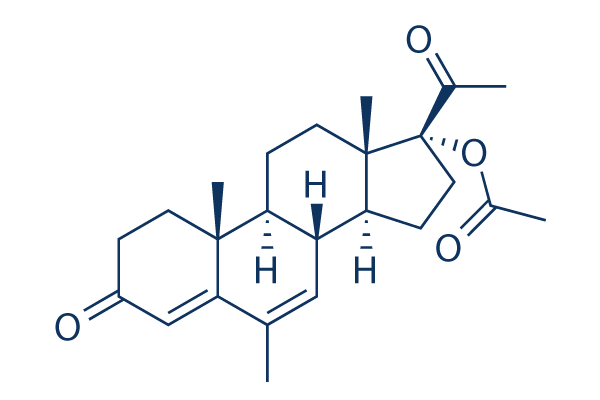
Structure chimique
Poids moléculaire: 384.51
Contrôle Qualité (Quality Control)
| Cibles apparentées | Adrenergic Receptor GPR Androgen Receptor Glucocorticoid Receptor ACE RAAS Progesterone Receptor Opioid Receptor THR PGES |
|---|---|
| Autre Estrogen/progestogen Receptor Inhibiteurs | Elacestrant (RAD1901) Dihydrochloride Vepdegestrant (ARV-471) MPP dihydrochloride Kaempferol Cholesterol PHTPP G15 Licochalcone A Endoxifen HCl Pregnenolone |
Informations chimiques, stockage et stabilité (Chemical Information, Storage & Stability)
| Poids moléculaire | 384.51 | Formule | C24H32O4 |
Stockage (À compter de la date de réception) | |
|---|---|---|---|---|---|
| N° CAS | 595-33-5 | Télécharger le SDF | Stockage des solutions mères |
|
|
| Synonymes | BDH1298, SC10363 | Smiles | CC1=CC2C(CCC3(C2CCC3(C(=O)C)OC(=O)C)C)C4(C1=CC(=O)CC4)C | ||
Solubilité (Solubility)
|
In vitro |
DMSO
: 76 mg/mL
(197.65 mM)
Ethanol : 21 mg/mL Water : Insoluble |
Calculateur de molarité
|
In vivo |
|||||
Calculateur de formulation in vivo (Solution claire)
Étape 1 : Saisir les informations ci-dessous (Recommandé : Un animal supplémentaire pour tenir compte des pertes pendant l'expérience)
Étape 2 : Saisir la formulation in vivo (Ceci est seulement le calculateur, pas la formulation. Veuillez nous contacter d'abord s'il n'y a pas de formulation in vivo dans la section Solubilité.)
Résultats du calcul :
Concentration de travail : mg/ml;
Méthode de préparation du liquide maître DMSO : mg médicament prédissous dans μL DMSO ( Concentration du liquide maître mg/mL, Veuillez nous contacter d'abord si la concentration dépasse la solubilité du DMSO du lot de médicament. )
Méthode de préparation de la formulation in vivo : Prendre μL DMSO liquide maître, puis ajouterμL PEG300, mélanger et clarifier, puis ajouterμL Tween 80, mélanger et clarifier, puis ajouter μL ddH2O, mélanger et clarifier.
Méthode de préparation de la formulation in vivo : Prendre μL DMSO liquide maître, puis ajouter μL Huile de maïs, mélanger et clarifier.
Note : 1. Veuillez vous assurer que le liquide est clair avant d'ajouter le solvant suivant.
2. Assurez-vous d'ajouter le(s) solvant(s) dans l'ordre. Vous devez vous assurer que la solution obtenue, lors de l'ajout précédent, est une solution claire avant de procéder à l'ajout du solvant suivant. Des méthodes physiques telles que le vortex, les ultrasons ou le bain-marie chaud peuvent être utilisées pour faciliter la dissolution.
Mécanisme d'action (Mechanism of Action)
| Targets/IC50/Ki |
progestogen Receptor
Androgen Receptor
|
|---|---|
| In vitro |
Megestrol acetate inhibits the expression of cytoplasmic aromatase through nuclear C/EBPβ in reperfusion injury-induced ischemic rat hippocampus. Megestrol acetate significantly increases the proliferation, migration, and adipogenic differentiation of adipose-derived stem cells (ASCs) in a dose-dependent manner. Megestrol acetate also upregulates genes downstream of glucocorticoid receptor (GR) in ASCs.
|
| In vivo |
Megestrol acetate significantly decreases the circulating concentrations of estradiol (E2) and testosterone (T) in female fish or 11-ketotestosterone (11-KT) in male fish. Megestrol acetate exposure significantly downregulates the transcription of certain genes along the hypothalamic-pituitary-gonadal (HPG) axis. Megestrol acetate produces a progressive deterioration in glucose tolerance, with a significant increase in mean fasting plasma glucose concentrations and decrease in mean plasma glucose clearance rates after 6 months and 12 months of treatment in cats. Megestrol acetate also produces a progressive decrease in both resting plasma cortisol concentrations and cortisol concentrations after ACTH stimulation in cats. Megestrol acetate (50 mg/kg/day) for 9 days significantly increases food and water intake compared with untreated controls. Megestrol acetate (50 mg/kg/day) significantly (90-140%) increases in neuropeptide Y concentrations in the arcuate nucleus (where neuropeptide Y is synthesized), in the lateral hypothalamic area (through which arcuate neurones project) and in the medial preoptic area, ventromedial nucleus and dorsomedial nucleus in rats.
|
Références |
|
Informations sur l'essai clinique (Clinical Trial Information)
(données du https://clinicaltrials.gov, mis à jour le 2026-07-02)
| Numéro NCT | Recrutement | Conditions | Promoteur/Collaborateurs | Date de début | Phases |
|---|---|---|---|---|---|
| NCT07436793 | RECRUITING | Endometrial Endometrioid Adenocarcinoma; Endometrial Hyperplasia |
New Mexico Cancer Research Alliance |
2026-06-15 | PHASE2 |
| NCT05255653 | RECRUITING | Endometrial Cancer |
Leiden University Medical Center |
2021-11-11 | PHASE2; PHASE3 |
| NCT06549855 | RECRUITING | Endometrial Cancer; Endometrioid Carcinoma; Mismatch Repair Deficiency |
Peking University People's Hospital |
2024-09-02 | |
| NCT07543536 | RECRUITING | Advanced/Metastatic Breast Cancer; HER2+, Low, or Ultralow Advanced/Metastatic Breast Cancer |
Sun Yat-sen University |
2026-06-08 | PHASE3 |
| NCT07477808 | NOT_YET_RECRUITING | Non-small Cell Lung Cancer |
Hunan Province Tumor Hospital |
2026-04-01 | PHASE3 |
| NCT07319429 | RECRUITING | Endometrial Cancer; Fertility |
Fudan University |
2026-01-25 | PHASE2; PHASE3 |

Les produits sont destinés à la recherche uniquement. Ne pas utiliser chez l'homme. Nous ne vendons pas aux patients.
©Copyright 2013 Selleck Chemicals. Tous droits réservés.