
pour la recherche uniquement
Odanacatib Cysteine Protease Inhibiteur
Réf. Catalogue: S1115
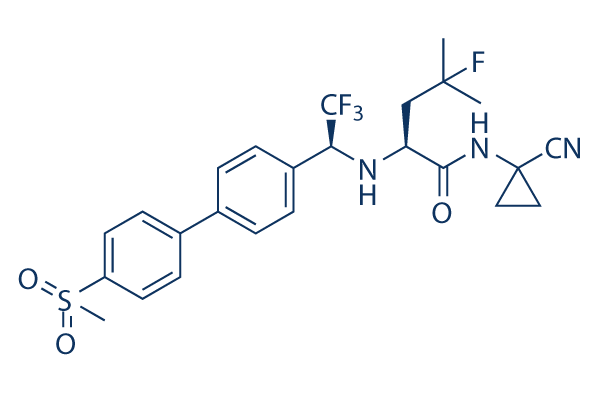
Structure chimique
Poids moléculaire: 525.56
Contrôle Qualité (Quality Control)
| Cibles apparentées | HDAC Caspase Proteasome Secretase MMP HCV Protease Tyrosinase HIV Protease DPP Serine Protease |
|---|---|
| Autre Cysteine Protease Inhibiteurs | N-Ethylmaleimide (NEM) MG132 SSS Calpeptin Aloxistatin (E-64d) E-64 MG-101 (ALLN) Z-FA-FMK Cathepsin Inhibitor 1 PD 151746 Loxistatin Acid (E-64C) |
Culture cellulaire, traitement et concentration de travail
(Cell Culture, Treatment & Working Concentration)
| Lignées cellulaires | Type d'essai | Concentration | Temps d'incubation | Formulation | Description de l'activité | PMID |
|---|---|---|---|---|---|---|
| ramos cells | Function assay | Inhibition of cathepsin S in human ramos cells, IC50=0.045μM | 18226527 | |||
| stem cells | Function assay | 7 days | Inhibition of osteoclastogenesis in human bone marrow-derived stem cells assessed as reduction of pit formation by measuring TRACP5b activity after 7 days by bone TRAP assay, IC50=0.1μM | 22984809 | ||
| HepG2 | Function assay | Inhibition of cathepsin B in human HepG2 cells, IC50=1.05μM | 18226527 | |||
| B cells | Function assay | Inhibition of antigen presenting mouse B cells, IC50=1.5μM | 18226527 | |||
| HepG2 | Function assay | Inhibition of cathepsin L in human HepG2 cells, IC50=4.843μM | 18226527 | |||
| SJ-GBM2 | qHTS assay | qHTS of pediatric cancer cell lines to identify multiple opportunities for drug repurposing: Primary screen for SJ-GBM2 cells | 29435139 | |||
| Cliquez pour voir plus de données expérimentales sur la lignée cellulaire | ||||||
Informations chimiques, stockage et stabilité (Chemical Information, Storage & Stability)
| Poids moléculaire | 525.56 | Formule | C25H27F4N3O3S |
Stockage (À compter de la date de réception) | |
|---|---|---|---|---|---|
| N° CAS | 603139-19-1 | Télécharger le SDF | Stockage des solutions mères |
|
|
| Synonymes | MK-0822 | Smiles | CC(C)(CC(C(=O)NC1(CC1)C#N)NC(C2=CC=C(C=C2)C3=CC=C(C=C3)S(=O)(=O)C)C(F)(F)F)F | ||
Solubilité (Solubility)
|
In vitro |
DMSO
: 100 mg/mL
(190.27 mM)
Water : Insoluble Ethanol : Insoluble |
Calculateur de molarité
|
In vivo |
|||||
Calculateur de formulation in vivo (Solution claire)
Étape 1 : Saisir les informations ci-dessous (Recommandé : Un animal supplémentaire pour tenir compte des pertes pendant l'expérience)
Étape 2 : Saisir la formulation in vivo (Ceci est seulement le calculateur, pas la formulation. Veuillez nous contacter d'abord s'il n'y a pas de formulation in vivo dans la section Solubilité.)
Résultats du calcul :
Concentration de travail : mg/ml;
Méthode de préparation du liquide maître DMSO : mg médicament prédissous dans μL DMSO ( Concentration du liquide maître mg/mL, Veuillez nous contacter d'abord si la concentration dépasse la solubilité du DMSO du lot de médicament. )
Méthode de préparation de la formulation in vivo : Prendre μL DMSO liquide maître, puis ajouterμL PEG300, mélanger et clarifier, puis ajouterμL Tween 80, mélanger et clarifier, puis ajouter μL ddH2O, mélanger et clarifier.
Méthode de préparation de la formulation in vivo : Prendre μL DMSO liquide maître, puis ajouter μL Huile de maïs, mélanger et clarifier.
Note : 1. Veuillez vous assurer que le liquide est clair avant d'ajouter le solvant suivant.
2. Assurez-vous d'ajouter le(s) solvant(s) dans l'ordre. Vous devez vous assurer que la solution obtenue, lors de l'ajout précédent, est une solution claire avant de procéder à l'ajout du solvant suivant. Des méthodes physiques telles que le vortex, les ultrasons ou le bain-marie chaud peuvent être utilisées pour faciliter la dissolution.
Mécanisme d'action (Mechanism of Action)
| Caractéristiques |
A potent, selective, and neutral cathepsin K inhibitor.
|
|---|---|
| Targets/IC50/Ki |
Cathepsin K (human)
0.2 nM
Cathepsin K (rabbit)
1 nM
|
| In vitro |
In vitro, Odanacatib shows the high inhibitory activity and selectivity on cathepsin K with IC50 values of 0.2 nM and 1 nM for human cathepsin K and rabbit cathepsin K, respectively. Furthermore, this compound also shows similar potencies in whole human cell enzyme occupancy assays with corrected IC50 of 5 nM. A recent study shows that this chemical results in reduction of Osteoclast (OC) resorption activity by interrupting intracellular vesicular trafficking.
|
| In vivo |
In preclinical rats, Odanacatib (10 mg/kg) exhibits excellent pharmacokinetics with clearance (Cl: 2 mL kg-1 min-1), low volume of distribution (Vdss: 1.1 L kg-1), half-life (T1/2: 6 hours) and oral bioavailability (F: 8%), respectively. Besides, this compound also exhibits excellent metabolic stability in rat hepatocytes with a 96% recovery of the parent identity. This chemical administrated by p.o. prevents bone loss in ovariectomized (OVX) rabbits in a dose-related manner. Moreover, it (9 µM/day) leads to a significant increase in proximal femur bone mineral density (BMD) (7.8%), femoral neck BMD (10.8%) and the greater trochanter BMD (6.5%). In the estrogen-deficient, skeletally mature rhesus monkeys, long-term treatment with this compound effectively inhibits bone turnover without reducing osteoclast number and maintains normal biomechanical properties of the spine of OVX nonhuman primates.
|
Références |
|
Informations sur l'essai clinique (Clinical Trial Information)
(données du https://clinicaltrials.gov, mis à jour le 2018-08-28)
| Numéro NCT | Recrutement | Conditions | Promoteur/Collaborateurs | Date de début | Phases |
|---|---|---|---|---|---|
| NCT01630616 | TERMINATED | Osteoporosis |
Merck Sharp & Dohme LLC |
2013-03-12 | PHASE1 |
| NCT01552122 | WITHDRAWN | Osteoporosis; Postmenopausal Osteoporosis |
Merck Sharp & Dohme LLC |
2012-05 | PHASE3 |
| NCT01803607 | TERMINATED | Osteoporosis |
Merck Sharp & Dohme LLC |
2013-03-14 | PHASE3 |
| NCT01120600 | COMPLETED | Osteoporosis |
Merck Sharp & Dohme LLC |
2010-06-09 | PHASE3 |
| NCT01803607 | Terminated | Osteoporosis |
Merck Sharp & Dohme LLC |
2013-03-14 | Phase 3 |
| NCT01630616 | Terminated | Osteoporosis |
Merck Sharp & Dohme LLC |
2013-03-12 | Phase 1 |

Les produits sont destinés à la recherche uniquement. Ne pas utiliser chez l'homme. Nous ne vendons pas aux patients.
©Copyright 2013 Selleck Chemicals. Tous droits réservés.