
pour la recherche uniquement
Ondansetron HCl 5-HT Receptor Antagoniste
Réf. Catalogue: S1390
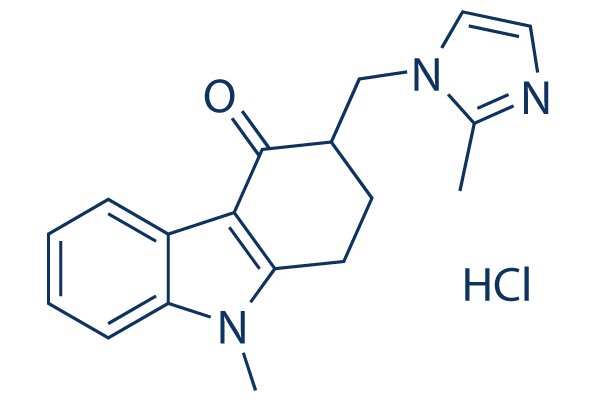
Structure chimique
Poids moléculaire: 329.82
Contrôle Qualité (Quality Control)
| Cibles apparentées | Adrenergic Receptor AChR COX Calcium Channel Histamine Receptor Dopamine Receptor GABA Receptor TRP Channel Cholinesterase (ChE) GluR |
|---|---|
| Autre 5-HT Receptor Inhibiteurs | Serotonin Hydrochloride (5-HT HCl) WAY-100635 Maleate Puerarin SB269970 HCl Ketanserin BRL-15572 Dihydrochloride RS-127445 Nuciferine Flopropione BRL-54443 |
Informations chimiques, stockage et stabilité (Chemical Information, Storage & Stability)
| Poids moléculaire | 329.82 | Formule | C18H19N3O.HCl |
Stockage (À compter de la date de réception) | |
|---|---|---|---|---|---|
| N° CAS | 99614-01-4 | Télécharger le SDF | Stockage des solutions mères |
|
|
| Synonymes | GR 38032F,SN 307 | Smiles | CC1=NC=CN1CC2CCC3=C(C2=O)C4=CC=CC=C4N3C.Cl | ||
Solubilité (Solubility)
|
In vitro |
Water : 166 mg/mL
DMSO
: 66 mg/mL
(200.1 mM)
Ethanol : 13 mg/mL |
Calculateur de molarité
|
In vivo |
|||||
Calculateur de formulation in vivo (Solution claire)
Étape 1 : Saisir les informations ci-dessous (Recommandé : Un animal supplémentaire pour tenir compte des pertes pendant l'expérience)
Étape 2 : Saisir la formulation in vivo (Ceci est seulement le calculateur, pas la formulation. Veuillez nous contacter d'abord s'il n'y a pas de formulation in vivo dans la section Solubilité.)
Résultats du calcul :
Concentration de travail : mg/ml;
Méthode de préparation du liquide maître DMSO : mg médicament prédissous dans μL DMSO ( Concentration du liquide maître mg/mL, Veuillez nous contacter d'abord si la concentration dépasse la solubilité du DMSO du lot de médicament. )
Méthode de préparation de la formulation in vivo : Prendre μL DMSO liquide maître, puis ajouterμL PEG300, mélanger et clarifier, puis ajouterμL Tween 80, mélanger et clarifier, puis ajouter μL ddH2O, mélanger et clarifier.
Méthode de préparation de la formulation in vivo : Prendre μL DMSO liquide maître, puis ajouter μL Huile de maïs, mélanger et clarifier.
Note : 1. Veuillez vous assurer que le liquide est clair avant d'ajouter le solvant suivant.
2. Assurez-vous d'ajouter le(s) solvant(s) dans l'ordre. Vous devez vous assurer que la solution obtenue, lors de l'ajout précédent, est une solution claire avant de procéder à l'ajout du solvant suivant. Des méthodes physiques telles que le vortex, les ultrasons ou le bain-marie chaud peuvent être utilisées pour faciliter la dissolution.
Mécanisme d'action (Mechanism of Action)
| Targets/IC50/Ki |
5-HT3
|
|---|---|
| In vivo |
Ondansetron decreases the intensity of withdrawal signs such as increased defecation, jumping and wet-dog shakes, elevated the nociceptive threshold values which are decreased by precipitated withdrawal, but produces no change in urination, rectal temperature or salivation. Ondansetron and granisetron significantly enhances gastric emptying of glass beads and improves cisplatin-induced slowing of gastric emptying in rats. Ondansetron exhibits a biphasic dose-response profile in mice, with antidepressant-like effects peaking at 0.1 mg/kg, in the forced swim and tail suspension tests. Ondansetron pretreatment augments the antidepressant effects of fluoxetine and venlafaxine but does not influence the effects of desipramine or 8-hydroxy-2-(di-n-propylamino) tetralin. Ondansetron (10 mg/kg) reverses hyperactivity in the open field, and decreases the percentage entry and time spent in open arms in the elevated plus maze. Ondansetron, a selective and potent 5HT3 receptor antagonist, is shown to be effective at blocking the amphetamine-induced disruption of LI at a dose of 0.01 mg/kg, but not at 0.1 mg/kg. Ondansetron is able to attenuate increases in dopamine activity, produces pharmacologically with amphetamine without affecting baseline dopamine activity. Ondansetron facilitates performance in young adult and aged animals, and inhibits an impairment in habituation induced by scopolamine, electrolesions or ibotenic acid lesions of the nucleus basalis magnocellularis. Ondansetron and arecoline antagonizes a scopolamine-induced impairment. |
Références |
|
Informations sur l'essai clinique (Clinical Trial Information)
(données du https://clinicaltrials.gov, mis à jour le 2026-08-20)
| Numéro NCT | Recrutement | Conditions | Promoteur/Collaborateurs | Date de début | Phases |
|---|---|---|---|---|---|
| NCT07777276 | NOT_YET_RECRUITING | Postoperative Sleep Quality; Postoperative Behaviour; Postoperative Recovery in Children; Postoperative Nausea and Vomiting (PONV); Paediatric Surgery; Anaesthesia |
Telethon Kids Institute |
2026-08-17 | PHASE4 |
| NCT07588217 | NOT_YET_RECRUITING | ARDS (Acute Respiratory Distress Syndrome); Invasive Mechanical Ventilation; Patient-Self Inflicted Lung Injury |
Centre Integre Universitaire de Sante et Services Sociaux du Nord de l'ile de Montreal |
2026-10-01 | PHASE2; PHASE3 |
| NCT05784350 | NOT_YET_RECRUITING | Intra-operative Hypotension |
Meir Medical Center |
2025-08-01 | |
| NCT03865290 | RECRUITING | Indigestion; Diabetes Mellitus |
Mayo Clinic |
2019-04-02 | PHASE2 |
| NCT05844501 | RECRUITING | Atrial Fibrillation |
Indiana University |
2025-04-22 | PHASE4 |
| NCT07795060 | NOT_YET_RECRUITING | Cholera (Disorder) |
Public Interest Science Center |
2027-03-01 | PHASE2 |

Les produits sont destinés à la recherche uniquement. Ne pas utiliser chez l'homme. Nous ne vendons pas aux patients.
©Copyright 2013 Selleck Chemicals. Tous droits réservés.