
pour la recherche uniquement
Tranilast Immunology & Inflammation related Chimique
Réf. Catalogue: S1439
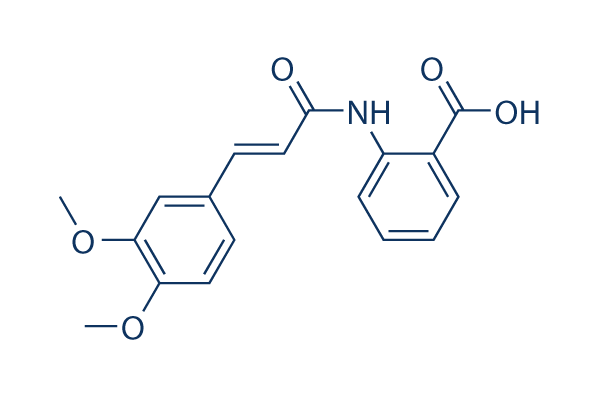
Structure chimique
Poids moléculaire: 327.33
Contrôle Qualité (Quality Control)
| Cibles apparentées | PD-1/PD-L1 CXCR STING AhR CD markers Interleukins Anti-infection Antioxidant COX Histamine Receptor |
|---|---|
| Autre Immunology & Inflammation related Inhibiteurs | Cl-amidine Bestatin (Ubenimex) Bindarit (AF 2838) Tempol Sinomenine GI254023X (GI4023) Geniposidic acid CORM-3 Oxymatrine Germacrone |
Culture cellulaire, traitement et concentration de travail
(Cell Culture, Treatment & Working Concentration)
| Lignées cellulaires | Type d'essai | Concentration | Temps d'incubation | Formulation | Description de l'activité | PMID |
|---|---|---|---|---|---|---|
| ECs | Function assay | Evaluated for inhibition of proliferation of human coronary artery endothelial cells (ECs), induced by 5 % FBS., IC50 = 19.1 μM. | 11229768 | |||
| SMCs | Function assay | Inhibition of human coronary artery smooth muscle cells (SMC's) proliferation, induced by platelet-derived growth factor (PDGF-BB) 20 ng mL., IC50 = 24.5 μM. | 11229768 | |||
| Cliquez pour voir plus de données expérimentales sur la lignée cellulaire | ||||||
Informations chimiques, stockage et stabilité (Chemical Information, Storage & Stability)
| Poids moléculaire | 327.33 | Formule | C18H17NO5 |
Stockage (À compter de la date de réception) | |
|---|---|---|---|---|---|
| N° CAS | 53902-12-8 | Télécharger le SDF | Stockage des solutions mères |
|
|
| Synonymes | SB 252218, MK-341 | Smiles | COC1=C(C=C(C=C1)C=CC(=O)NC2=CC=CC=C2C(=O)O)OC | ||
Solubilité (Solubility)
|
In vitro |
DMSO
: 65 mg/mL
(198.57 mM)
Water : Insoluble Ethanol : Insoluble |
Calculateur de molarité
|
In vivo |
|||||
Calculateur de formulation in vivo (Solution claire)
Étape 1 : Saisir les informations ci-dessous (Recommandé : Un animal supplémentaire pour tenir compte des pertes pendant l'expérience)
Étape 2 : Saisir la formulation in vivo (Ceci est seulement le calculateur, pas la formulation. Veuillez nous contacter d'abord s'il n'y a pas de formulation in vivo dans la section Solubilité.)
Résultats du calcul :
Concentration de travail : mg/ml;
Méthode de préparation du liquide maître DMSO : mg médicament prédissous dans μL DMSO ( Concentration du liquide maître mg/mL, Veuillez nous contacter d'abord si la concentration dépasse la solubilité du DMSO du lot de médicament. )
Méthode de préparation de la formulation in vivo : Prendre μL DMSO liquide maître, puis ajouterμL PEG300, mélanger et clarifier, puis ajouterμL Tween 80, mélanger et clarifier, puis ajouter μL ddH2O, mélanger et clarifier.
Méthode de préparation de la formulation in vivo : Prendre μL DMSO liquide maître, puis ajouter μL Huile de maïs, mélanger et clarifier.
Note : 1. Veuillez vous assurer que le liquide est clair avant d'ajouter le solvant suivant.
2. Assurez-vous d'ajouter le(s) solvant(s) dans l'ordre. Vous devez vous assurer que la solution obtenue, lors de l'ajout précédent, est une solution claire avant de procéder à l'ajout du solvant suivant. Des méthodes physiques telles que le vortex, les ultrasons ou le bain-marie chaud peuvent être utilisées pour faciliter la dissolution.
Mécanisme d'action (Mechanism of Action)
| In vitro |
Tranilast is an anti-allergic drug inhibiting the release of substances such as histamine and prostaglandins from mast cells, which suppresses collagen synthesis of fibroblasts derived from keloid tissues. This compound (3-300 mM) suppresses the collagen synthesis of fibroblasts from keloid and hypertrophic scar tissue but not healthy skin fibroblasts. It (30-300 mM) inhibits the release of transforming growth factor (TGF)-beta 1 from keloid fibroblasts, which enhances the collagen synthesis of keloid fibroblasts. This drug improves keloids and hypertrophic scars which originate from the abnormal proliferation and excessive collagen accumulation of fibroblasts. It inhibits the release of TGF-beta 1, IL-1 beta and PGE2 from the human monocytes-macrophages. This chemical inhibits the proliferation stimulated with fetal bovine serum (FBS), TGF-beta 1 and platelet-derived growth factor-BB (PDGF-BB) as well as PDGF-BB-induced migration. It exhibits inhibitory effects on spontaneous collagen synthesis and TGF-beta 1-induced collagen and glycosaminoglycan synthesis.
|
|---|---|
| In vivo |
Tranilast results in a 58% reduction in TGF-beta1-induced 3[H]-hydroxyproline incorporation in the diabetic heart of rats. This compound attenuates cardiac fibrosis by 37% in association with reduction in phospho-Smad2 in the diabetic heart of rats. It completely prevents the increase in chymaselike activity, reduces the chymase mRNA levels by 43%, and decreases the carotid intima/media ratio by 63% in the carotid artery of dogs.
|
Références |
|
Informations sur l'essai clinique (Clinical Trial Information)
(données du https://clinicaltrials.gov, mis à jour le 2024-11-14)
| Numéro NCT | Recrutement | Conditions | Promoteur/Collaborateurs | Date de début | Phases |
|---|---|---|---|---|---|
| NCT06643689 | NOT_YET_RECRUITING | Esophageal Stricture; Esophageal Neoplasms |
Second Affiliated Hospital, Zhejiang University, School of Medicine |
2025-01-01 | PHASE2 |
| NCT06689514 | RECRUITING | Prostatic Hypertrophy, Benign |
Yifeng Jing |
2025-01-20 | EARLY_PHASE1 |
| NCT05626829 | UNKNOWN | Nasopharyngeal Carcinoma; Recurrent Cancer |
Jian Guan |
2022-07-20 | PHASE2 |
| NCT06307288 | UNKNOWN | Rosacea |
Second Affiliated Hospital of Xi'an Jiaotong University |
2023-10-16 | PHASE4 |
| NCT03923140 | UNKNOWN | Cryopyrin-Associated Periodic Syndromes |
Peking Union Medical College Hospital |
2019-05-23 | PHASE2 |
| NCT05130892 | COMPLETED | NLRP3; hsCRP; Percutaneous Coronary Intervention |
Union Hospital, Tongji Medical College, Huazhong University of Science and Technology |
2021-11-15 | PHASE4 |

Les produits sont destinés à la recherche uniquement. Ne pas utiliser chez l'homme. Nous ne vendons pas aux patients.
©Copyright 2013 Selleck Chemicals. Tous droits réservés.