
pour la recherche uniquement
Acesulfame Potassium
Réf. Catalogue: S2884
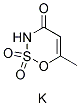
Structure chimique
Poids moléculaire: 202.25
Contrôle Qualité (Quality Control)
- Cité dans Nature Medicine pour sa qualité supérieure
- COA
- NMR
- HPLC
- SDS
- Fiche technique
Informations chimiques, stockage et stabilité (Chemical Information, Storage & Stability)
| Poids moléculaire | 202.25 | Formule | C4H5NO4S.K |
Stockage (À compter de la date de réception) | |
|---|---|---|---|---|---|
| N° CAS | 55589-62-3 | Télécharger le SDF | Stockage des solutions mères |
|
|
| Synonymes | N/A | Smiles | CC1=CC(=O)[N-]S(=O)(=O)O1.[K+] | ||
Solubilité (Solubility)
|
In vitro |
DMSO
: 40 mg/mL
(197.77 mM)
Water : 40 mg/mL Ethanol : Insoluble |
Calculateur de molarité
|
In vivo |
|||||
Calculateur de formulation in vivo (Solution claire)
Étape 1 : Saisir les informations ci-dessous (Recommandé : Un animal supplémentaire pour tenir compte des pertes pendant l'expérience)
Étape 2 : Saisir la formulation in vivo (Ceci est seulement le calculateur, pas la formulation. Veuillez nous contacter d'abord s'il n'y a pas de formulation in vivo dans la section Solubilité.)
Résultats du calcul :
Concentration de travail : mg/ml;
Méthode de préparation du liquide maître DMSO : mg médicament prédissous dans μL DMSO ( Concentration du liquide maître mg/mL, Veuillez nous contacter d'abord si la concentration dépasse la solubilité du DMSO du lot de médicament. )
Méthode de préparation de la formulation in vivo : Prendre μL DMSO liquide maître, puis ajouterμL PEG300, mélanger et clarifier, puis ajouterμL Tween 80, mélanger et clarifier, puis ajouter μL ddH2O, mélanger et clarifier.
Méthode de préparation de la formulation in vivo : Prendre μL DMSO liquide maître, puis ajouter μL Huile de maïs, mélanger et clarifier.
Note : 1. Veuillez vous assurer que le liquide est clair avant d'ajouter le solvant suivant.
2. Assurez-vous d'ajouter le(s) solvant(s) dans l'ordre. Vous devez vous assurer que la solution obtenue, lors de l'ajout précédent, est une solution claire avant de procéder à l'ajout du solvant suivant. Des méthodes physiques telles que le vortex, les ultrasons ou le bain-marie chaud peuvent être utilisées pour faciliter la dissolution.
Mécanisme d'action (Mechanism of Action)
| In vitro |
Acesulfame potassium activates two members of the human TAS2R family (hTAS2R43 and hTAS2R44) to stimulate bitter taste. Acesulfame potassium elicited robust elevation of cytosolic Ca2+ in hTAS2R44-expressing cells, with a threshold value of activation of 0.25 mM and an EC50 value of 2.5 mM. Acesulfame potassium elicited response of hTAS2R43-expressing cells with a threshold value of 3.1 mM and an estimated EC50 value ﹥10 mM
Acesulfame potassium acts directly on the pancreatic islets and potentiates glucose-induced insulin release. Acesulfame potassium (1.0-15.0 mM) augmented insulin release from islets incubated in the presence of 7.0 mM d-glucose.
Acesulfame Potassium enhanced glucose absorption via activating sweet taste receptors in the enterocyte to translocate GLUT2 to the apical membrane through the PLC βII. In Caco-2 and RIE-1 cells, Acesulfame potassium (10 mM) increased glucose uptake by 20-30 % when incubated for 10 min with glucose >25 mM.
Acesulfame potassium increased the contractile response of isolated rat detrusor muscle strips via increased extracellular Ca2+ influx. Acesulfame potassium (10-7 M to 10-2 M) enhanced the contractile response to 10 Hz EFS compared to control. The atropine-resistant response to EFS is marginally increased by Acesulfame potassium (10-6 M). Acesulfame potassium (10-6 M) increased the maximum contractile response to α, β methylene ATP by 35% and to KCl by 12%. Acesulfame potassium (10-6 M) increased the log EC50 from -2.7 to -3.03.
|
|---|---|
| In vivo |
Acesulfame potassium acts on two members of the TAS1R family of G-protein-coupled receptors (TAS1R2 and TAS1R3) to stimulate sweet taste. Selective elimination of T1R-subunits differentially abolishes de tection and perception of these two taste modalities.
Acesulfame potassium can also induce insulin secretion in rats. Injection of Acesulfame potassium (150 mg/kg body weight) increased the plasma insulin concentration at 5 min from 27.3 mU/mL to 58.6 mU/mL. Infusion of Acesulfame potassium (20 mg/kg body weight/min) for one hour maintained the insulin concentration at a high level (about 85-100 mU/mL). When using different amounts of Acesulfame potassium, the insulin secretion is stimulated in a dose-dependent fashion.
Oral administration of Acesulfame potassium (60, 450, 1500 and 2250 mg/kg body weight) induced a significant increase in the frequency of cellular damage and chromosome aberrations in the Bone marrow cells isolated from mice femora. Oral administration of Acesulfame potassium at the concentration of 150, 300, and 600 mg/kg body weight is found to induce DNA damage in bone marrow cells of mice with a minimum effective concentration (MEC) value of 150 mg/kg in the comet assay.
|
Références |
|
Informations sur l'essai clinique (Clinical Trial Information)
(données du https://clinicaltrials.gov, mis à jour le 2024-05-22)
| Numéro NCT | Recrutement | Conditions | Promoteur/Collaborateurs | Date de début | Phases |
|---|---|---|---|---|---|
| NCT05379270 | Active not recruiting | Breastfeeding |
George Washington University |
2022-02-28 | Not Applicable |

Les produits sont destinés à la recherche uniquement. Ne pas utiliser chez l'homme. Nous ne vendons pas aux patients.
©Copyright 2013 Selleck Chemicals. Tous droits réservés.