
pour la recherche uniquement
AMD3465 hexahydrobromide CXCR Antagoniste
Réf. Catalogue: S2879
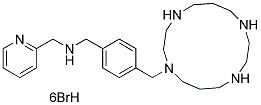
Structure chimique
Poids moléculaire: 896.07
Contrôle Qualité (Quality Control)
- Cité dans Nature Medicine pour sa qualité supérieure
- COA
- NMR
- HPLC
- SDS
- Fiche technique
| Cibles apparentées | Hedgehog/Smoothened PKA Adrenergic Receptor AChR 5-HT Receptor Histamine Receptor Dopamine Receptor Ras KRas GPR |
|---|---|
| Autre CXCR Inhibiteurs | AZD5069 SB 225002 Reparixin (Repertaxin) WZ811 Navarixin (SCH-527123) LIT-927 SX-682 AMG 487 SB 265610 LY2510924 |
Informations chimiques, stockage et stabilité (Chemical Information, Storage & Stability)
| Poids moléculaire | 896.07 | Formule | C24H38N6.6HBr |
Stockage (À compter de la date de réception) | |
|---|---|---|---|---|---|
| N° CAS | 185991-07-5 | Télécharger le SDF | Stockage des solutions mères |
|
|
| Synonymes | N/A | Smiles | C1CNCCNCCCN(CCNC1)CC2=CC=C(C=C2)CNCC3=CC=CC=N3.Br.Br.Br.Br.Br.Br | ||
Solubilité (Solubility)
|
In vitro |
Water : 98 mg/mL
DMSO
: 2 mg/mL
(2.23 mM)
Ethanol : Insoluble |
Calculateur de molarité
|
In vivo |
|||||
Calculateur de formulation in vivo (Solution claire)
Étape 1 : Saisir les informations ci-dessous (Recommandé : Un animal supplémentaire pour tenir compte des pertes pendant l'expérience)
Étape 2 : Saisir la formulation in vivo (Ceci est seulement le calculateur, pas la formulation. Veuillez nous contacter d'abord s'il n'y a pas de formulation in vivo dans la section Solubilité.)
Résultats du calcul :
Concentration de travail : mg/ml;
Méthode de préparation du liquide maître DMSO : mg médicament prédissous dans μL DMSO ( Concentration du liquide maître mg/mL, Veuillez nous contacter d'abord si la concentration dépasse la solubilité du DMSO du lot de médicament. )
Méthode de préparation de la formulation in vivo : Prendre μL DMSO liquide maître, puis ajouterμL PEG300, mélanger et clarifier, puis ajouterμL Tween 80, mélanger et clarifier, puis ajouter μL ddH2O, mélanger et clarifier.
Méthode de préparation de la formulation in vivo : Prendre μL DMSO liquide maître, puis ajouter μL Huile de maïs, mélanger et clarifier.
Note : 1. Veuillez vous assurer que le liquide est clair avant d'ajouter le solvant suivant.
2. Assurez-vous d'ajouter le(s) solvant(s) dans l'ordre. Vous devez vous assurer que la solution obtenue, lors de l'ajout précédent, est une solution claire avant de procéder à l'ajout du solvant suivant. Des méthodes physiques telles que le vortex, les ultrasons ou le bain-marie chaud peuvent être utilisées pour faciliter la dissolution.
Mécanisme d'action (Mechanism of Action)
| Targets/IC50/Ki |
CXCR4
|
|---|---|
| In vitro |
AMD3465 blocks the binding of CXCL12 with IC50 of 18 nM in SupT1 cells. AMD3465 inhibits CXCL12-induced calcium signaling in SupT1 cells with IC50 of 17 nM and also inhibits MAPK phosphorylation. While AMD3465 couldn't block the intracellular calcium fluxes elicited by the CCR5 ligands RANTES, LD78β and MIP-1β in U87.CD4.CCR5 cells. AMD3465 suppresses CXCL12-induced chemotaxis of human T-lymphoid SupT1 cells and prevents chemokine-induced internalization of CXCR4 in U87.CD4 cells. Moreover, AMD3465 proves active against the X4 HIV-1 strains IIIB, NL4.3, RF and HE with IC50 from 6-12 nM. AMD3465 suppresses the HIV-2 strains ROD and EHO with IC50 of 12.3 nM. AMD3465 inhibits SDF-1αligand binding with Ki of 41.7 nM sing the CCRF-CEM cell line. Inhibition of CXCR4 signaling pathways by AMD3465 is demonstrated by inhibition of SDF-1α stimulated calcium flux and GTP binding with IC50 of 12.07 nM and 10.38 nM, respectively. Furthermore AMD3465 is able to inhibit CXCR4-mediated physiological response, cell chemotaxis, with IC50 of 8.7 nM. In addition, AMD3465 has no inhibitory effect on either MIP1α, MCP-1, TARC, RANTES, MIP-3β, or IP10 mediated calcium flux, ligands for CCR1, CCR2b, CCR4, CCR5, CCR7 and CXCR3 respectively, or LTB4 binding to BLT1, thus indicating that AMD3465 is a selective inhibitor of CXCR4 over other chemokine receptors. In a separate study AMD3465 is shown to inhibit SDF-1-mediated CXCR4 internalization in cells expressing GFP-linked CXCR4, and does not cause receptor internalization when incubated with the cells alone.
|
| In vivo |
The pharmacokinetics of AMD3465 is investigated in mice and dogs. Absorption is rapid following subcutaneous administration. AMD3465 is cleared from dog plasma in a biphasic manner with a terminal half-life of 1.56-4.63 h. AMD3465 shows 100% bioavailability following subcutaneous administration by comparison of exposure to the intravenous and subcutaneous doses. AMD3465 causes leukocytosis when administered subcutaneously in mice and dogs, with peak mobilization occurring between 0.5 h and 1.5 h following subcutaneous dosing in mice and with maximum peak plasma concentration of compound preceding peak mobilization in dogs, indicating that AMD3465 has the potential to mobilize hematopoietic stem cells. AMD3465 abrogates type-2 granuloma formation and eosinophil mobilization at the 6 and 30 mg/kg doses. AMD3465 treatment could cause an ~90% reduction in CXCR4 transcript levels in lungs with type-2 lesions.
|
Références |
|

Les produits sont destinés à la recherche uniquement. Ne pas utiliser chez l'homme. Nous ne vendons pas aux patients.
©Copyright 2013 Selleck Chemicals. Tous droits réservés.