
pour la recherche uniquement
Bexarotene Retinoid Receptor Agoniste
Réf. Catalogue: S2098
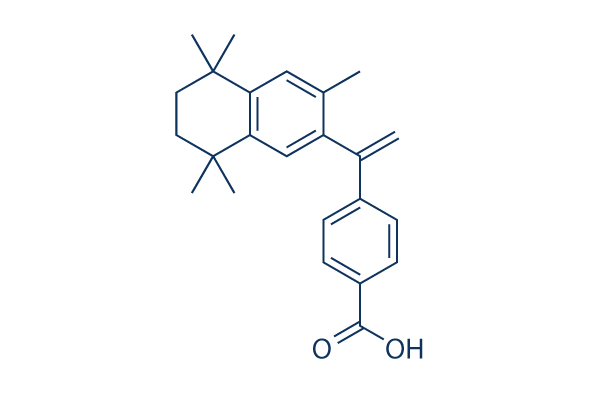
Structure chimique
Poids moléculaire: 348
Contrôle Qualité (Quality Control)
| Cibles apparentées | Dehydrogenase HSP Transferase P450 (e.g. CYP17) PDE phosphatase PPAR Vitamin Carbohydrate Metabolism Mitochondrial Metabolism |
|---|---|
| Autre Retinoid Receptor Inhibiteurs | TTNPB (Arotinoid acid) Tamibarotene AM580 Fenretinide UVI 3003 SR 11237 BMS493 AR7 All trans-Retinal AGN 193109 |
Informations chimiques, stockage et stabilité (Chemical Information, Storage & Stability)
| Poids moléculaire | 348 | Formule | C24H28O2 |
Stockage (À compter de la date de réception) | |
|---|---|---|---|---|---|
| N° CAS | 153559-49-0 | Télécharger le SDF | Stockage des solutions mères |
|
|
| Synonymes | LGD1069 | Smiles | CC1=CC2=C(C=C1C(=C)C3=CC=C(C=C3)C(=O)O)C(CCC2(C)C)(C)C | ||
Solubilité (Solubility)
|
In vitro |
DMSO
: 70 mg/mL
(201.14 mM)
Water : Insoluble Ethanol : Insoluble |
Calculateur de molarité
|
In vivo |
|||||
Calculateur de formulation in vivo (Solution claire)
Étape 1 : Saisir les informations ci-dessous (Recommandé : Un animal supplémentaire pour tenir compte des pertes pendant l'expérience)
Étape 2 : Saisir la formulation in vivo (Ceci est seulement le calculateur, pas la formulation. Veuillez nous contacter d'abord s'il n'y a pas de formulation in vivo dans la section Solubilité.)
Résultats du calcul :
Concentration de travail : mg/ml;
Méthode de préparation du liquide maître DMSO : mg médicament prédissous dans μL DMSO ( Concentration du liquide maître mg/mL, Veuillez nous contacter d'abord si la concentration dépasse la solubilité du DMSO du lot de médicament. )
Méthode de préparation de la formulation in vivo : Prendre μL DMSO liquide maître, puis ajouterμL PEG300, mélanger et clarifier, puis ajouterμL Tween 80, mélanger et clarifier, puis ajouter μL ddH2O, mélanger et clarifier.
Méthode de préparation de la formulation in vivo : Prendre μL DMSO liquide maître, puis ajouter μL Huile de maïs, mélanger et clarifier.
Note : 1. Veuillez vous assurer que le liquide est clair avant d'ajouter le solvant suivant.
2. Assurez-vous d'ajouter le(s) solvant(s) dans l'ordre. Vous devez vous assurer que la solution obtenue, lors de l'ajout précédent, est une solution claire avant de procéder à l'ajout du solvant suivant. Des méthodes physiques telles que le vortex, les ultrasons ou le bain-marie chaud peuvent être utilisées pour faciliter la dissolution.
Mécanisme d'action (Mechanism of Action)
| Targets/IC50/Ki |
RXR
|
|---|---|
| In vitro |
Bexarotene treatment at 1 mM and 10 mM for 96 h increases the number of cells with sub-G1 populations and annexin V binding in a dose-dependent manner compared with vehicle controls (DMSO) in well-established CTCL cell lines (MJ, Hut78, and HH), respectively. This compound suppresses the expression of retinoid X receptor alpha and retinoic acid receptor alpha proteins in all three lines compared with untreated controls. It decreases the protein levels of survivin, activates caspase-3, and cleaved poly(ADP-Ribose) polymerase, but has no obvious effect on expression of Fas/Fas ligand and bcl-2 proteins in all three CTCL lines. It induces a loss of viability and more pronounced inhibition of clonogenic proliferation in HH and Hut-78 cells, whereas the MJ line exhibits resistance. The chemical upregulates and activates Bax in sensitive lines, although not enough to signal significant apoptosis. It signals both G(1) and G(2)/M arrest by the modulation of critical checkpoint proteins. It activates p53 by phosphorylation at Ser15, which influences the binding of p53 to promoters for cell cycle arrest, induces p73 upregulation, and, in concordance, also modulates some p53/p73 downstream target genes, such as p21, Bax, survivin and cdc2.
|
| In vivo |
Bexarotene significantly prevents ER-negative mammary tumorigenesis with less toxicity than naturally occurring retinoids in animal models. This compound inhibits the development of preinvasive mammary lesions such as hyperplasias and carcinoma-in-situ in MMTV-erbB2 mice.
|
Références |
|
Informations sur l'essai clinique (Clinical Trial Information)
(données du https://clinicaltrials.gov, mis à jour le 2026-02-04)
| Numéro NCT | Recrutement | Conditions | Promoteur/Collaborateurs | Date de début | Phases |
|---|---|---|---|---|---|
| NCT05296304 | RECRUITING | Cutaneous T-cell Lymphoma |
Memorial Sloan Kettering Cancer Center |
2022-03-16 | PHASE1 |
| NCT04664829 | COMPLETED | Metastatic Triple-Negative Breast Carcinoma |
National Cancer Centre, Singapore |
2020-10-01 | PHASE1 |
| NCT05106192 | WITHDRAWN | Mycosis Fungoides of Skin (Diagnosis); Cutaneous T-cell Lymphoma; Non Hodgkin Lymphoma; Lymphomatoid Papulosis; Lymphoma, Large-Cell, Anaplastic; Lymphoma, Follicular |
Case Comprehensive Cancer Center |
2022-04-01 | |
| NCT03323658 | COMPLETED | Breast Atypical Ductal Hyperplasia; Breast Atypical Lobular Hyperplasia; Breast Ductal Carcinoma In Situ; Breast Lobular Carcinoma In Situ; Invasive Breast Carcinoma |
National Cancer Institute (NCI) |
2018-06-15 | PHASE1 |
| NCT03323658 | Completed | Breast Atypical Ductal Hyperplasia|Breast Atypical Lobular Hyperplasia|Breast Ductal Carcinoma In Situ|Breast Lobular Carcinoma In Situ|Invasive Breast Carcinoma |
National Cancer Institute (NCI) |
2018-06-15 | Phase 1 |
| NCT00411632 | COMPLETED | Lung Cancer |
M.D. Anderson Cancer Center |
2006-11-29 | PHASE2 |

Les produits sont destinés à la recherche uniquement. Ne pas utiliser chez l'homme. Nous ne vendons pas aux patients.
©Copyright 2013 Selleck Chemicals. Tous droits réservés.