
pour la recherche uniquement
Bindarit (AF 2838) Inhibiteur de MCP/CCL
Réf. Catalogue: S3032
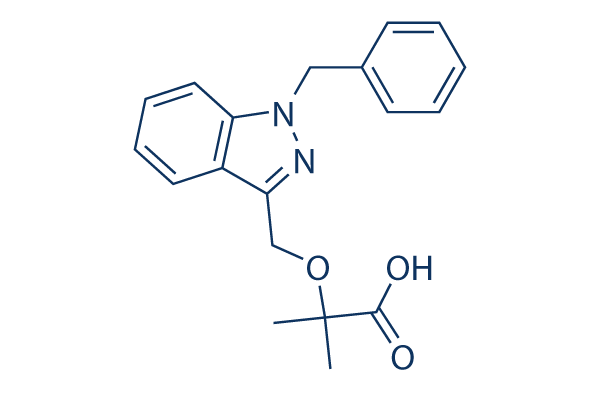
Structure chimique
Poids moléculaire: 324.37
Contrôle Qualité (Quality Control)
| Cibles apparentées | PD-1/PD-L1 CXCR STING AhR CD markers Interleukins Anti-infection Antioxidant COX Histamine Receptor |
|---|---|
| Autre Immunology & Inflammation related Inhibiteurs | Cl-amidine Bestatin (Ubenimex) Tempol Tranilast Sinomenine GI254023X (GI4023) Geniposidic acid CORM-3 Oxymatrine Germacrone |
Culture cellulaire, traitement et concentration de travail
(Cell Culture, Treatment & Working Concentration)
| Lignées cellulaires | Type d'essai | Concentration | Temps d'incubation | Formulation | Description de l'activité | PMID |
|---|---|---|---|---|---|---|
| SK-N-MC | qHTS assay | qHTS of pediatric cancer cell lines to identify multiple opportunities for drug repurposing: Primary screen for SK-N-MC cells | 29435139 | |||
| NB-EBc1 | qHTS assay | qHTS of pediatric cancer cell lines to identify multiple opportunities for drug repurposing: Primary screen for NB-EBc1 cells | 29435139 | |||
| SK-N-SH | qHTS assay | qHTS of pediatric cancer cell lines to identify multiple opportunities for drug repurposing: Primary screen for SK-N-SH cells | 29435139 | |||
| Cliquez pour voir plus de données expérimentales sur la lignée cellulaire | ||||||
Informations chimiques, stockage et stabilité (Chemical Information, Storage & Stability)
| Poids moléculaire | 324.37 | Formule | C19H20N2O3 |
Stockage (À compter de la date de réception) | |
|---|---|---|---|---|---|
| N° CAS | 130641-38-2 | Télécharger le SDF | Stockage des solutions mères |
|
|
Solubilité (Solubility)
|
In vitro |
DMSO
: 64 mg/mL
(197.3 mM)
Ethanol : 64 mg/mL Water : Insoluble |
Calculateur de molarité
|
In vivo |
|||||
Calculateur de formulation in vivo (Solution claire)
Étape 1 : Saisir les informations ci-dessous (Recommandé : Un animal supplémentaire pour tenir compte des pertes pendant l'expérience)
Étape 2 : Saisir la formulation in vivo (Ceci est seulement le calculateur, pas la formulation. Veuillez nous contacter d'abord s'il n'y a pas de formulation in vivo dans la section Solubilité.)
Résultats du calcul :
Concentration de travail : mg/ml;
Méthode de préparation du liquide maître DMSO : mg médicament prédissous dans μL DMSO ( Concentration du liquide maître mg/mL, Veuillez nous contacter d'abord si la concentration dépasse la solubilité du DMSO du lot de médicament. )
Méthode de préparation de la formulation in vivo : Prendre μL DMSO liquide maître, puis ajouterμL PEG300, mélanger et clarifier, puis ajouterμL Tween 80, mélanger et clarifier, puis ajouter μL ddH2O, mélanger et clarifier.
Méthode de préparation de la formulation in vivo : Prendre μL DMSO liquide maître, puis ajouter μL Huile de maïs, mélanger et clarifier.
Note : 1. Veuillez vous assurer que le liquide est clair avant d'ajouter le solvant suivant.
2. Assurez-vous d'ajouter le(s) solvant(s) dans l'ordre. Vous devez vous assurer que la solution obtenue, lors de l'ajout précédent, est une solution claire avant de procéder à l'ajout du solvant suivant. Des méthodes physiques telles que le vortex, les ultrasons ou le bain-marie chaud peuvent être utilisées pour faciliter la dissolution.
Mécanisme d'action (Mechanism of Action)
| Caractéristiques |
Bindarit is devoid of immunosuppressive effects.
|
|---|---|
| Targets/IC50/Ki |
MCP-1/CCL2
MCP-3/CCL7
MCP-2/CCL8
|
| In vitro |
Bindarit treatment causes a dose-dependent inhibition of the capacity of human monocytes to produce monocyte chemotactic protein-1 (MCP-1) in response to bacterial LPS or C. albicans with IC50 of 172 µM and 403 µM, respectively. The inhibition of LP-induced MCP-1 production by this compound is associated with reduced levels of MCP-1 mRNA transcripts with IC50 of 75 µM. It inhibits the production of MCP-1 by LPS-stimulated MM6 cells with IC50 of 425 μM, without affecting the release of IL-8 or IL-6. This chemical inhibits the release of MCP-1 from IL-1 stimulated osteoblast cell line Saos-2. It, even at the maximal concentration, does not exhibit a direct in vitro cytotoxic effect on human IIB-MEL-J melanoma or ECs, although it inhibits MCP-1 expression. This compound (10-300 μM) reduces rat vascular smooth muscle cell (VSMC) proliferation, migration, and invasion. It induces the downregulation of the classical NF-κB pathway. This chemical displays a specific inhibitory effect on the p65 and p65/p50 induced MCP-1 promoter activation, with no effect on other tested activated promoters, indicating that it acts on a specific subpopulation of NF-κB isoforms and selects its targets within the whole NF-κB inflammatory pathway. It modulates cancer-cell proliferation and migration, mainly through negative regulation of TGF-β and AKT signaling. |
| In vivo |
Oral administration of Bindarit at 50 mg/kg in NZB/W mice delays the onset of proteinuria, significantly protects from renal function impairment, and prolongs survival of NZB/W mice or lupus mice. This compound treatment completely MCP-1 up-regulation during the progression of nephritis. Inhibition of MCP-1 with this chemical also reduces tumor growth and macrophage recruitment, rendering necrotic tumor masses in human melanoma xenografts. This compound is effective in reducing neointima formation in both non-hyperlipidaemic and hyperlipidaemic animal models of vascular injury by a direct effect on VSMC proliferation and migration and by reducing neointimal macrophage content. Administration of this chemical results in impaired metastatic disease in prostate cancer PC-3M-Luc2 xenograft mice and impairment of local tumorigenesis in Balb/c mice with murine breast cancer 4T1-Luc cells. In addition, this treatment significantly decreases the infiltration of tumor-associated macrophages and myeloid-derived suppressor cells in 4T1-Luc primary tumors. |
Références |
|
Informations sur l'essai clinique (Clinical Trial Information)
(données du https://clinicaltrials.gov, mis à jour le 2016-08-05)
| Numéro NCT | Recrutement | Conditions | Promoteur/Collaborateurs | Date de début | Phases |
|---|---|---|---|---|---|
| NCT01269242 | COMPLETED | Coronary Restenosis |
Aziende Chimiche Riunite Angelini Francesco S.p.A |
2009-01 | PHASE2 |
| NCT01269242 | Completed | Coronary Restenosis |
Aziende Chimiche Riunite Angelini Francesco S.p.A |
2009-01 | Phase 2 |
| NCT01109212 | COMPLETED | Diabetic Nephropathy |
Aziende Chimiche Riunite Angelini Francesco S.p.A |
2007-03 | PHASE2 |
| NCT01109212 | Completed | Diabetic Nephropathy |
Aziende Chimiche Riunite Angelini Francesco S.p.A|Mario Negri Institute for Pharmacological Research |
2007-03 | Phase 2 |

Les produits sont destinés à la recherche uniquement. Ne pas utiliser chez l'homme. Nous ne vendons pas aux patients.
©Copyright 2013 Selleck Chemicals. Tous droits réservés.