
pour la recherche uniquement
Fexofenadine HCl Histamine Receptor Inhibiteur
Réf. Catalogue: S3208
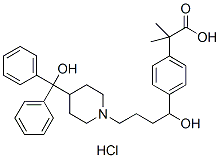
Structure chimique
Poids moléculaire: 538.12
Contrôle Qualité (Quality Control)
| Cibles apparentées | Adrenergic Receptor AChR 5-HT Receptor COX Calcium Channel Dopamine Receptor GABA Receptor TRP Channel Cholinesterase (ChE) GluR |
|---|---|
| Autre Histamine Receptor Inhibiteurs | GSK2879552 Dihydrochloride JNJ-7777120 Ebastine Mianserin HCl Ciproxifan Maleate Astemizole Lafutidine Mizolastine Cloperastine hydrochloride Rupatadine |
Informations chimiques, stockage et stabilité (Chemical Information, Storage & Stability)
| Poids moléculaire | 538.12 | Formule | C32H39NO4.HCl |
Stockage (À compter de la date de réception) | |
|---|---|---|---|---|---|
| N° CAS | 153439-40-8 | Télécharger le SDF | Stockage des solutions mères |
|
|
| Synonymes | MDL 16455A | Smiles | CC(C)(C1=CC=C(C=C1)C(CCCN2CCC(CC2)C(C3=CC=CC=C3)(C4=CC=CC=C4)O)O)C(=O)O.Cl | ||
Solubilité (Solubility)
|
In vitro |
DMSO
: 107 mg/mL
(198.84 mM)
Ethanol : 107 mg/mL Water : 2 mg/mL |
Calculateur de molarité
|
In vivo |
|||||
Calculateur de formulation in vivo (Solution claire)
Étape 1 : Saisir les informations ci-dessous (Recommandé : Un animal supplémentaire pour tenir compte des pertes pendant l'expérience)
Étape 2 : Saisir la formulation in vivo (Ceci est seulement le calculateur, pas la formulation. Veuillez nous contacter d'abord s'il n'y a pas de formulation in vivo dans la section Solubilité.)
Résultats du calcul :
Concentration de travail : mg/ml;
Méthode de préparation du liquide maître DMSO : mg médicament prédissous dans μL DMSO ( Concentration du liquide maître mg/mL, Veuillez nous contacter d'abord si la concentration dépasse la solubilité du DMSO du lot de médicament. )
Méthode de préparation de la formulation in vivo : Prendre μL DMSO liquide maître, puis ajouterμL PEG300, mélanger et clarifier, puis ajouterμL Tween 80, mélanger et clarifier, puis ajouter μL ddH2O, mélanger et clarifier.
Méthode de préparation de la formulation in vivo : Prendre μL DMSO liquide maître, puis ajouter μL Huile de maïs, mélanger et clarifier.
Note : 1. Veuillez vous assurer que le liquide est clair avant d'ajouter le solvant suivant.
2. Assurez-vous d'ajouter le(s) solvant(s) dans l'ordre. Vous devez vous assurer que la solution obtenue, lors de l'ajout précédent, est une solution claire avant de procéder à l'ajout du solvant suivant. Des méthodes physiques telles que le vortex, les ultrasons ou le bain-marie chaud peuvent être utilisées pour faciliter la dissolution.
Mécanisme d'action (Mechanism of Action)
| Targets/IC50/Ki |
Histamine H1 receptor
246 nM
|
|---|---|
| In vitro |
Fexofenadine exhibits a potent and concentration-dependent anti-anaphylactic activity with an IC50 value of 95.5nM. Fexofenadine shows only a weak competitive antagonist behaviour for the 5-HT2A receptorsfrom rat caudal artery with pA2 of 5.2. All four P-gp inhibitors has a strong, concentration-dependent effect on the Papp of fexofenadine in both directions in the Caco-2 cell model. The IC50 of verapamil is 8.44 mM on the P-gp-mediated secretion of Fexofenadine. Fexofenadine causes a significant increase in the QT and Tp-e intervals and receives a significant TdP score at doses greater than 100 fold its free TPC in the rabbit left ventricular wedge preparation.
|
| In vivo |
Fexofenadine is excreted unchanged in the urine, bile, and gastrointestinal tract, indicating minimal metabolism in rats, making it an ideal probe to study transport processes. Coadministration of Fexofenadine with Ketoconazole increases the oral exposure of Fexofenadine by 187% in rats. In contrast, coadministration of Fexofenadine with orange juice or apple juice to rats decreases the oral exposure of Fexofenadine by 31% and 22%, respectively. Increasing the quantity of orange or apple juice administered further decreases the oral exposure of Fexofenadine, by 40% and 28%, respectively. Biliary excretion clearance of Fexofenadine (17 ml/min/kg) accounts for almost 60% of the total body clearance (30 ml/min/kg) in mice. Knockout mice of Mdr1a/1b P-gp does not affect the biliary excretion clearance with regard to both plasma and liver concentrations, whereas the absence of P-gp causes a 6-fold increase in the plasma concentration and 3-fold higher brain-to-plasma concentration ratio after oral administration.
|
Références |
|
Informations sur l'essai clinique (Clinical Trial Information)
(données du https://clinicaltrials.gov, mis à jour le 2026-07-06)
| Numéro NCT | Recrutement | Conditions | Promoteur/Collaborateurs | Date de début | Phases |
|---|---|---|---|---|---|
| NCT05263206 | RECRUITING | Pruritus |
Sanofi |
2022-02-15 | PHASE3 |
| NCT07526558 | NOT_YET_RECRUITING | Post-tick Bite Illness; Mast Cell Stabilizer |
University of North Carolina, Chapel Hill |
2026-04-30 | PHASE2 |
| NCT06152497 | RECRUITING | Histamine |
University Ghent |
2023-09-01 | |
| NCT06548204 | RECRUITING | ST-segment Elevation Myocardial Infarction (STEMI) |
Second Affiliated Hospital, Zhejiang University, School of Medicine |
2025-01-20 | PHASE2 |
| NCT06785298 | RECRUITING | Parkinson Disease |
Tanta University |
2024-12-10 | PHASE2; PHASE3 |
| NCT07381803 | RECRUITING | Zhejiang University |
Second Affiliated Hospital, Zhejiang University, School of Medicine |
2025-01-27 | PHASE3 |

Les produits sont destinés à la recherche uniquement. Ne pas utiliser chez l'homme. Nous ne vendons pas aux patients.
©Copyright 2013 Selleck Chemicals. Tous droits réservés.