
pour la recherche uniquement
Glucosamine hydrochloride
Réf. Catalogue: S3694
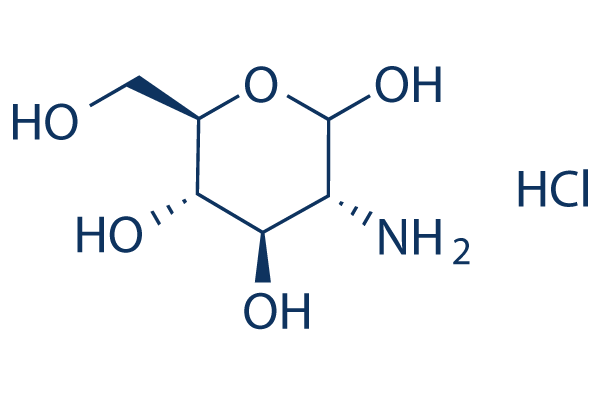
Structure chimique
Poids moléculaire: 215.63
Contrôle Qualité (Quality Control)
- Cité dans Nature Medicine pour sa qualité supérieure
- COA
- NMR
- SDS
- Fiche technique
Informations chimiques, stockage et stabilité (Chemical Information, Storage & Stability)
| Poids moléculaire | 215.63 | Formule | C6H13NO5.HCl |
Stockage (À compter de la date de réception) | |
|---|---|---|---|---|---|
| N° CAS | 66-84-2 | Télécharger le SDF | Stockage des solutions mères |
|
|
| Synonymes | 2-Amino-2-deoxy-glucose HCl, Chitosamine HCl | Smiles | C(C1C(C(C(C(O1)O)N)O)O)O.Cl | ||
Solubilité (Solubility)
|
In vitro |
Water : 43 mg/mL
DMSO
: 4 mg/mL
(18.55 mM)
Ethanol : Insoluble |
Calculateur de molarité
|
In vivo |
|||||
Calculateur de formulation in vivo (Solution claire)
Étape 1 : Saisir les informations ci-dessous (Recommandé : Un animal supplémentaire pour tenir compte des pertes pendant l'expérience)
Étape 2 : Saisir la formulation in vivo (Ceci est seulement le calculateur, pas la formulation. Veuillez nous contacter d'abord s'il n'y a pas de formulation in vivo dans la section Solubilité.)
Résultats du calcul :
Concentration de travail : mg/ml;
Méthode de préparation du liquide maître DMSO : mg médicament prédissous dans μL DMSO ( Concentration du liquide maître mg/mL, Veuillez nous contacter d'abord si la concentration dépasse la solubilité du DMSO du lot de médicament. )
Méthode de préparation de la formulation in vivo : Prendre μL DMSO liquide maître, puis ajouterμL PEG300, mélanger et clarifier, puis ajouterμL Tween 80, mélanger et clarifier, puis ajouter μL ddH2O, mélanger et clarifier.
Méthode de préparation de la formulation in vivo : Prendre μL DMSO liquide maître, puis ajouter μL Huile de maïs, mélanger et clarifier.
Note : 1. Veuillez vous assurer que le liquide est clair avant d'ajouter le solvant suivant.
2. Assurez-vous d'ajouter le(s) solvant(s) dans l'ordre. Vous devez vous assurer que la solution obtenue, lors de l'ajout précédent, est une solution claire avant de procéder à l'ajout du solvant suivant. Des méthodes physiques telles que le vortex, les ultrasons ou le bain-marie chaud peuvent être utilisées pour faciliter la dissolution.
Mécanisme d'action (Mechanism of Action)
| In vitro |
Glucosamine enters the hexosamine biosynthetic pathway (HBP) downstream of the rate-limiting step catalyzed by the GFAT (glutamine:fluctose-6-phosphate amidotransferase), providing UDP-GlcNAc substrates for O-linked β-N-acetylglucosamine (O-GlcNAc) protein modification. Glucosamine inhibits proteasomal activity and the proliferation of ALVA41 prostate cancer cells. The inhibition of proteasomal activity results in the accumulation of ubiquitinated proteins, followed by induction of apoptosis. Glucosamine downregulates proteasome activator PA28γ and overexpression of PA28γ rescues the proteasomal activity and growth inhibition mediated by glucosamine. Glucosamine inhibits the proliferation of RCC cells by promoting cell cycle arrest at G0/G1 phase, but not promoting apoptosis.
|
|---|---|
| In vivo |
Glucosamine could significantly inhibit the production of nitric oxide and prostagladin E2 and suppress the progression of adjuvant arthritis in rats. Glucosamine may be expected as a novel anti-inflammatory agent for treatment of rheumatoid arthritis. Administration of glucosamine normalizes cartilage metabolism, so as to inhibit the degradation and stimulate the synthesis of proteoglycans, and to restore the articular function. Glucosamine has been demonstrated to prolong the allogeneic cardiac allograft survival by repressing the activation of T-lymphoblasts and dendritic cells.
|
Références |
|

Les produits sont destinés à la recherche uniquement. Ne pas utiliser chez l'homme. Nous ne vendons pas aux patients.
©Copyright 2013 Selleck Chemicals. Tous droits réservés.