
pour la recherche uniquement
Guadecitabine sodium Inhibiteur de DNMT
Réf. Catalogue: S7013
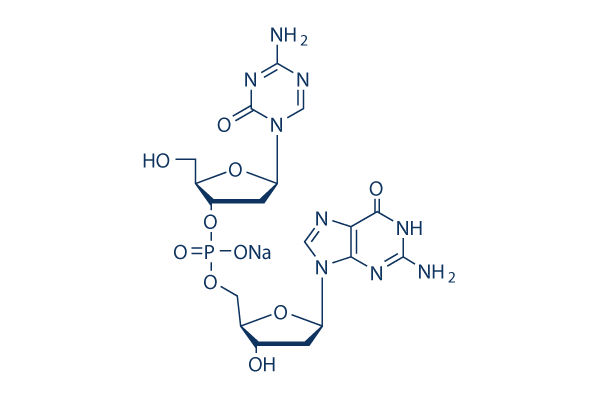
Structure chimique
Poids moléculaire: 579.39
Contrôle Qualité (Quality Control)
- Cité dans Nature Medicine pour sa qualité supérieure
- COA
- NMR
- HPLC
- SDS
- Fiche technique
| Cibles apparentées | PRMT EZH2 MAT2A DNA Methyltransferase LSD1 JMJD G9a/GLP MLL NSD FTO |
|---|---|
| Produits vedettes | Y-27632 Dihydrochloride SB431542 CHIR-99021 (Laduviglusib) RMC-7977 RMC-6236 (Daraxonrasib) MRTX1133 MG132 Z-VAD-FMK VT3989 IAG933 |
Informations chimiques, stockage et stabilité (Chemical Information, Storage & Stability)
| Poids moléculaire | 579.39 | Formule | C18 H23 N9 O10 P . Na |
Stockage (À compter de la date de réception) | |
|---|---|---|---|---|---|
| N° CAS | 929904-85-8 | -- | Stockage des solutions mères |
|
|
| Synonymes | SGI-110 sodium; S-110 sodium | Smiles | C1C(C(OC1N2C=NC3=C2N=C(NC3=O)N)COP(=O)([O-])OC4CC(OC4CO)N5C=NC(=NC5=O)N)O.[Na+] | ||
Solubilité (Solubility)
|
In vitro |
DMSO
: 100 mg/mL
(172.59 mM)
Water : 50 mg/mL Ethanol : Insoluble |
Calculateur de molarité
|
In vivo |
|||||
Calculateur de formulation in vivo (Solution claire)
Étape 1 : Saisir les informations ci-dessous (Recommandé : Un animal supplémentaire pour tenir compte des pertes pendant l'expérience)
Étape 2 : Saisir la formulation in vivo (Ceci est seulement le calculateur, pas la formulation. Veuillez nous contacter d'abord s'il n'y a pas de formulation in vivo dans la section Solubilité.)
Résultats du calcul :
Concentration de travail : mg/ml;
Méthode de préparation du liquide maître DMSO : mg médicament prédissous dans μL DMSO ( Concentration du liquide maître mg/mL, Veuillez nous contacter d'abord si la concentration dépasse la solubilité du DMSO du lot de médicament. )
Méthode de préparation de la formulation in vivo : Prendre μL DMSO liquide maître, puis ajouterμL PEG300, mélanger et clarifier, puis ajouterμL Tween 80, mélanger et clarifier, puis ajouter μL ddH2O, mélanger et clarifier.
Méthode de préparation de la formulation in vivo : Prendre μL DMSO liquide maître, puis ajouter μL Huile de maïs, mélanger et clarifier.
Note : 1. Veuillez vous assurer que le liquide est clair avant d'ajouter le solvant suivant.
2. Assurez-vous d'ajouter le(s) solvant(s) dans l'ordre. Vous devez vous assurer que la solution obtenue, lors de l'ajout précédent, est une solution claire avant de procéder à l'ajout du solvant suivant. Des méthodes physiques telles que le vortex, les ultrasons ou le bain-marie chaud peuvent être utilisées pour faciliter la dissolution.
Mécanisme d'action (Mechanism of Action)
| Targets/IC50/Ki |
DNA methyltransferase
|
|---|---|
| In vitro |
Guadecitabine (SGI-110) is a 5-aza-2′-deoxycytidine-containing demethylating dinucleotide that works via a mechanism similar to that of 5-aza-CdR after incorporation of its aza-moiety into DNA. However, it is well protected from deamination by cytidine deaminase. This compound (1 μM) induces a significant decrease in the level of methylation in both T24 and HCT116 cells and is able to induce robust p16 expression. It also causes depletion of extractable DNMT1 in cells at 1 μM concentration. Furthermore, it decreases the plating efficiency of T24 bladder carcinoma cells in a dose-dependent manner, with no colonies forming at 10 μM concentration, which is quite similar to 5-aza-CdR in T24 cells. It shows immunomodulatory activity in vitro. At 1 μM, it induces/up-regulates the expression of several cancer/testis antigens (CTA) (i.e., MAGE-A1, MAGE-A2, MAGE-A3, MAGE-A4, MAGE-A10, GAGE1-2, GAGE 1-6, NY-ESO-1, and SSX 1-5) in cancer cell lines (cutaneous melanoma, mesothelioma, renal cell carcinoma, and sarcoma cells), both at mRNA and at protein levels. This compound also up-regulates the expression of HLA class I antigens and of ICAM-1, resulting in improved recognition of cancer cells by gp100-specific CTL. |
| In vivo |
Guadecitabine (SGI-110) is as effective as 5-Aza-CdR, but is better tolerated in mice. This compound (10 mg/kg) displays potent activity on inducing p16 expression, reducing DNA methylation at the p16 promoter region, and retarding tumor growth in human xenograft. It is effective by both i.p. and s.c. deliveries. |
Références |
|
Informations sur l'essai clinique (Clinical Trial Information)
(données du https://clinicaltrials.gov, mis à jour le 2026-08-05)
| Numéro NCT | Recrutement | Conditions | Promoteur/Collaborateurs | Date de début | Phases |
|---|---|---|---|---|---|
| NCT03220477 | ACTIVE_NOT_RECRUITING | Lung Cancer |
Memorial Sloan Kettering Cancer Center |
2017-08-04 | PHASE1 |
| NCT02935361 | ACTIVE_NOT_RECRUITING | Chronic Myelomonocytic Leukemia; Myelodysplastic Syndrome; Recurrent Acute Myeloid Leukemia With Myelodysplasia-Related Changes |
University of Southern California |
2016-11-02 | PHASE1; PHASE2 |
| NCT02998567 | ACTIVE_NOT_RECRUITING | Non Small Cell Lung Cancer |
Royal Marsden NHS Foundation Trust |
2017-01-26 | PHASE1 |
| NCT02684162 | COMPLETED | Acute Myeloid Leukemia; Chronic Myelomonocytic Leukemia; Myelodysplastic Syndrome; Recurrent Acute Myeloid Leukemia; Recurrent Myelodysplastic Syndrome |
M.D. Anderson Cancer Center |
2016-06-22 | PHASE2 |
| NCT02131597 | COMPLETED | High Risk Myelodysplastic Syndrome |
M.D. Anderson Cancer Center |
2014-11-10 | PHASE2 |
| NCT04340843 | ACTIVE_NOT_RECRUITING | Locally Advanced Unresectable Primary Central Chondrosarcoma; Metastatic Primary Central Chondrosarcoma; Unresectable Primary Central Chondrosarcoma |
National Cancer Institute (NCI) |
2020-09-08 | PHASE2 |

Les produits sont destinés à la recherche uniquement. Ne pas utiliser chez l'homme. Nous ne vendons pas aux patients.
©Copyright 2013 Selleck Chemicals. Tous droits réservés.