
pour la recherche uniquement
ON123300 CDK Inhibiteur
Réf. Catalogue: S8161
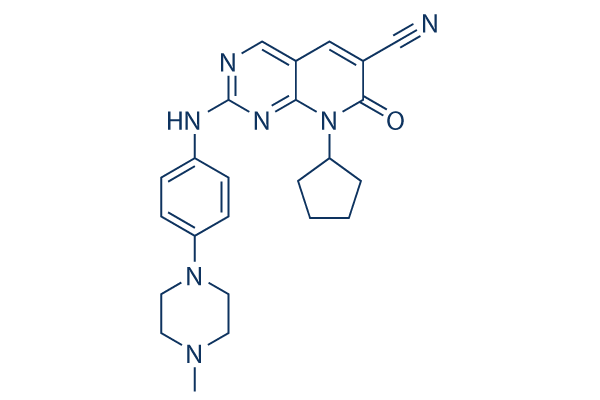
Structure chimique
Poids moléculaire: 429.52
Contrôle Qualité (Quality Control)
Informations chimiques, stockage et stabilité (Chemical Information, Storage & Stability)
| Poids moléculaire | 429.52 | Formule | C24H27N7O |
Stockage (À compter de la date de réception) | |
|---|---|---|---|---|---|
| N° CAS | 1357470-29-1 | Télécharger le SDF | Stockage des solutions mères |
|
|
| Synonymes | N/A | Smiles | CN1CCN(CC1)C2=CC=C(C=C2)NC3=NC=C4C=C(C(=O)N(C4=N3)C5CCCC5)C#N | ||
Solubilité (Solubility)
|
In vitro |
DMSO
: 29 mg/mL
(67.51 mM)
Water : Insoluble Ethanol : Insoluble |
Calculateur de molarité
|
In vivo |
|||||
Calculateur de formulation in vivo (Solution claire)
Étape 1 : Saisir les informations ci-dessous (Recommandé : Un animal supplémentaire pour tenir compte des pertes pendant l'expérience)
Étape 2 : Saisir la formulation in vivo (Ceci est seulement le calculateur, pas la formulation. Veuillez nous contacter d'abord s'il n'y a pas de formulation in vivo dans la section Solubilité.)
Résultats du calcul :
Concentration de travail : mg/ml;
Méthode de préparation du liquide maître DMSO : mg médicament prédissous dans μL DMSO ( Concentration du liquide maître mg/mL, Veuillez nous contacter d'abord si la concentration dépasse la solubilité du DMSO du lot de médicament. )
Méthode de préparation de la formulation in vivo : Prendre μL DMSO liquide maître, puis ajouterμL PEG300, mélanger et clarifier, puis ajouterμL Tween 80, mélanger et clarifier, puis ajouter μL ddH2O, mélanger et clarifier.
Méthode de préparation de la formulation in vivo : Prendre μL DMSO liquide maître, puis ajouter μL Huile de maïs, mélanger et clarifier.
Note : 1. Veuillez vous assurer que le liquide est clair avant d'ajouter le solvant suivant.
2. Assurez-vous d'ajouter le(s) solvant(s) dans l'ordre. Vous devez vous assurer que la solution obtenue, lors de l'ajout précédent, est une solution claire avant de procéder à l'ajout du solvant suivant. Des méthodes physiques telles que le vortex, les ultrasons ou le bain-marie chaud peuvent être utilisées pour faciliter la dissolution.
Mécanisme d'action (Mechanism of Action)
| Targets/IC50/Ki |
CDK4/CyclinD1
(Cell-free assay) 3.87 nM
ARK5
(Cell-free assay) 4.95 nM
RET
(Cell-free assay) 9.2 nM
CDK6/CyclinD1
(Cell-free assay) 9.82 nM
Fyn
(Cell-free assay) 11 nM
PDGFRβ
(Cell-free assay) 26 nM
FGFR1
(Cell-free assay) 26 nM
PI3Kδ
(Cell-free assay) 144 nM
FGFR1
(Cell-free assay) 260 nM
|
|---|---|
| In vitro |
ON123300 inhibits U87 glioma cell proliferation with an IC50 3.4±0.1 μmol/L and reduces phosphorylation of Akt, yet it also unexpectedly induces Erk activation, both in a dose- and time-dependent manner that subsequently is attributed to relieving Akt mediated C-Raf S259 inactivation and activating a p70S6K-initiated PI3K-negative feedback loop. This compound also inhibits CDK4/6 and PI3K-δ and exhibits potent activity against mantle cell lymphomas (MCLs). It is a potent inhibitor of CDK4, with an IC50 of 3.8 nM, with little inhibitory activity against CDKs 1,2,5 and 8. MCL cell lines treated with this chemical accumulate in the G1 phase at lower concentrations (0.1-1.0μM), at higher concentrations of the compound, a large proportion of the cells progress through the S and G2/M phases of the cell cycle and eventually accumulate in the sub-G1 phase, suggesting an induction of apoptosis. It also inhibits the phosphorylation of pRb and p130 in a dose-dependent manner. This treatment results in inhibition of FOXO1 phosphorylation, a target of mTOR. |
| In vivo |
In a preclinical brain tumor model (U87MG), ON123300 shows high brain and brain tumor accumulation. Consistent with the in vitro studies, single agent this compound causes a dose-dependent suppression of phosphorylation of Akt as well as activation of Erk in brain tumors. It is highly bound (99.4%) to plasma proteins in mice and rapidly penetrates into brain. It has proficient BBB penetration and accumulates in normal brain. The pharmacokinetic profiles of plasma this chemical concentration are multiexponential and overall declines fairly rapidly with terminal elimination half-lives of 1.5 hours. Mouse xenograft assays show a strong inhibition of MCL tumor growth in this compound-treated animals. Safety studies in mice suggest that it is orally bio-available and is minimally toxic when administered orally or intraperitoneally. |
Références |
|
Informations sur l'essai clinique (Clinical Trial Information)
(données du https://clinicaltrials.gov, mis à jour le 2023-12-12)
| Numéro NCT | Recrutement | Conditions | Promoteur/Collaborateurs | Date de début | Phases |
|---|---|---|---|---|---|
| NCT05705505 | UNKNOWN | Endometrioid Endometrial Cancer |
Traws Pharma, Inc. |
2023-03-29 | PHASE1; PHASE2 |
| NCT06351644 | TERMINATED | Relapsed and/or Refractory Multiple Myeloma |
Adriana Rossi |
2024-10-02 | PHASE1; PHASE2 |
| NCT04739293 | UNKNOWN | Solid Tumors, Adult |
Traws Pharma, Inc. |
2021-05-13 | PHASE1 |
| NCT06351644 | Not yet recruiting | Relapsed and/or Refractory Multiple Myeloma |
Adriana Rossi|Icahn School of Medicine at Mount Sinai |
2024-06-03 | Phase 1|Phase 2 |
| NCT04739293 | Recruiting | Solid Tumors Adult |
Traws Pharma Inc. |
2021-05-13 | Phase 1 |

Les produits sont destinés à la recherche uniquement. Ne pas utiliser chez l'homme. Nous ne vendons pas aux patients.
©Copyright 2013 Selleck Chemicals. Tous droits réservés.