
pour la recherche uniquement
ONC212 GPR Agoniste
Réf. Catalogue: S8673
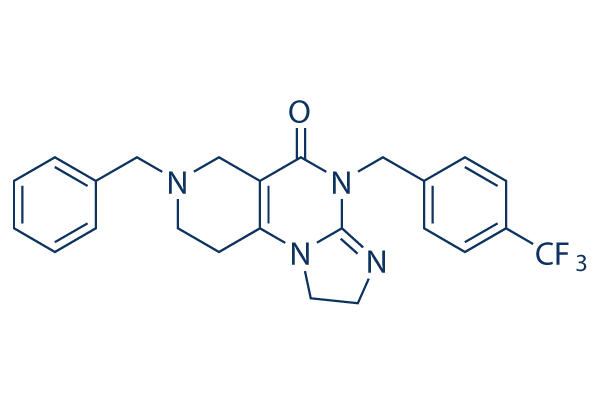
Structure chimique
Poids moléculaire: 440.46
Contrôle Qualité (Quality Control)
- Cité dans Nature Medicine pour sa qualité supérieure
- COA
- NMR
- SDS
- Fiche technique
Informations chimiques, stockage et stabilité (Chemical Information, Storage & Stability)
| Poids moléculaire | 440.46 | Formule | C24H23F3N4O |
Stockage (À compter de la date de réception) | |
|---|---|---|---|---|---|
| N° CAS | 1807861-48-8 | Télécharger le SDF | Stockage des solutions mères |
|
|
| Synonymes | N/A | Smiles | C1CN(CC2=C1N3CCN=C3N(C2=O)CC4=CC=C(C=C4)C(F)(F)F)CC5=CC=CC=C5 | ||
Solubilité (Solubility)
|
In vitro |
DMSO
: 88 mg/mL
(199.79 mM)
Ethanol : 88 mg/mL Water : Insoluble |
Calculateur de molarité
|
In vivo |
|||||
Calculateur de formulation in vivo (Solution claire)
Étape 1 : Saisir les informations ci-dessous (Recommandé : Un animal supplémentaire pour tenir compte des pertes pendant l'expérience)
Étape 2 : Saisir la formulation in vivo (Ceci est seulement le calculateur, pas la formulation. Veuillez nous contacter d'abord s'il n'y a pas de formulation in vivo dans la section Solubilité.)
Résultats du calcul :
Concentration de travail : mg/ml;
Méthode de préparation du liquide maître DMSO : mg médicament prédissous dans μL DMSO ( Concentration du liquide maître mg/mL, Veuillez nous contacter d'abord si la concentration dépasse la solubilité du DMSO du lot de médicament. )
Méthode de préparation de la formulation in vivo : Prendre μL DMSO liquide maître, puis ajouterμL PEG300, mélanger et clarifier, puis ajouterμL Tween 80, mélanger et clarifier, puis ajouter μL ddH2O, mélanger et clarifier.
Méthode de préparation de la formulation in vivo : Prendre μL DMSO liquide maître, puis ajouter μL Huile de maïs, mélanger et clarifier.
Note : 1. Veuillez vous assurer que le liquide est clair avant d'ajouter le solvant suivant.
2. Assurez-vous d'ajouter le(s) solvant(s) dans l'ordre. Vous devez vous assurer que la solution obtenue, lors de l'ajout précédent, est une solution claire avant de procéder à l'ajout du solvant suivant. Des méthodes physiques telles que le vortex, les ultrasons ou le bain-marie chaud peuvent être utilisées pour faciliter la dissolution.
Mécanisme d'action (Mechanism of Action)
| In vitro |
ONC212 shows an anti-proliferative effect in a large panel of pancreatic cancer cell lines with this compound having at least a ten-fold increased potency than ONC201. It induces apoptosis earlier and at lower concentrations than ONC201 in sensitive pancreatic cancer cell lines. This compound exerts potent and prominent apoptogenic effects on acute myeloid leukemia (AML) and mantle cell lymphoma (MCL) cell lines (e.g., ED50s of 141.0 nM in p53 wild-type OCI-AML3 cells, 105.7 nM in MOLM13 cells, and 265.2 nM in p53-null JeKo-1 cell lines). Time course analysis of apoptosis in OCI-AML3 cells shows that it takes more than 36 hours to start to induce apoptosis. This chemical significantly induces Sub-G1 apoptotic cells and/or cell cycle arrest.
|
|---|---|
| In vivo |
ONC212 shows improved efficacy in melanoma and hepatocellular carcinoma xenograft models. This compound has a broad therapeutic window, an acceptable PK profile, and is orally well-tolerated in mice with no evidence of toxicity at efficacious doses in both colon and triple negative breast cancer. It exhibits rapid kinetics of activity. This chemical has a slightly shorter half-life than ONC201, with a clearance from the blood at 12 hours, T1/2 of 4.3 hours, and Cmax of 1.4 mg/mL. It has a prolonged pharmacodynamic effect despite systemic clearance. Oral administration shows potent anti-tumor efficacy in a human melanoma xenograft and hepatocellular model. ONC206 and ONC201 both inhibit invasion and migration of tumor cells while this compound inhibits only invasion.
|
Références |
|

Les produits sont destinés à la recherche uniquement. Ne pas utiliser chez l'homme. Nous ne vendons pas aux patients.
©Copyright 2013 Selleck Chemicals. Tous droits réservés.