
pour la recherche uniquement
Procarbazine HCl DNA/RNA Synthesis Inhibiteur
Réf. Catalogue: S1995
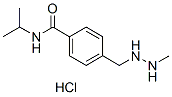
Structure chimique
Poids moléculaire: 257.76
Contrôle Qualité (Quality Control)
| Cibles apparentées | HDAC PARP ATM/ATR DNA-PK WRN Topoisomerase PPAR Sirtuin Casein Kinase eIF |
|---|---|
| Autre DNA/RNA Synthesis Inhibiteurs | CX-5461 (Pidnarulex) SCR7 Favipiravir (T-705) RK-33 EED226 BMH-21 Carmofur Triapine (3-AP) YK-4-279 Halofuginone |
Informations chimiques, stockage et stabilité (Chemical Information, Storage & Stability)
| Poids moléculaire | 257.76 | Formule | C12H19N3O.HCl |
Stockage (À compter de la date de réception) | |
|---|---|---|---|---|---|
| N° CAS | 366-70-1 | Télécharger le SDF | Stockage des solutions mères |
|
|
| Synonymes | NSC-77213 HCl | Smiles | CC(C)NC(=O)C1=CC=C(C=C1)CNNC.Cl | ||
Solubilité (Solubility)
|
In vitro |
Water : 52 mg/mL Ethanol : 52 mg/mL
DMSO
: Insoluble
|
Calculateur de molarité
|
In vivo |
|||||
Calculateur de formulation in vivo (Solution claire)
Étape 1 : Saisir les informations ci-dessous (Recommandé : Un animal supplémentaire pour tenir compte des pertes pendant l'expérience)
Étape 2 : Saisir la formulation in vivo (Ceci est seulement le calculateur, pas la formulation. Veuillez nous contacter d'abord s'il n'y a pas de formulation in vivo dans la section Solubilité.)
Résultats du calcul :
Concentration de travail : mg/ml;
Méthode de préparation du liquide maître DMSO : mg médicament prédissous dans μL DMSO ( Concentration du liquide maître mg/mL, Veuillez nous contacter d'abord si la concentration dépasse la solubilité du DMSO du lot de médicament. )
Méthode de préparation de la formulation in vivo : Prendre μL DMSO liquide maître, puis ajouterμL PEG300, mélanger et clarifier, puis ajouterμL Tween 80, mélanger et clarifier, puis ajouter μL ddH2O, mélanger et clarifier.
Méthode de préparation de la formulation in vivo : Prendre μL DMSO liquide maître, puis ajouter μL Huile de maïs, mélanger et clarifier.
Note : 1. Veuillez vous assurer que le liquide est clair avant d'ajouter le solvant suivant.
2. Assurez-vous d'ajouter le(s) solvant(s) dans l'ordre. Vous devez vous assurer que la solution obtenue, lors de l'ajout précédent, est une solution claire avant de procéder à l'ajout du solvant suivant. Des méthodes physiques telles que le vortex, les ultrasons ou le bain-marie chaud peuvent être utilisées pour faciliter la dissolution.
Mécanisme d'action (Mechanism of Action)
| In vitro |
Procarbazine plus Cu(II) induce piperidine-labile and formamidopyrimidine-DNA glycosylase-sensitive lesions at the 5'-ACG-3' sequence, complementary to a hotspot of the p53 gene, and the 5'-TG-3' sequence. Procarbazine causes DNA damage through non-enzymatic formation of the Cu(I)-hydroperoxo complex and methyl radicals. Procarbazine has a strong clastogenic effect in hematopoietic cells and is mutagenic in a variety organs after high dose treatment. |
|---|---|
| In vivo |
Procarbazine causes significant decrease in testicular and epididymal weight and a drastic reduction in haploid cells and spermatogenic arrest, demonstrating variation among the test golden hamster. Procarbazine produces a dose-dependent potentiation of MAO A in brown adipose tissue, the elevation being more pronounced following monomethylhydrazine, with activity rising to 350% of that in control homogenates in rats. Procarbazine or monomethylhydrazine reduces metabolism of this amine by a similar degree as had been determined ex-vivo in blood vessel homogenates. Procarbazine is mutagenic, clastogenic and teratogenic in a wide range of test systems of varying complexity and a wide-spectrum carcinogen in rodents and monkeys, causing tumours of the haemopoietic system, the mammary gland, the lung and the nervous system. Procarbazine in vivo undergoes a complex series of metabolic changes that result in the generation of a number of chemically reactive species, including methylating agents and free radicals. |
Références |
|
Informations sur l'essai clinique (Clinical Trial Information)
(données du https://clinicaltrials.gov, mis à jour le 2026-09-04)
| Numéro NCT | Recrutement | Conditions | Promoteur/Collaborateurs | Date de début | Phases |
|---|---|---|---|---|---|
| NCT05675410 | RECRUITING | Lugano Classification Limited Stage Hodgkin Lymphoma AJCC v8 |
National Cancer Institute (NCI) |
2023-05-11 | PHASE3 |
| NCT00887146 | ACTIVE_NOT_RECRUITING | Brain and Central Nervous System Tumors |
Alliance for Clinical Trials in Oncology |
2009-09 | PHASE3 |
| NCT06830421 | RECRUITING | Primary Central Nervous System Lymphoma |
University Hospital Freiburg |
2023-08-09 | PHASE3 |
| NCT06541665 | ACTIVE_NOT_RECRUITING | Primary Central Nervous System Lymphoma |
Ono Pharmaceutical Co., Ltd. |
2024-05-17 | PHASE1 |
| NCT07015242 | RECRUITING | Lymphoma |
Juno Therapeutics, Inc., a Bristol-Myers Squibb Company |
2025-11-06 | PHASE2 |
| NCT02315326 | COMPLETED | Adult Patients With Newly Diagnosed or Relapsed or Refractory Primary Central Nervous System Lymphoma (PCNSL); Or Relapsed or Refractory Secondary Central Nervous System Lymphoma (SCNSL) |
Memorial Sloan Kettering Cancer Center |
2014-12-08 | PHASE1; PHASE2 |

Les produits sont destinés à la recherche uniquement. Ne pas utiliser chez l'homme. Nous ne vendons pas aux patients.
©Copyright 2013 Selleck Chemicals. Tous droits réservés.