
pour la recherche uniquement
Sitagliptin DPP Inhibiteur
Réf. Catalogue: S5079
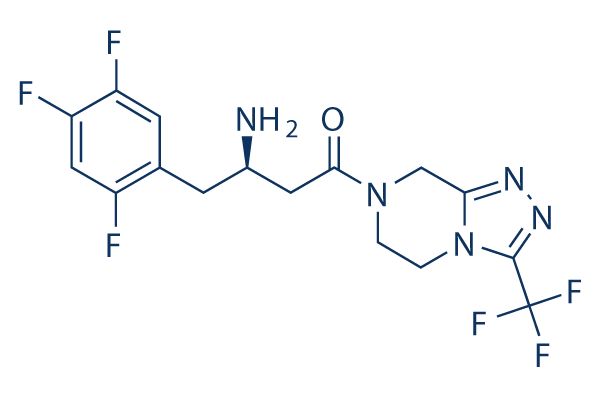
Structure chimique
Poids moléculaire: 407.31
Contrôle Qualité (Quality Control)
Informations chimiques, stockage et stabilité (Chemical Information, Storage & Stability)
| Poids moléculaire | 407.31 | Formule | C16H15F6N5O |
Stockage (À compter de la date de réception) | |
|---|---|---|---|---|---|
| N° CAS | 486460-32-6 | -- | Stockage des solutions mères |
|
|
| Synonymes | MK-0431 | Smiles | C1CN2C(=NN=C2C(F)(F)F)CN1C(=O)CC(CC3=CC(=C(C=C3F)F)F)N | ||
Solubilité (Solubility)
|
In vitro |
DMSO
: 81 mg/mL
(198.86 mM)
Ethanol : 81 mg/mL Water : 5 mg/mL (Ultrasonic and heating for 10 minutes, at 60℃.) |
Calculateur de molarité
|
In vivo |
|||||
Calculateur de formulation in vivo (Solution claire)
Étape 1 : Saisir les informations ci-dessous (Recommandé : Un animal supplémentaire pour tenir compte des pertes pendant l'expérience)
Étape 2 : Saisir la formulation in vivo (Ceci est seulement le calculateur, pas la formulation. Veuillez nous contacter d'abord s'il n'y a pas de formulation in vivo dans la section Solubilité.)
Résultats du calcul :
Concentration de travail : mg/ml;
Méthode de préparation du liquide maître DMSO : mg médicament prédissous dans μL DMSO ( Concentration du liquide maître mg/mL, Veuillez nous contacter d'abord si la concentration dépasse la solubilité du DMSO du lot de médicament. )
Méthode de préparation de la formulation in vivo : Prendre μL DMSO liquide maître, puis ajouterμL PEG300, mélanger et clarifier, puis ajouterμL Tween 80, mélanger et clarifier, puis ajouter μL ddH2O, mélanger et clarifier.
Méthode de préparation de la formulation in vivo : Prendre μL DMSO liquide maître, puis ajouter μL Huile de maïs, mélanger et clarifier.
Note : 1. Veuillez vous assurer que le liquide est clair avant d'ajouter le solvant suivant.
2. Assurez-vous d'ajouter le(s) solvant(s) dans l'ordre. Vous devez vous assurer que la solution obtenue, lors de l'ajout précédent, est une solution claire avant de procéder à l'ajout du solvant suivant. Des méthodes physiques telles que le vortex, les ultrasons ou le bain-marie chaud peuvent être utilisées pour faciliter la dissolution.
Mécanisme d'action (Mechanism of Action)
| Targets/IC50/Ki |
DPP-4
(Cell-free) 18 nM
|
|---|---|
| In vitro |
Sitagliptin exhibits a > 2600-fold margin of selectivity against DPP8, DPP9, and other members of the dipeptidyl peptidase family (i.e., potency against DPP-4 vs. DPP8/9). This compound reduces in vitro migration of isolated splenic CD4 T-cells through a pathway involving cAMP/PKA/Rac1 activation. It exerts a novel, direct action in order to stimulate GLP-1 secretion by the intestinal L cell through a DPP-4-independent, protein kinase A- and MEK-ERK1/2-dependent pathway. It therefore reduces the effect of autoimmunity on graft survival.
|
| In vivo |
Sitagliptin is well absorbed after oral administration with a bioavailability of 87%. It has an apparent terminal half-life of 10–12 h at doses of 25-100 mg and is excreted mainly (≈ 80%) as unchanged compound by the kidneys. This compound does not interfere with the P450 cytochrome enzymes nor have there been any reported significant drug-drug interactions. It has been shown to inhibit DPP-4 activity by > 90% within 1-2 h of administration. It has a short half-life in mice (1-2 h). Chronic sitagliptin treatment in a non-geneticmouse model of type 2 diabetes elicits significant improvement in glycemic control. The improved glucose homeostasis correlates with restoration of normal islet cell (α and β cells) mass, architecture and insulin secretion capacity in response to glucose stimulation. This compound prolongs islet graft survival in streptozotocin-induced and NOD mice. Administration of this chemical in vivo reduces lymph node and splenic CD4+ T-cell migration, measured in vitro, via incretin- and nonincretin-mediated effects, respectively, and splenic sDPP-IV-responsive CD4+ T-cells and lymph node incretin nonresponsive CD4+ T-cells selectively infiltrated islets of diabetic NOD mice, after tail vein injection. It significantly suppressed epileptogenesis in PTZ (pentylenetetrazole)-induced seizures. This compound counteracted neuronal damage and all biochemical, and histo-chemical alteration induced by PTZ. Oral sitagliptin can promote hippocampal neurogenesis, counteract hippocampal oxidative stress, and prevent the decline in mice cognition.
|
Références |
|
Informations sur l'essai clinique (Clinical Trial Information)
(données du https://clinicaltrials.gov, mis à jour le 2026-02-18)
| Numéro NCT | Recrutement | Conditions | Promoteur/Collaborateurs | Date de début | Phases |
|---|---|---|---|---|---|
| NCT06813014 | NOT_YET_RECRUITING | Diabetes |
University of Maryland, Baltimore |
2026-12 | PHASE4 |
| NCT07365592 | RECRUITING | Colorectal Cancer |
Second Affiliated Hospital, Zhejiang University, School of Medicine |
2026-04-09 | PHASE1; PHASE2 |
| NCT07108985 | NOT_YET_RECRUITING | Diabetes Mellitus, Type 2; Hyperglycemia; Insulin Resistance |
Yonsei University |
2025-09 | PHASE4 |
| NCT07541781 | RECRUITING | Glioma; Glioblastoma; Recurrent Glioma; Recurrent Glioblastoma; Grade 4 Malignant Glioma of Brain (Disorder) |
Kailin Yang, MD, PhD |
2026-06-11 | PHASE1 |
| NCT06246799 | RECRUITING | Type 2 Diabetes (Adult Onset) |
The University of Texas Health Science Center at San Antonio |
2024-11-07 | PHASE3 |
| NCT07804381 | NOT_YET_RECRUITING | Parkinson Disease |
Yonsei University |
2026-12-15 | PHASE2 |

Les produits sont destinés à la recherche uniquement. Ne pas utiliser chez l'homme. Nous ne vendons pas aux patients.
©Copyright 2013 Selleck Chemicals. Tous droits réservés.