
pour la recherche uniquement
TBHQ Nrf2 Activateur
Réf. Catalogue: S4990
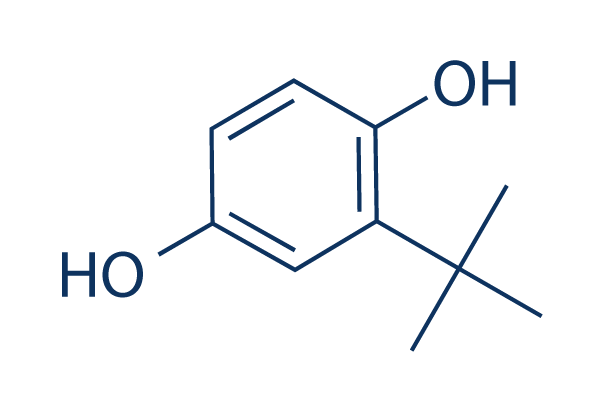
Structure chimique
Poids moléculaire: 166.22
Contrôle Qualité (Quality Control)
| Cibles apparentées | PD-1/PD-L1 CXCR STING AhR Immunology & Inflammation related CD markers Interleukins Anti-infection Antioxidant COX |
|---|---|
| Autre Nrf2 Inhibiteurs | Bardoxolone Methyl (RTA 402) ML385 Sulforaphane Brusatol Oltipraz Bardoxolone (CDDO) 4-Octyl Itaconate (4-OI) KI696 Mangiferin CDDO-Im (RTA-403) |
Informations chimiques, stockage et stabilité (Chemical Information, Storage & Stability)
| Poids moléculaire | 166.22 | Formule | C10H14O2 |
Stockage (À compter de la date de réception) | |
|---|---|---|---|---|---|
| N° CAS | 1948-33-0 | -- | Stockage des solutions mères |
|
|
| Synonymes | Tert-butylhydroquinone | Smiles | CC(C)(C)C1=C(C=CC(=C1)O)O | ||
Solubilité (Solubility)
|
In vitro |
DMSO
: 33 mg/mL
(198.53 mM)
Ethanol : 33 mg/mL Water : 4 mg/mL |
Calculateur de molarité
|
In vivo |
|||||
Calculateur de formulation in vivo (Solution claire)
Étape 1 : Saisir les informations ci-dessous (Recommandé : Un animal supplémentaire pour tenir compte des pertes pendant l'expérience)
Étape 2 : Saisir la formulation in vivo (Ceci est seulement le calculateur, pas la formulation. Veuillez nous contacter d'abord s'il n'y a pas de formulation in vivo dans la section Solubilité.)
Résultats du calcul :
Concentration de travail : mg/ml;
Méthode de préparation du liquide maître DMSO : mg médicament prédissous dans μL DMSO ( Concentration du liquide maître mg/mL, Veuillez nous contacter d'abord si la concentration dépasse la solubilité du DMSO du lot de médicament. )
Méthode de préparation de la formulation in vivo : Prendre μL DMSO liquide maître, puis ajouterμL PEG300, mélanger et clarifier, puis ajouterμL Tween 80, mélanger et clarifier, puis ajouter μL ddH2O, mélanger et clarifier.
Méthode de préparation de la formulation in vivo : Prendre μL DMSO liquide maître, puis ajouter μL Huile de maïs, mélanger et clarifier.
Note : 1. Veuillez vous assurer que le liquide est clair avant d'ajouter le solvant suivant.
2. Assurez-vous d'ajouter le(s) solvant(s) dans l'ordre. Vous devez vous assurer que la solution obtenue, lors de l'ajout précédent, est une solution claire avant de procéder à l'ajout du solvant suivant. Des méthodes physiques telles que le vortex, les ultrasons ou le bain-marie chaud peuvent être utilisées pour faciliter la dissolution.
Mécanisme d'action (Mechanism of Action)
| Targets/IC50/Ki |
Nrf2
|
|---|---|
| In vitro |
Tert-butylhydroquinone (tBHQ) is a metabolite of the chemical compound butylated hydroxyanisole and induces Nrf2 activation and conveys protection against hydrogen peroxide, 6-hydroxydopamine, the pesticidal deltamethrin, and other toxicants. This compound preferentially alters the redox status in the mitochondrial compartment in HeLa cells. HeLa cells treated with this chemical show a preferential oxidation of mitochondrial thioredoxin-2 (Trx2), while cellular glutathione and cytosolic thioredoxin-1 are not affected. In cultured H9c2 cells and primary cardiac myocytes, it stimulates Akt phosphorylation and suppresses oxidant-induced apoptosis.
|
| In vivo |
TBHQ treatment elicits significant cytoprotective actions in different organs under pathological conditions. Systemic or local intra-cerebroventricular treatment with this compound in an ischemic stroke model in rats significantly reduces the infarct size and neurological deficits. Administration of this chemical in rats suppresses renal damage and oxidative stress after ischemia and reperfusion injury. In mice with type 1 diabetes, chronic treatment with this compound significantly reduces the degree of glomerular fibrosis and ameliorates proteinuria. This compound prevents left ventricular dilatation and cardiac dysfunction induced by transverse aortic constriction (TAC), and decreases the prevalence of myocardial apoptosis. The beneficial effects of this chemical are associated with an increase in Akt activation, but not related to activations of Nrf2 or AMP-activated protein kinase. This compound-induced Akt activation is accompanied by increased phosphorylation of Bad, glycogen synthase kinase-3β (GSK-3β) and mammalian target of rapamycin (mTOR).
|
Références |
|
Applications (Applications)
| Méthodes | Biomarqueurs | Images | PMID |
|---|---|---|---|
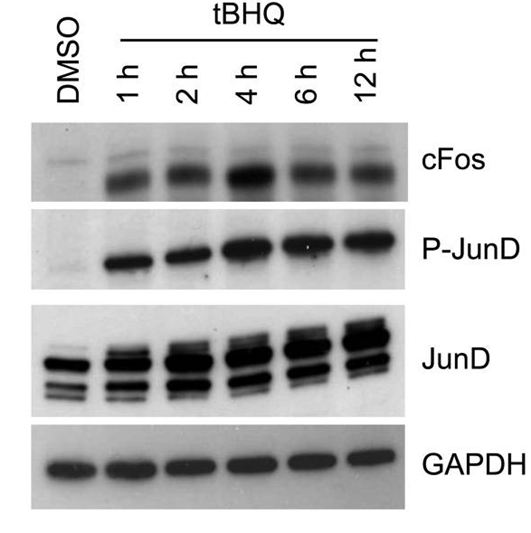
| Western blot | c-Fos / p-JunD / JunD p-JNK / JNK / p-ERK / ERK p-AKT / AKT α-Nrf2 / α-AKR1C1 |
|
24830941 |
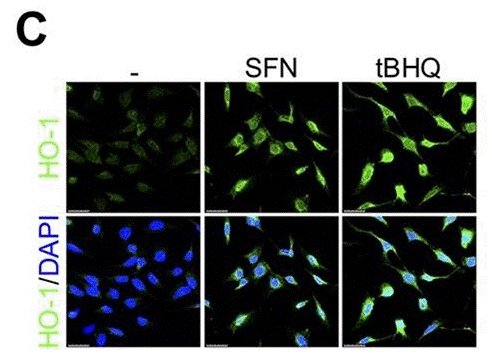
| Immunofluorescence | HO-1 |
|
31333462 |

Les produits sont destinés à la recherche uniquement. Ne pas utiliser chez l'homme. Nous ne vendons pas aux patients.
©Copyright 2013 Selleck Chemicals. Tous droits réservés.