
pour la recherche uniquement
Evofosfamide (TH-302)
Réf. Catalogue: S2757
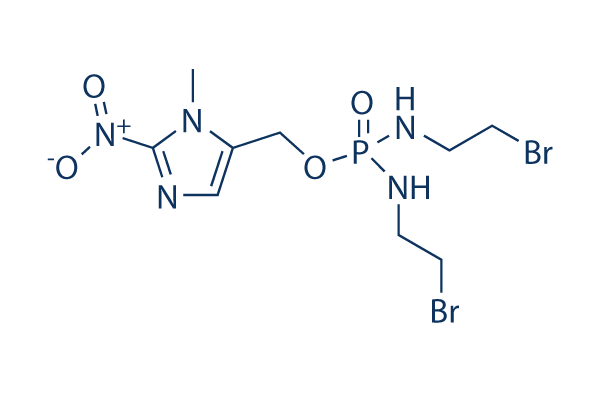
Structure chimique
Poids moléculaire: 449.04
Contrôle Qualité (Quality Control)
Culture cellulaire, traitement et concentration de travail
(Cell Culture, Treatment & Working Concentration)
| Lignées cellulaires | Type d'essai | Concentration | Temps d'incubation | Formulation | Description de l'activité | PMID |
|---|---|---|---|---|---|---|
| H460 | Cytotoxicity assay | 2 hrs | Cytotoxicity against human H460 cells under hypoxic condition after 2 hrs by Alamar blue staining assay, IC50=0.019μM. | 18257544 | ||
| H460 | Cytotoxicity assay | 2 hrs | Cytotoxicity against human H460 cells under hypoxic condition after 2 hrs by clonogenic assay, IC90=0.1μM. | 18257544 | ||
| HT29 | Cytotoxicity assay | 2 hrs | Cytotoxicity against human HT29 cells under hypoxic condition after 2 hrs by clonogenic assay, IC90=0.2μM. | 18257544 | ||
| H460 | Cytotoxicity assay | 2 hrs | Cytotoxicity against human H460 cells under normoxic condition after 2 hrs by Alamar blue staining assay, IC50=5.1μM. | 18257544 | ||
| H460 | Cytotoxicity assay | 2 hrs | Cytotoxicity against human H460 cells under normoxic condition after 2 hrs by clonogenic assay, IC90=30μM. | 18257544 | ||
| HT29 | Cytotoxicity assay | 2 hrs | Cytotoxicity against human HT29 cells under normoxic condition after 2 hrs by clonogenic assay, IC90=40μM. | 18257544 | ||
| NCI-H460 | Cytotoxicity assay | 24 hrs | Cytotoxicity against human NCI-H460 cells pretreated for 24 hrs under hypoxic condition followed by compound washout measured after 72 hrs by MTT assay, IC50=9.08μM. | 28350997 | ||
| HT-29 | Cytotoxicity assay | 24 hrs | Cytotoxicity against human HT-29 cells pretreated for 24 hrs under hypoxic condition followed by compound washout measured after 72 hrs by MTT assay, IC50=49.51μM. | 28350997 | ||
| NCI-H460 | Cytotoxicity assay | 24 hrs | Cytotoxicity against human NCI-H460 cells after 24 hrs under hypoxic condition by luminescence-based Cell-Titer Glo assay, IC50=0.0093μM. | 29079474 | ||
| NCI-H460 | Cytotoxicity assay | 24 hrs | Cytotoxicity against human NCI-H460 cells after 24 hrs under normoxic condition by luminescence-based Cell-Titer Glo assay, IC50=6.65μM. | 29079474 | ||
| DU145 | Cytotoxicity assay | 2 hrs | Cytotoxicity against human DU145 cells incubated for 2 hrs under hypoxic condition measured after 72 hrs by Alamar blue assay, IC50=4.14μM. | 29259746 | ||
| PC3 | Cytotoxicity assay | 2 hrs | Cytotoxicity against human PC3 cells incubated for 2 hrs under hypoxic condition measured after 72 hrs by Alamar blue assay, IC50=6.49μM. | 29259746 | ||
| HEMC-SS | Antiproliferative assay | 24 hrs | Antiproliferative activity against human HEMC-SS cells treated for 24 hrs under hypoxic condition followed by compound wash-out and incubated under normoxic condition for 48 hrs by alamar blue assay, IC50=0.13μM. | 30199705 | ||
| HEMC-SS | Antiproliferative assay | 24 hrs | Antiproliferative activity against human HEMC-SS cells treated for 24 hrs under normoxic condition followed by compound wash-out and incubated under normoxic condition for 48 hrs by alamar blue assay, IC50=2.9μM. | 30199705 | ||
| NCI-H460 | Antiproliferative assay | Antiproliferative activity against human NCI-H460 cells in presence of N2, IC50=2μM. | 30295477 | |||
| NCI-H460 | Antiproliferative assay | Antiproliferative activity against human NCI-H460 cells in presence of O2, IC50=25μM. | 30295477 | |||
| MDA-MB-468 | Cytotoxicity assay | 4 hrs | Cytotoxicity against human MDA-MB-468 cells incubated for 4 hrs under hypoxic condition followed by compound washout and measured after 5 days by SRB assay, IC50=0.0062μM. | 30885680 | ||
| SW620 | Cytotoxicity assay | 4 hrs | Cytotoxicity against human SW620 cells incubated for 4 hrs under hypoxic condition followed by compound washout and measured after 5 days by SRB assay, IC50=0.052μM. | 30885680 | ||
| MDA-MB-468 | Cytotoxicity assay | 4 hrs | Cytotoxicity against human MDA-MB-468 cells incubated for 4 hrs under aerobic condition followed by compound washout and measured after 5 days by SRB assay, IC50=4.403μM. | 30885680 | ||
| SW620 | Cytotoxicity assay | 4 hrs | Cytotoxicity against human SW620 cells incubated for 4 hrs under aerobic condition followed by compound washout and measured after 5 days by SRB assay, IC50=20.6μM. | 30885680 | ||
| Cliquez pour voir plus de données expérimentales sur la lignée cellulaire | ||||||
Informations chimiques, stockage et stabilité (Chemical Information, Storage & Stability)
| Poids moléculaire | 449.04 | Formule | C9H16Br2N5O4P |
Stockage (À compter de la date de réception) | |
|---|---|---|---|---|---|
| N° CAS | 918633-87-1 | Télécharger le SDF | Stockage des solutions mères |
|
|
Solubilité (Solubility)
|
In vitro |
DMSO
: 90 mg/mL
(200.42 mM)
Ethanol : 90 mg/mL Water : 10 mg/mL |
Calculateur de molarité
|
In vivo |
|||||
Calculateur de formulation in vivo (Solution claire)
Étape 1 : Saisir les informations ci-dessous (Recommandé : Un animal supplémentaire pour tenir compte des pertes pendant l'expérience)
Étape 2 : Saisir la formulation in vivo (Ceci est seulement le calculateur, pas la formulation. Veuillez nous contacter d'abord s'il n'y a pas de formulation in vivo dans la section Solubilité.)
Résultats du calcul :
Concentration de travail : mg/ml;
Méthode de préparation du liquide maître DMSO : mg médicament prédissous dans μL DMSO ( Concentration du liquide maître mg/mL, Veuillez nous contacter d'abord si la concentration dépasse la solubilité du DMSO du lot de médicament. )
Méthode de préparation de la formulation in vivo : Prendre μL DMSO liquide maître, puis ajouterμL PEG300, mélanger et clarifier, puis ajouterμL Tween 80, mélanger et clarifier, puis ajouter μL ddH2O, mélanger et clarifier.
Méthode de préparation de la formulation in vivo : Prendre μL DMSO liquide maître, puis ajouter μL Huile de maïs, mélanger et clarifier.
Note : 1. Veuillez vous assurer que le liquide est clair avant d'ajouter le solvant suivant.
2. Assurez-vous d'ajouter le(s) solvant(s) dans l'ordre. Vous devez vous assurer que la solution obtenue, lors de l'ajout précédent, est une solution claire avant de procéder à l'ajout du solvant suivant. Des méthodes physiques telles que le vortex, les ultrasons ou le bain-marie chaud peuvent être utilisées pour faciliter la dissolution.
Mécanisme d'action (Mechanism of Action)
| In vitro |
Evofosfamide (TH-302) is selectively potent under hypoxia and stable to liver microsomes. Substitution of the chlorine with bromine on the phosphorus mustard in 3b increases the potency by 10-fold and maintaines the high hypoxic selectivity [Hypoxia cytotoxicity ratio (HCR) = 270]. In both human lung cancer H460 cells and human colon cancer HT29 cells, potent cytotoxicity of this compound is observed under N2. It inhibits H460 cells and HT29 cells with IC90 of 0.1 μM and 0.2 μM, respectively. It shows much enhanced potency in H460 spheroids compared to H460 monolayer cells under normoxia. This compound exhibits potent cytotoxicity to MM cells with hypoxic selectivity and dose dependency. It can induce G0/G1 cell-cycle arrest under hypoxic conditions. The effect of it on cell-cycle machinery is mediated by down-regulating cyclin D1/2/3, CDK4/6, p21cip-1, p27kip-1, and pRb expression, whereas CDK2 expression remained undisturbed. It can induce dose-dependent apoptosis in both human and murine MM cells in hypoxic conditions. TH-302-activated apoptosis is mediated through down-regulating the antiapoptotic proteins BCL-2 and BCL-xL, as well as up-regulating the expression of cleaved proapoptotic protein caspase-3, -8, and -9 and poly ADP-ribose polymerase. In contrast to the hypoxia-specific toxicity, it shows very low toxicity in normoxic condition, even at high concentrations. |
|---|---|
| In vivo |
Evofosfamide (TH-302) inhibits primary tumor growth by 41% on day 25 after implantation, whereas this compound plus a nucleoside analog inhibits primary tumor growth by 96% on day 25. When administered at 6.25, 12.5, 25, or 50 mg/kg in the H460 NSCLC xenograft model QD × 5/wk × 2 wks (once a day for 5 days per week for 2 weeks) i.p., it shows tumor growth inhibition at Day 22 of 43%, 51%, 75%, and 89%, respectively. At 100 mg/kg, it causes a decrease in blood cell counts 3 days after treatment end, but these are totally recovered 7 days post-treatment. Under all tested regimens, it exhibits efficacy metrics ranging from 58% to 89% tumor growth inhibition. Its induced cell killing is breathing oxygen concentration dependent, with the greatest cytotoxicity occurring when the tumor-bearing mice are exposed to low oxygen concentrations. Tumor growth is significantly reduced by this compound in animals breathing 10% O2 compared with 95% O2 breathing. After treatment, the pimonidazole-positive area is significantly decreased at 48 hours after dosing (6.3 % in vehicle vs. 1.8 % in the TH-302 treatment group). |
Références |
|
Informations sur l'essai clinique (Clinical Trial Information)
(données du https://clinicaltrials.gov, mis à jour le 2026-01-28)
| Numéro NCT | Recrutement | Conditions | Promoteur/Collaborateurs | Date de début | Phases |
|---|---|---|---|---|---|
| NCT06836726 | NOT_YET_RECRUITING | Castration Resistant Prostate Cancer |
University Health Network, Toronto |
2026-05-27 | PHASE2 |
| NCT06782555 | RECRUITING | Metastatic Prostate Cancer; Metastatic Head and Neck Squamous Cell Carcinoma; Metastatic Pancreatic Cancer |
ImmunoGenesis |
2025-01-08 | PHASE1; PHASE2 |
| NCT02342379 | COMPLETED | Glioblastoma |
The University of Texas Health Science Center at San Antonio |
2015-05 | PHASE2 |
| NCT03098160 | UNKNOWN | Pancreatic Cancer; Melanoma; Squamous Cell Carcinoma of the Head and Neck; Prostate Cancer |
Threshold Pharmaceuticals |
2017-05-10 | PHASE1 |
| NCT02402062 | COMPLETED | Neuroendocrine Tumors; Pancreatic Neoplasms |
Grupo Espanol de Tumores Neuroendocrinos |
2015-05-11 | PHASE2 |
| NCT02433639 | COMPLETED | Biliary Tract Cancer |
Seoul National University Hospital |
2015-04 | PHASE2 |

Les produits sont destinés à la recherche uniquement. Ne pas utiliser chez l'homme. Nous ne vendons pas aux patients.
©Copyright 2013 Selleck Chemicals. Tous droits réservés.