
pour la recherche uniquement
Thiostrepton
Réf. Catalogue: S4354
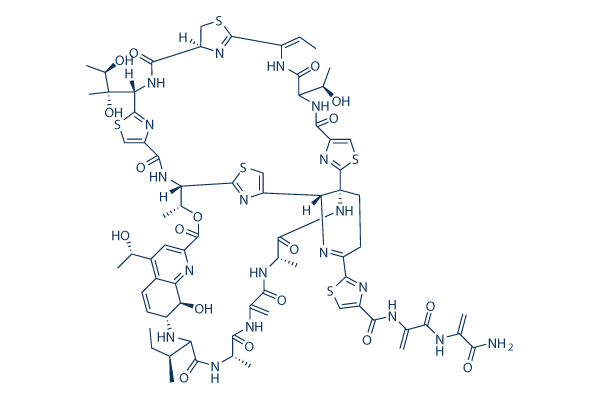
Structure chimique
Poids moléculaire: 1664.89
Contrôle Qualité (Quality Control)
Informations chimiques, stockage et stabilité (Chemical Information, Storage & Stability)
| Poids moléculaire | 1664.89 | Formule | C72H85N19O18S5 |
Stockage (À compter de la date de réception) | |
|---|---|---|---|---|---|
| N° CAS | 1393-48-2 | Télécharger le SDF | Stockage des solutions mères |
|
|
| Synonymes | Alaninamide, Bryamycin, Thiactin | Smiles | CCC(C)C1C(=O)NC(C(=O)NC(=C)C(=O)NC(C(=O)NC23CCC(=NC2C4=CSC(=N4)C(C(OC(=O)C5=NC6=C(C=CC(C6O)N1)C(=C5)C(C)O)C)NC(=O)C7=CSC(=N7)C(NC(=O)C8CSC(=N8)C(=CC)NC(=O)C(NC(=O)C9=CSC3=N9)C(C)O)C(C)(C(C)O)O)C1=NC(=CS1)C(=O)NC(=C)C(=O)NC(=C)C(=O)N)C)C | ||
Solubilité (Solubility)
|
In vitro |
|
Calculateur de molarité
|
In vivo |
|||||
Calculateur de formulation in vivo (Solution claire)
Étape 1 : Saisir les informations ci-dessous (Recommandé : Un animal supplémentaire pour tenir compte des pertes pendant l'expérience)
Étape 2 : Saisir la formulation in vivo (Ceci est seulement le calculateur, pas la formulation. Veuillez nous contacter d'abord s'il n'y a pas de formulation in vivo dans la section Solubilité.)
Résultats du calcul :
Concentration de travail : mg/ml;
Méthode de préparation du liquide maître DMSO : mg médicament prédissous dans μL DMSO ( Concentration du liquide maître mg/mL, Veuillez nous contacter d'abord si la concentration dépasse la solubilité du DMSO du lot de médicament. )
Méthode de préparation de la formulation in vivo : Prendre μL DMSO liquide maître, puis ajouterμL PEG300, mélanger et clarifier, puis ajouterμL Tween 80, mélanger et clarifier, puis ajouter μL ddH2O, mélanger et clarifier.
Méthode de préparation de la formulation in vivo : Prendre μL DMSO liquide maître, puis ajouter μL Huile de maïs, mélanger et clarifier.
Note : 1. Veuillez vous assurer que le liquide est clair avant d'ajouter le solvant suivant.
2. Assurez-vous d'ajouter le(s) solvant(s) dans l'ordre. Vous devez vous assurer que la solution obtenue, lors de l'ajout précédent, est une solution claire avant de procéder à l'ajout du solvant suivant. Des méthodes physiques telles que le vortex, les ultrasons ou le bain-marie chaud peuvent être utilisées pour faciliter la dissolution.
Mécanisme d'action (Mechanism of Action)
| In vitro |
Thiostrepton inhibits growth of the parasite in the micromolar range which is 10-fold below concentrations with observable effects on total protein synthesis. This compound results in disappearance of organellar-encoded RNA transcripts within 6 hours of treatment while transcripts of a nuclear-encoded mRNA remain constant for at least 8 hous of treatment. It directly interacts with two nucleotides in the GTPase domain of Escherichia coli. This chemical directly interacts the region around position 1067 in domain II of 23S rRNA inhibits GTP hydrolysis by elongation factor G (EF-G) on the ribosome at the conditions of multiple turnover. It interferes with EF-G footprints in the alpha-sarcin stem loop (A2660, A2662) located in domain VI of 23S rRNA. The compound interacts with a 58-nucleotide domain of large subunit ribosomal RNA, and binds to the ribosome cooperatively with Ribosomal protein L11. Its and RNA recognition cooperativity can be attributed to N- and C-terminal domains of L11, respectively. It binds primarily to 23 S rRNA, thus probably inhibits peptide elongation by impeding a conformational change within protein L11 that is important for the function of the ribosomal GTPase centre. Treatment with this compound (10 μM) reduces FOXM1 expression in a time- and dose-dependent manner, independent of de novo protein synthesis and predominantly at transcriptional and gene promoter levels. It (10 μM) induces cell cycle arrest at G(1) and S phases and cell death, concomitant with FOXM1 repression in breast cancer cells. This agent (10 μM) also shows efficacy in repressing breast cancer cell migration, metastasis, and transformation, which are all downstream functional attributes of FOXM1.
|
Références |
|
|---|

Les produits sont destinés à la recherche uniquement. Ne pas utiliser chez l'homme. Nous ne vendons pas aux patients.
©Copyright 2013 Selleck Chemicals. Tous droits réservés.