
pour la recherche uniquement
Valdecoxib COX Inhibiteur
Réf. Catalogue: S4049
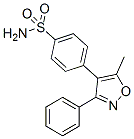
Structure chimique
Poids moléculaire: 314.36
Contrôle Qualité (Quality Control)
- Cité dans Nature Medicine pour sa qualité supérieure
- COA
- NMR
- SDS
- Fiche technique
Informations chimiques, stockage et stabilité (Chemical Information, Storage & Stability)
| Poids moléculaire | 314.36 | Formule | C16H14N2O3S |
Stockage (À compter de la date de réception) | |
|---|---|---|---|---|---|
| N° CAS | 181695-72-7 | Télécharger le SDF | Stockage des solutions mères |
|
|
| Synonymes | N/A | Smiles | CC1=C(C(=NO1)C2=CC=CC=C2)C3=CC=C(C=C3)S(=O)(=O)N | ||
Solubilité (Solubility)
|
In vitro |
DMSO
: 63 mg/mL
(200.4 mM)
Ethanol : 18 mg/mL Water : Insoluble |
Calculateur de molarité
|
In vivo |
|||||
Calculateur de formulation in vivo (Solution claire)
Étape 1 : Saisir les informations ci-dessous (Recommandé : Un animal supplémentaire pour tenir compte des pertes pendant l'expérience)
Étape 2 : Saisir la formulation in vivo (Ceci est seulement le calculateur, pas la formulation. Veuillez nous contacter d'abord s'il n'y a pas de formulation in vivo dans la section Solubilité.)
Résultats du calcul :
Concentration de travail : mg/ml;
Méthode de préparation du liquide maître DMSO : mg médicament prédissous dans μL DMSO ( Concentration du liquide maître mg/mL, Veuillez nous contacter d'abord si la concentration dépasse la solubilité du DMSO du lot de médicament. )
Méthode de préparation de la formulation in vivo : Prendre μL DMSO liquide maître, puis ajouterμL PEG300, mélanger et clarifier, puis ajouterμL Tween 80, mélanger et clarifier, puis ajouter μL ddH2O, mélanger et clarifier.
Méthode de préparation de la formulation in vivo : Prendre μL DMSO liquide maître, puis ajouter μL Huile de maïs, mélanger et clarifier.
Note : 1. Veuillez vous assurer que le liquide est clair avant d'ajouter le solvant suivant.
2. Assurez-vous d'ajouter le(s) solvant(s) dans l'ordre. Vous devez vous assurer que la solution obtenue, lors de l'ajout précédent, est une solution claire avant de procéder à l'ajout du solvant suivant. Des méthodes physiques telles que le vortex, les ultrasons ou le bain-marie chaud peuvent être utilisées pour faciliter la dissolution.
Mécanisme d'action (Mechanism of Action)
| Caractéristiques |
Valdecoxib is more potent in inhibiting COX-2 than COX-1.
|
|---|---|
| Targets/IC50/Ki |
COX-2
5 nM
|
| In vitro |
Valdecoxib inhibits LPS-induced PGE2 production in plasma with IC50 of 0.89 μM for assessment of the extent of COX-2 inhibition. This compound inhibits TxB2 production in plasma with IC50 of 25.4 μM for assessment of the extent of COX-1 inhibition. It binds to COX-2 with Ka of 1.1×10⁵ M/s. The overall saturation binding affinity for COX-2 of this chemical is 2.6 nM. It shows similar activity in the human whole-blood COX assay (COX-2 IC50 = 0.24 μM; COX-1 IC50 = 21.9 μM). The affinity of [3H]Valdecoxib for COX-2 with KD of 3.2 nM. The binding of this compound to COX-2 seems to be both rapid and slowly reversible with association rates of 4.5 × 10⁶/M/min and dissociation rates of 7.0 × 10⁻³/min (t1/2 of 98 min). The percent of dissolved this chemical at 15 min (DP15) is 10.5% for Valdecoxib and 50%, 91% and 93% for its hydrophilic derivatives (VALD-βCd, VALD-HPβCd and VALD-SBE7βCd complexes), respectively.
|
| In vivo |
Valdecoxib administrated orally inhibits rat carrageenan foot pad edema with ED50 of 10.2 mg/kg. This compound administrated orally shows chronic antiinflammatory activity with ED50 of 0.032 mg/kg/day in rat adjuvant arthritis model. It shows blockade of prostaglandin production at the inflammatory site with ED50 of 0.02 mg/kg in the rat carrageenan air pouch model. This chemical demonstrates marked potency in acute and chronic models of inflammation (air pouch ED50 = 0.06 mg/kg; paw edema ED50 = 5.9 mg/kg; adjuvant arthritis ED50 = 0.03 mg/kg) in rats. It alone shows slow in vivo absorption giving maximum % inhibition of edema (16%) after a period of 3 hour. In contrast, VALD-βCd and VALD-SBE7βCd complexes shows high absorption rate in vivo achieving more than 50% inhibition of edema in the 1 hour and maximum percentage of inhibition of edema (66%) after a period of 3 hours. This compound (5 mg/kg, po) results in AUC in plasma of 3.58 μg*h/mL and 2.08 μg*h/mL in males and female mice, respectively. It (5 mg/kg, po) results in AUC red blood cells of 12.1 μg*h/mL and 6.42 μg*h/mL in males and female mice, respectively.
|
Références |
|
Informations sur l'essai clinique (Clinical Trial Information)
(données du https://clinicaltrials.gov, mis à jour le 2024-05-22)
| Numéro NCT | Recrutement | Conditions | Promoteur/Collaborateurs | Date de début | Phases |
|---|---|---|---|---|---|
| NCT00122096 | Completed | Neurosurgery|Pain |
University of Washington|Pfizer |
2002-11 | Phase 4 |

Les produits sont destinés à la recherche uniquement. Ne pas utiliser chez l'homme. Nous ne vendons pas aux patients.
©Copyright 2013 Selleck Chemicals. Tous droits réservés.