
pour la recherche uniquement
Vinblastine sulfate Antineoplastic and Immunosuppressive Antibiotics Inhibiteur
Réf. Catalogue: S4505
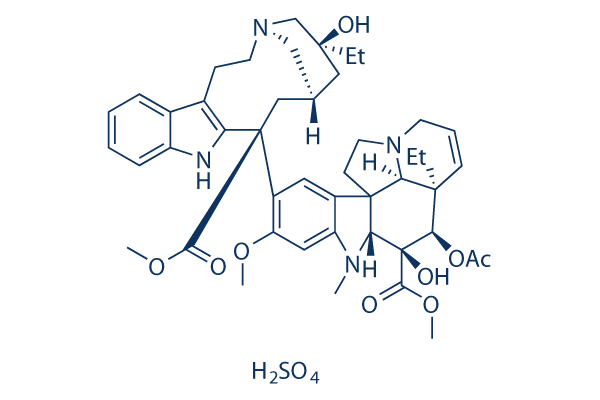
Structure chimique
Poids moléculaire: 909.05
Contrôle Qualité (Quality Control)
| Cibles apparentées | Akt Wnt/beta-catenin PKC HSP ROCK Microtubule Associated Integrin Bcr-Abl Actin FAK |
|---|---|
| Autre Antineoplastic and Immunosuppressive Antibiotics Inhibiteurs | Staurosporine (STS) Cyclosporin A Oligomycin A (MCH 32) Puromycin Dihydrochloride Nigericin sodium salt Geldanamycin (NSC 122750) Honokiol Streptozotocin (STZ) Sodium Monensin (NSC 343257) Hygromycin B |
Culture cellulaire, traitement et concentration de travail
(Cell Culture, Treatment & Working Concentration)
| Lignées cellulaires | Type d'essai | Concentration | Temps d'incubation | Formulation | Description de l'activité | PMID |
|---|---|---|---|---|---|---|
| COLO 320 human colorectal carcinoma cell line | Function assay | In vitro concentration required to kill 50% of COLO 320 human colorectal carcinoma cell line, EC50=0.08 μM | ||||
| LNCaP human prostate cancer cell line | Function assay | In vitro concentration required to kill 50% of LNCaP human prostate cancer cell line, EC50=0.5 μM | ||||
| K562 cell | Growth inhibition assay | In vitro inhibitory concentration against human chronic myelogenous leukemia K562 cell growth, IC50=0.001 μM | ||||
| T47D cells | Function assay | In vitro concentration required to kill 50% of T47D human breast ductal carcinoma cell line, EC50=0.08 μM | ||||
| K562 cell | Proliferation assay | 48 h | Antiproliferative activity against human K562 cells after 48 hrs, IC50=0.001 μM | |||
| ACHN cells | Cytotoxicity assay | 48 h | Cytotoxicity against human ACHN cells after 48 hrs by SRB assay, IC50=22.7 μM | |||
| A375 cells | Cytotoxicity assay | 48 h | Cytotoxicity against human A375 cells after 48 hrs by SRB assay, IC50=7.2 μM | |||
| C32 cells | Cytotoxicity assay | 48 h | Cytotoxicity against human C32 cells after 48 hrs by SRB assay, IC50=3 μM | |||
| LNCAP cells | Cytotoxicity assay | 48 h | Cytotoxicity against human LNCAP cells after 48 hrs by SRB assay, IC50=29.3 μM | |||
| Huh-7D12 cells | Cytotoxicity assay | 48 h | Cytotoxicity against human Huh-7D12 cells after 48 hrs by SRB assay, IC50=45.6 μM | |||
| COR-L23 cells | Cytotoxicity assay | 48 h | Cytotoxicity against human COR-L23 cells after 48 hrs by SRB assay, IC50=45.5 μM | |||
| 142BR cells | Cytotoxicity assay | 48 h | Cytotoxicity against human 142BR cells after 48 hrs by SRB assay, IC50=37.6 μM | |||
| HT-29 cells | Cytotoxicity assay | 48 h | Cytotoxicity against human HT-29 cells after 48 hrs by MTS assay, IC50=0.55 μM | |||
| A549 cells | Proliferation assay | 48 h | Antiproliferative activity against human A549 cells after 48 hrs by MTS assay, IC50=2.36 μM | |||
| DU145 cells | Proliferation assay | 48 h | Antiproliferative activity against human DU145 cells after 48 hrs by MTS assay, IC50=4.25 μM | |||
| SK-MEL-5 cells | Proliferation assay | 48 h | Antiproliferative activity against human SK-MEL-5 cells after 48 hrs by MTS assay, IC50=1.74 μM | |||
| HepG2 cells | Proliferation assay | 48 h | Antiproliferative activity against human HepG2 cells after 48 hrs by MTS assay, IC50=0.16 μM | |||
| HT-29 cells | Proliferation assay | 48 h | Antiproliferative activity against human HT-29 cells after 48 hrs by MTS assay, IC50=11.18 μM | |||
| MCF7 cells | Proliferation assay | 48 h | Antiproliferative activity against human MCF7 cells after 48 hrs by MTS assay, IC50=24.08 μM | |||
| MDA-MB-231 cells | Proliferation assay | 48 h | Antiproliferative activity against human MDA-MB-231 cells after 48 hrs by MTS assay, IC50=31.52 μM | |||
| rat REF52 cells | Function assay | 0.1 μM | 30 mins | Induction of microtubule depolymerization in rat REF52 cells at 0.1 uM after 30 mins by fluorescence assay | ||
| HepG2 cells | Cytotoxicity assay | 72 h | Cytotoxicity against adriamycin-resistant human HepG2 cells assessed as growth inhibition after 72 hrs by MTT assay, IC50=0.056 μM | |||
| HepG2 cells | Cytotoxicity assay | 72 h | Cytotoxicity against human HepG2 cells assessed as growth inhibition after 72 hrs by MTT assay, IC50=0.019 μM | |||
| K562 cells | Cytotoxicity assay | 72 h | Cytotoxicity against human K562 cells assessed as growth inhibition after 72 hrs by MTT assay, IC50=0.016 μM | |||
| MDA-MB-231 cells | Cytotoxicity assay | 72 h | Cytotoxicity against human MDA-MB-231 cells assessed as growth inhibition after 72 hrs by MTT assay, IC50=0.0083 μM | |||
| MCF7 cells | Cytotoxicity assay | 72 h | Cytotoxicity against human MCF7 cells assessed as growth inhibition after 72 hrs by MTT assay, IC50=0.007 μM | |||
| SCL6 cells | Cytotoxicity assay | Cytotoxicity against human SCL6 cells by MTT assay, ED50=6.1 Μm | ||||
| SCL9 | Cytotoxicity assay | Cytotoxicity against human SCL9 cells by MTT assay, ED=5.3 μM | ||||
| KATO III cells | Cytotoxicity assay | Cytotoxicity against human KATO III cells by MTT assay, ED50=6.1 μM | ||||
| NUGC4 cells | Cytotoxicity assay | Cytotoxicity against human NUGC4 cells by MTT assay, ED50=5.3 μM | ||||
| UACC903 cells | Cytotoxicity assay | 48 h | Cytotoxicity against human UACC903 cells after 48 hrs by MTS assay, IC50=1.65 μM | |||
| K562 cells | Function assay | Inhibition of tubulin polymerization in human K562 cells, IC50=0.13 μM | ||||
| BxPC3 cells | Proliferation assay | 48 h | Antiproliferative activity against human BxPC3 cells after 48 hrs by MTS assay, IC50=1.13 μM | |||
| Cliquez pour voir plus de données expérimentales sur la lignée cellulaire | ||||||
Informations chimiques, stockage et stabilité (Chemical Information, Storage & Stability)
| Poids moléculaire | 909.05 | Formule | C46H58N4O9.H2SO4 |
Stockage (À compter de la date de réception) | |
|---|---|---|---|---|---|
| N° CAS | 143-67-9 | Télécharger le SDF | Stockage des solutions mères |
|
|
| Synonymes | NSC-49842, Vincaleukoblastine, 29060-LE | Smiles | CCC1(CC2CC(C3=C(CCN(C2)C1)C4=CC=CC=C4N3)(C5=C(C=C6C(=C5)C78CCN9C7C(C=CC9)(C(C(C8N6C)(C(=O)OC)O)OC(=O)C)CC)OC)C(=O)OC)O.OS(=O)(=O)O | ||
Solubilité (Solubility)
|
In vitro |
DMSO
: 100 mg/mL
(110.0 mM)
Water : 50 mg/mL Ethanol : Insoluble |
Calculateur de molarité
|
In vivo |
|||||
Calculateur de formulation in vivo (Solution claire)
Étape 1 : Saisir les informations ci-dessous (Recommandé : Un animal supplémentaire pour tenir compte des pertes pendant l'expérience)
Étape 2 : Saisir la formulation in vivo (Ceci est seulement le calculateur, pas la formulation. Veuillez nous contacter d'abord s'il n'y a pas de formulation in vivo dans la section Solubilité.)
Résultats du calcul :
Concentration de travail : mg/ml;
Méthode de préparation du liquide maître DMSO : mg médicament prédissous dans μL DMSO ( Concentration du liquide maître mg/mL, Veuillez nous contacter d'abord si la concentration dépasse la solubilité du DMSO du lot de médicament. )
Méthode de préparation de la formulation in vivo : Prendre μL DMSO liquide maître, puis ajouterμL PEG300, mélanger et clarifier, puis ajouterμL Tween 80, mélanger et clarifier, puis ajouter μL ddH2O, mélanger et clarifier.
Méthode de préparation de la formulation in vivo : Prendre μL DMSO liquide maître, puis ajouter μL Huile de maïs, mélanger et clarifier.
Note : 1. Veuillez vous assurer que le liquide est clair avant d'ajouter le solvant suivant.
2. Assurez-vous d'ajouter le(s) solvant(s) dans l'ordre. Vous devez vous assurer que la solution obtenue, lors de l'ajout précédent, est une solution claire avant de procéder à l'ajout du solvant suivant. Des méthodes physiques telles que le vortex, les ultrasons ou le bain-marie chaud peuvent être utilisées pour faciliter la dissolution.
Mécanisme d'action (Mechanism of Action)
| Targets/IC50/Ki |
nAChR
(Adrenal Chromaffin Cells) 8.9 μM
|
|---|---|
| In vitro |
The average terminal half-lives of Vinblastine sulfate is 14.3 h. When incubated in freshly isolated rat hepatocytes, this compound penetrates rapidly and intensely into the cells, probably through a passive diffusion mechanism followed by tight cellular binding. It inhibits the angiogenic response induced by adrenomedullin and is also positive for mitotic slippage, causing micronuclei in mononucleate cells with cytokinesis block. This chemical gives significant increase in micronucleated mononucleated cells at concentrations that produced approximately 50% cell death and cytostasis or less as calculated using RPD, RICC and RCC.
|
| In vivo |
Vinblastine is a widely used anticancer drug with undesired side effects . A combination of this compound and RAP at very low doses against human HCC gets a satisfactory antiangiogenic effect in vivo. The clinically relevant dose of this chemical inhibits palmitoylation of tubulin in vivo in CEM cells (effect on depalmitoylation of tubulin).
|
Références |
|
Applications (Applications)
| Méthodes | Biomarqueurs | Images | PMID |
|---|---|---|---|
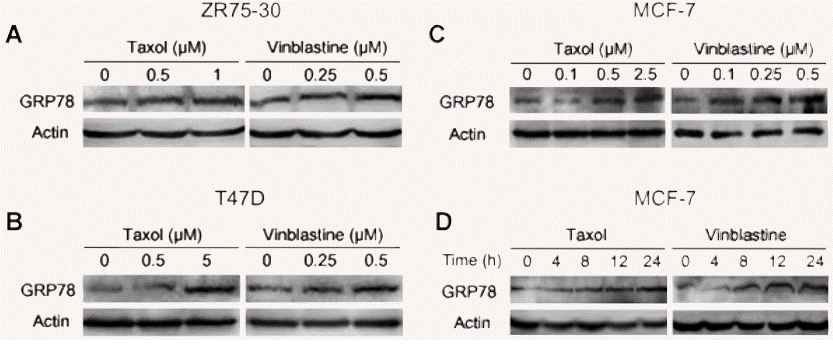
| Western blot | GRP78 p-eIF2 p-JNK / c-Caspase-7 / c-PARP ERK / p-ERK / Mcl-1 / Bad / Bid / Noxa |
|
19674193 |
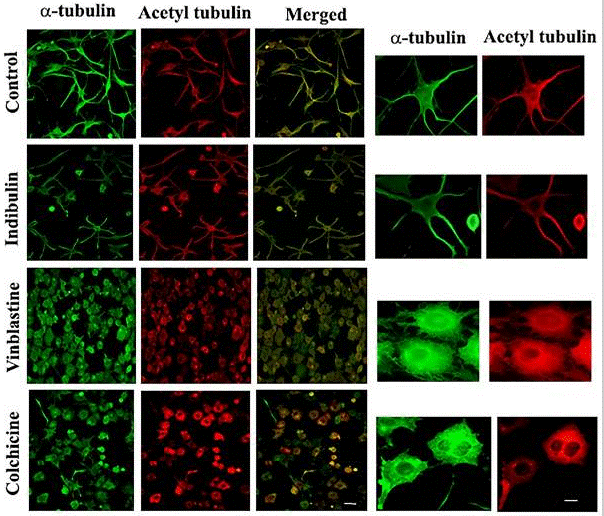
| Immunofluorescence | α-tubulin / Acetyl tubulin |
|
30120268 |
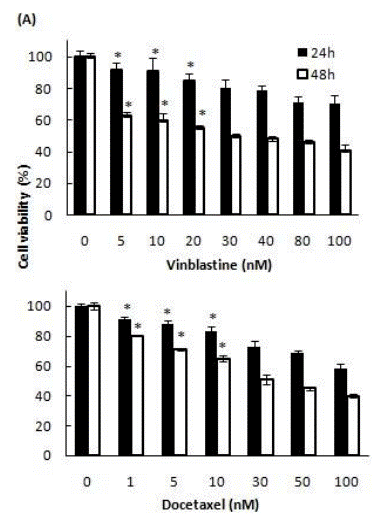
| Growth inhibition assay | Cell viability |
|
27114800 |
Informations sur l'essai clinique (Clinical Trial Information)
(données du https://clinicaltrials.gov, mis à jour le 2026-08-20)
| Numéro NCT | Recrutement | Conditions | Promoteur/Collaborateurs | Date de début | Phases |
|---|---|---|---|---|---|
| NCT06745076 | RECRUITING | Advanced Hodgkin Lymphoma; Classic Hodgkin Lymphoma; Lugano Classification Stage III Hodgkin Lymphoma AJCC v8; Lugano Classification Stage IV Hodgkin Lymphoma AJCC v8 |
University of Washington |
2025-03-06 | PHASE2 |
| NCT05180825 | RECRUITING | Grade 1 Glioma; Mixed Glio-neuronal Tumors; Pleomorphic Xanthoastrocytoma |
University Hospital, Strasbourg, France |
2022-05-05 | PHASE2 |
| NCT05675410 | RECRUITING | Lugano Classification Limited Stage Hodgkin Lymphoma AJCC v8 |
National Cancer Institute (NCI) |
2023-05-11 | PHASE3 |
| NCT07551583 | RECRUITING | Hodgkin Lymphoma |
M.D. Anderson Cancer Center |
2026-08-19 | PHASE2 |
| NCT04685616 | RECRUITING | Hodgkin Lymphoma |
University College, London |
2022-04-14 | PHASE3 |
| NCT06666348 | RECRUITING | Pediatric Low-grade Glioma |
St. Justine's Hospital |
2026-01-12 | PHASE1; PHASE2 |

Les produits sont destinés à la recherche uniquement. Ne pas utiliser chez l'homme. Nous ne vendons pas aux patients.
©Copyright 2013 Selleck Chemicals. Tous droits réservés.