
pour la recherche uniquement
Vincamine
Réf. Catalogue: S3891
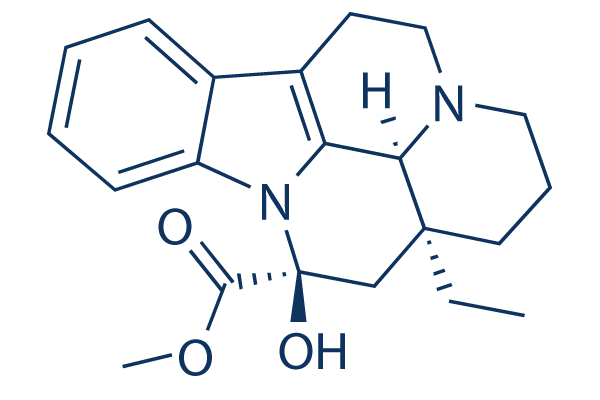
Structure chimique
Poids moléculaire: 354.44
Contrôle Qualité (Quality Control)
Informations chimiques, stockage et stabilité (Chemical Information, Storage & Stability)
| Poids moléculaire | 354.44 | Formule | C21H26N2O3 |
Stockage (À compter de la date de réception) | |
|---|---|---|---|---|---|
| N° CAS | 1617-90-9 | Télécharger le SDF | Stockage des solutions mères |
|
|
| Synonymes | Angiopac, Devincan, Equipur, Minorin, Novicet, Oxybral, Perval, Sostenil, Tripervan | Smiles | CCC12CCCN3C1C4=C(CC3)C5=CC=CC=C5N4C(C2)(C(=O)OC)O | ||
Solubilité (Solubility)
|
In vitro |
DMSO
: 3 mg/mL
(8.46 mM)
|
Calculateur de molarité
|
In vivo |
|||||
Calculateur de formulation in vivo (Solution claire)
Étape 1 : Saisir les informations ci-dessous (Recommandé : Un animal supplémentaire pour tenir compte des pertes pendant l'expérience)
Étape 2 : Saisir la formulation in vivo (Ceci est seulement le calculateur, pas la formulation. Veuillez nous contacter d'abord s'il n'y a pas de formulation in vivo dans la section Solubilité.)
Résultats du calcul :
Concentration de travail : mg/ml;
Méthode de préparation du liquide maître DMSO : mg médicament prédissous dans μL DMSO ( Concentration du liquide maître mg/mL, Veuillez nous contacter d'abord si la concentration dépasse la solubilité du DMSO du lot de médicament. )
Méthode de préparation de la formulation in vivo : Prendre μL DMSO liquide maître, puis ajouterμL PEG300, mélanger et clarifier, puis ajouterμL Tween 80, mélanger et clarifier, puis ajouter μL ddH2O, mélanger et clarifier.
Méthode de préparation de la formulation in vivo : Prendre μL DMSO liquide maître, puis ajouter μL Huile de maïs, mélanger et clarifier.
Note : 1. Veuillez vous assurer que le liquide est clair avant d'ajouter le solvant suivant.
2. Assurez-vous d'ajouter le(s) solvant(s) dans l'ordre. Vous devez vous assurer que la solution obtenue, lors de l'ajout précédent, est une solution claire avant de procéder à l'ajout du solvant suivant. Des méthodes physiques telles que le vortex, les ultrasons ou le bain-marie chaud peuvent être utilisées pour faciliter la dissolution.
Mécanisme d'action (Mechanism of Action)
| In vitro |
Vincamine decreases amyloid-β 25-35 induced oxidative stress and reduces reactive oxygen species levels. It significantly reduces the rate of apoptosis in a dose-dependent manner. This compound could provide neuroprotection from Aβ25-35 induced PC12 apoptosis through the phosphatidylinositol-3 kinase/Akt signaling pathway.
|
|---|---|
| In vivo |
Vincamine could cross the blood-brain barrier, and its antioxidant scavenging capacity to inactivate hydroxyl free radicals is actually ranked in part with Vitamin E. This compound decreases the mean arterial blood pressure (by 5-35%), the cardial output and the heart rate. After oral application of 20 mg/kg vincamine in rats, this chemical is rapidly absorbed and eliminated. The apparent elimination half life is 1.71 h. The bioavailability of this compound after oral administration is 58% suggesting a significant firstpass metabolism. It is taken up in a high concentration by the different organs, the maximal organ-plasma concentration ratio is 21 for lungs, 14.6 for brain, 14.3 for the kidneys, 8.9 for the liver and 7.6 for the heart. There is no steady-state between plasma and heart, lungs and brain, the elimination from these organs is significantly more rapid than from plasma. This chemical is mainly metabolized in the liver and excreted by the kidneys and it may also go through cerebral metabolism. In the pharmacokinetic profile of vincamine, the compound is about 64% bound to plasma proteins, and 6% bound to erythrocytes.
|
Références |
|

Les produits sont destinés à la recherche uniquement. Ne pas utiliser chez l'homme. Nous ne vendons pas aux patients.
©Copyright 2013 Selleck Chemicals. Tous droits réservés.