
Données techniques
| Formule | C26H30FN7O3 |
||||||
| Poids moléculaire | 507.56 | Numéro CAS | 722544-51-6 | ||||
| Solubilité (25°C)* | In vitro | DMSO | 100 mg/mL (197.02 mM) | ||||
| Water | Insoluble | ||||||
| Ethanol | Insoluble | ||||||
| In vivo (Ajouter les solvants au produit individuellement et dans lordre.) |
|
||||||
|
* <1 mg/ml signifie légèrement soluble ou insoluble. * Veuillez noter que Selleck teste la solubilité de tous les composés en interne, et la solubilité réelle peut différer légèrement des valeurs publiées. Ceci est normal et est dû à de légères variations dun lot à lautre. * Expédition à température ambiante (les tests de stabilité montrent que ce produit peut être expédié sans aucune mesure de refroidissement.) |
|||||||
Préparation des solutions mères
Activité biologique
| Description | Le Defosbarasertib (AZD1152-HQPA, AZD2811, INH-34, Barasertib-HQPA) est un inhibiteur hautement sélectif d'Aurora B avec une IC50 de 0,37 nM dans un essai acellulaire, ~3700 fois plus sélectif pour Aurora B que pour Aurora A. Phase 1. | ||
|---|---|---|---|
| Cibles |
|
||
| In vitro | Barasertib (AZD1152-HQPA), un inhibiteur hautement sélectif d'Aurora B, provoque la polyploïdie et l'apoptose dans de nombreuses lignées de cellules cancéreuses. |
||
| In vivo | Barasertib (AZD1152-HQPA) est un inhibiteur de la kinase aurora B et présente une efficacité contre les xénogreffes de lignées cellulaires RB1 / SCLC, les PDX RB1 / SCLC et les tumeurs neuroendocrines / Rb1 autochtones. |
Protocole (de référence)
| Test cellulaire : |
|
|---|
Références
|
Validation du produit par le client
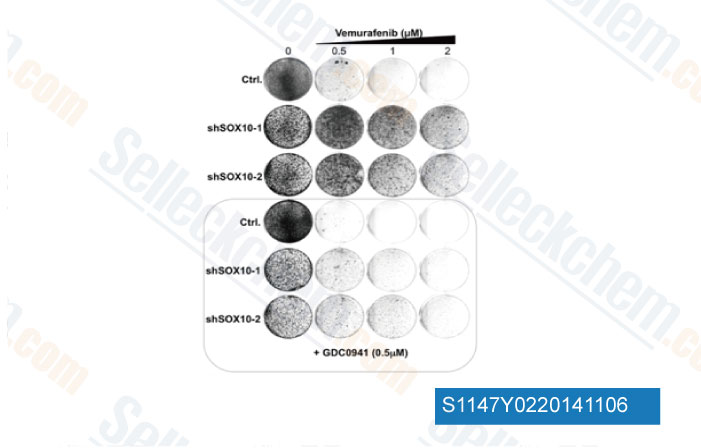
-
Données de [ Nature , 2014 , 508(7494), 118-22 ]
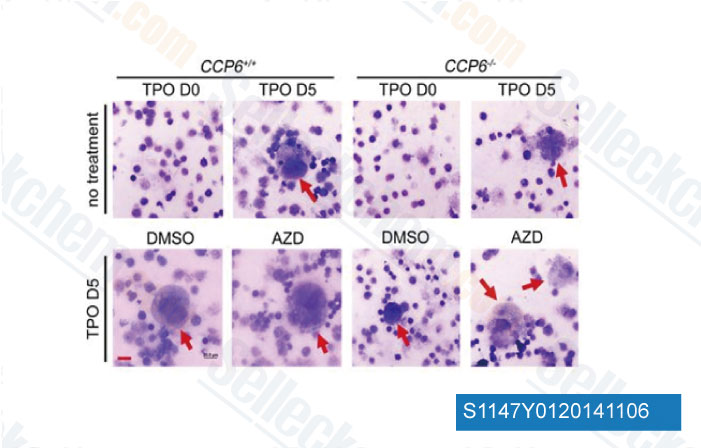
-
Données de [ J Exp Med , 2014 , 10.1084/jem.20141123 ]
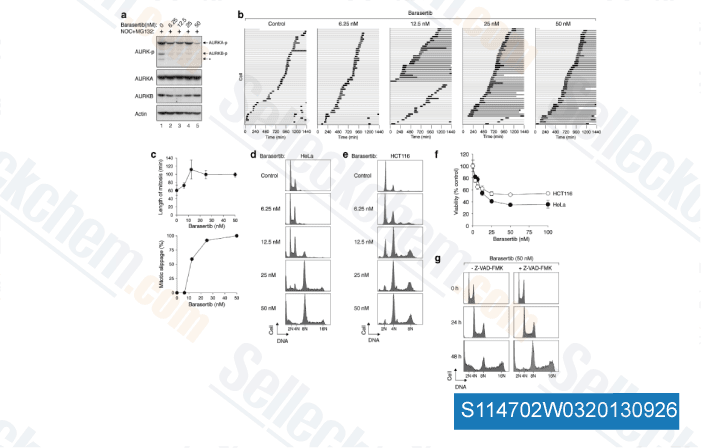
-
Données de [ Oncogene , 2014 , 33, 3550-60 ]
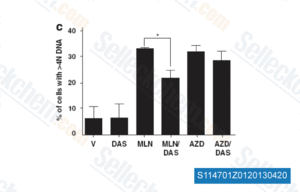
-
Données de [ Oncogene , 2012 , 31, 1217–1227 ]
Sellecks Barasertib-HQPA (AZD2811) A été cité par 171 Publications
| High-throughput screening identifies Aurora kinase B as a critical therapeutic target for Merkel cell carcinoma [ Nat Commun, 2025, 16(1):1583] | PubMed: 39939315 |
| Unraveling AURKB as a potential therapeutic target in pulmonary hypertension using integrated transcriptomic analysis and pre-clinical studies [ Cell Rep Med, 2025, 6(2):101964] | PubMed: 39933527 |
| Aurora B controls microtubule stability to regulate abscission dynamics in stem cells [ Cell Rep, 2025, 44(2):115238] | PubMed: 39854207 |
| Identification of chemical inhibitors targeting long noncoding RNA through gene signature-based high throughput screening [ Int J Biol Macromol, 2025, 292:139119] | PubMed: 39722392 |
| Oversized cells activate global proteasome-mediated protein degradation to maintain cell size homeostasis [ Elife, 2025, 14e75393] | PubMed: 39791360 |
| The mechanoresponsive chromosomal passenger complex sustains furrow ingression under confinement [ J Mol Cell Biol, 2025, mjaf019] | PubMed: 40693957 |
| Overcoming MET-targeted drug resistance in MET-amplified lung cancer by aurora kinase B inhibition [ Biochim Biophys Acta Mol Cell Res, 2025, 1872(7):120001] | PubMed: 40499687 |
| Proteomic profiling identifies upregulation of aurora kinases causing resistance to taxane-type chemotherapy in triple negative breast cancer [ Sci Rep, 2025, 15(1):3211] | PubMed: 39863788 |
| Nucleosome stability safeguards cell identity, stress resilience and healthy aging [ bioRxiv, 2025, 2025.09.17.676776] | PubMed: 41000743 |
| Proteogenomic characterization of small cell lung cancer identifies biological insights and subtype-specific therapeutic strategies [ Cell, 2024, 187(1):184-203.e28] | PubMed: 38181741 |
POLITIQUE DE RETOUR
La politique de retour inconditionnelle de Selleck Chemical garantit une expérience dachat en ligne fluide à nos clients. Si vous nêtes en aucun cas satisfait de votre achat, vous pouvez retourner tout article dans les 7 jours suivant sa réception. En cas de problèmes de qualité du produit, quil sagisse de problèmes liés au protocole ou au produit, vous pouvez retourner tout article dans les 365 jours suivant la date dachat initiale. Veuillez suivre les instructions ci-dessous lors du retour des produits.
EXPÉDITION ET STOCKAGE
Les produits Selleck sont transportés à température ambiante. Si vous recevez le produit à température ambiante, soyez assuré que le service dinspection de la qualité de Selleck a mené des expériences pour vérifier que le placement à température normale pendant un mois naffectera pas lactivité biologique des produits en poudre. Après réception, veuillez stocker le produit conformément aux exigences décrites dans la fiche technique. La plupart des produits Selleck sont stables dans les conditions recommandées.
NON DESTINÉ À UN USAGE HUMAIN, VÉTÉRINAIRE DIAGNOSTIQUE OU THÉRAPEUTIQUE.