
Données techniques
| Formule | C15H10O5 |
||||||
| Poids moléculaire | 270.24 | Numéro CAS | 520-36-5 | ||||
| Solubilité (25°C)* | In vitro | DMSO | 54 mg/mL (199.82 mM) | ||||
| Water | Insoluble | ||||||
| Ethanol | Insoluble | ||||||
| In vivo (Ajouter les solvants au produit individuellement et dans lordre.) |
|
||||||
|
* <1 mg/ml signifie légèrement soluble ou insoluble. * Veuillez noter que Selleck teste la solubilité de tous les composés en interne, et la solubilité réelle peut différer légèrement des valeurs publiées. Ceci est normal et est dû à de légères variations dun lot à lautre. * Expédition à température ambiante (les tests de stabilité montrent que ce produit peut être expédié sans aucune mesure de refroidissement.) |
|||||||
Préparation des solutions mères
Activité biologique
| Description | Apigenin est un puissant inhibiteur de P450 pour le CYP2C9 avec un Ki de 2 μM. | ||
|---|---|---|---|
| Cibles |
|
||
| In vitro | Apigenin inhibe la PKC en compétition avec l'adénosine triphosphate (ATP). Ce composé réduit également le niveau de phosphorylation des protéines cellulaires stimulée par le TPA et inhibe l'expression de c-jun et c-fos induite par le TPA. Il présente un effet réversif sur la morphologie transformée des cellules NIH3T3 transformées par v-H-ras. Il a été démontré qu'il possède des propriétés anti-mutagènes dans un contexte de génotoxicité induite par le nitropyrène dans des cellules ovariennes de hamster chinois. Ce produit chimique supprime l'activité et l'expression de la cyclooxygénase-2 et de la monoxyde d'azote synthase-2 induites par le LPS dans les macrophages de souris. Il a été rapporté qu'il inhibe l'activité de la protéine kinase C, la protéine kinase activée par les mitogènes (MAPK), la transformation des fibroblastes embryonnaires de souris C3HI et les oncogènes en aval dans les cellules NIH3T3 transformées par v-Ha-ras. Ce composé bloque la kinase régulée par la prolifération des peroxysomes (ERK), une MAPK dans les hépatocytes isolés. Il a en outre été démontré qu'il régule à la baisse l'expression de l'échangeur Na+/Ca2+, une protéine importante pour l'extrusion du calcium dans les myocytes cardiaques de rats nouveau-nés. Il induit un arrêt réversible en G2/M et G0/G1 en inhibant l'activité de la kinase p34 (cdc2), accompagné d'une augmentation de la stabilité de la protéine p53 dans les cellules épidermiques et les fibroblastes. Il est également efficace pour inhiber la régulation positive de la molécule d'adhésion intracellulaire-1 induite par le TNFα dans les cellules endothéliales humaines cultivées. Il inhibe l'expression de HIF-1α et de VEGF via les voies PI3K/Akt/p70S6K1 et HDM2/p53 dans les cellules de cancer de l'ovaire humain. Il inhibe la différenciation en supprimant la transduction du signal MAPK et en réduisant le niveau du facteur de transcription API dans les kératinocytes humains. Ce composé inhibe également la prolifération des kératinocytes humains. | ||
| In vivo | Apigenin régule à la baisse la production d'IL-4 chez les souris BALB/C immunisées à l'ovalbumine. Ce composé inhibe les métastases pulmonaires du mélanome en altérant l'interaction des cellules tumorales avec l'endothélium. Il a été démontré qu'il provoque une augmentation significative du poids utérin et de la concentration utérine globale du récepteur d'œstrogènes (ER)-α chez les souris femelles (64) et qu'il supprime également la croissance des cellules cancéreuses de la prostate et du sein via le récepteur d'œstrogènes β1. Ce produit chimique supprime les niveaux d'IGF-I dans les xénogreffes de tumeurs prostatiques et augmente les niveaux d'IGFBP-3, une protéine de liaison qui séquestre l'IGF-I dans la circulation vasculaire. Ce composé (12,5 mg/kg) augmente la prolifération cellulaire dans le gyrus denté de l'hippocampe de souris adultes. | ||
| Caractéristiques | Beaucoup plus puissant que le kaempférol et la myricétine dans l'inhibition de la CT-L. |
Protocole (de référence)
| Test cellulaire : |
|
|---|---|
| Étude animale : |
|
Références
|
Validation du produit par le client
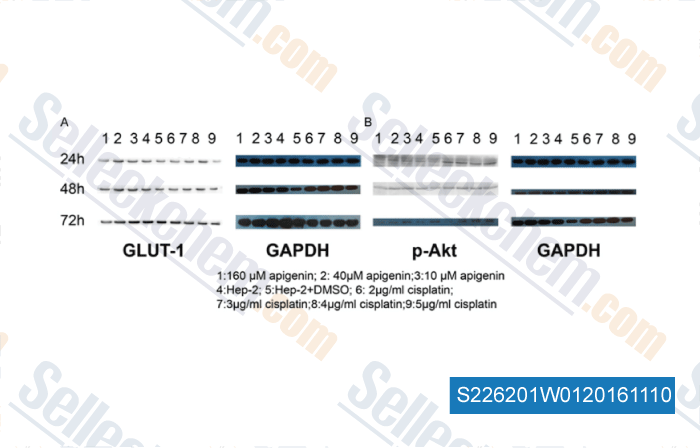
-
, , Int J Clin Exp Pathol, 2014, 7(7):3938-3.
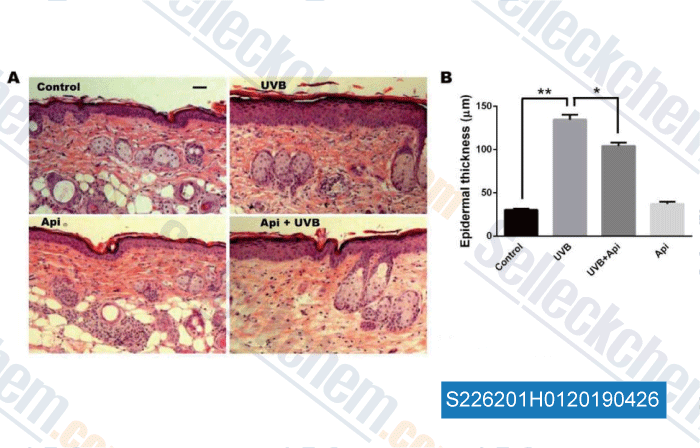
-
Données de [ , , Cell Signal, 2016, 28(5):460-468 ]
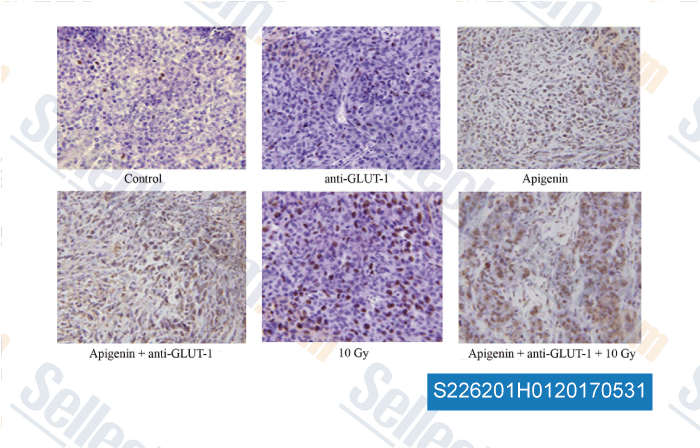
-
Données de [ , , Oncol Rep, 2015, 34(4):1805-14 ]
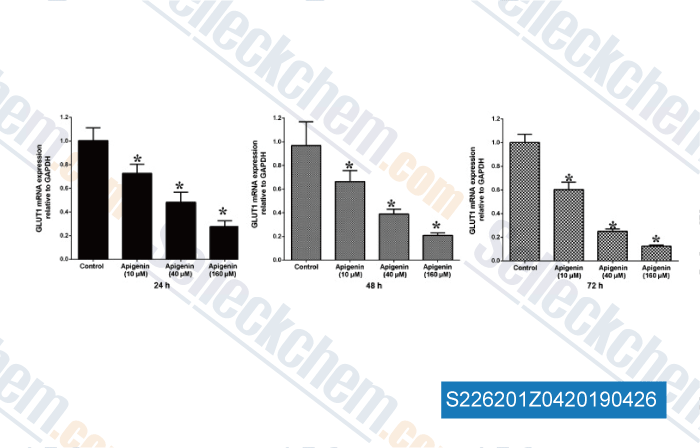
-
Données de [ , , Mol Med Rep, 2015, 12(5):6461-6 ]
Sellecks Apigenin A été cité par 33 Publications
| Apigenin inhibits lipid metabolism of hepatocellular carcinoma cells by targeting the histone demethylase KDM1A [ Phytomedicine, 2024, 135:156024] | PubMed: 39341125 |
| The Effects of Resveratrol and Apigenin on Jejunal Oxidative Injury in Ducks and on Immortalized Duck Intestinal Epithelial Cells Exposed to H2O2 [ Antioxidants (Basel), 2024, 13(5)611] | PubMed: 38790716 |
| Viscoelastic high-molecular-weight hyaluronic acid hydrogels support rapid glioblastoma cell invasion with leader-follower dynamics [ bioRxiv, 2024, 2024.04.04.588167] | PubMed: 38617333 |
| Connexin43 is associated with the progression of clear cell renal carcinoma and is regulated by tangeretin to sygergize with tyrosine kinase inhibitors [ Transl Oncol, 2023, 35:101712] | PubMed: 37354638 |
| Synergism Antiproliferative Effects of Apigenin and Naringenin in NSCLC Cells [ Molecules, 2023, 28(13)4947] | PubMed: 37446609 |
| Nao Tan Qing ameliorates Alzheimer's disease-like pathology by regulating glycolipid metabolism and neuroinflammation: A network pharmacology analysis and biological validation [ Pharmacol Res, 2022, 185:106489] | PubMed: 36228869 |
| Glycosylated modification of MUC1 maybe a new target to promote drug sensitivity and efficacy for breast cancer chemotherapy [ Cell Death Dis, 2022, 13(8):708] | PubMed: 35970845 |
| Apigenin Induced Apoptosis by Downregulating Sulfiredoxin Expression in Cutaneous Squamous Cell Carcinoma [ Oxid Med Cell Longev, 2022, 2022:8172866] | PubMed: 35965686 |
| Identification of EZH2 as Cancer Stem Cell Marker in Clear Cell Renal Cell Carcinoma and the Anti-Tumor Effect of Epigallocatechin-3-Gallate -EGCG [ Cancers -Basel, 2022, 14-174200] | PubMed: 36077742 |
| Biphasic Effect of Pirfenidone on Angiogenesis [ Chem Biol Interact, 2022, S0009-2797(22)00171-5] | PubMed: 35513012 |
POLITIQUE DE RETOUR
La politique de retour inconditionnelle de Selleck Chemical garantit une expérience dachat en ligne fluide à nos clients. Si vous nêtes en aucun cas satisfait de votre achat, vous pouvez retourner tout article dans les 7 jours suivant sa réception. En cas de problèmes de qualité du produit, quil sagisse de problèmes liés au protocole ou au produit, vous pouvez retourner tout article dans les 365 jours suivant la date dachat initiale. Veuillez suivre les instructions ci-dessous lors du retour des produits.
EXPÉDITION ET STOCKAGE
Les produits Selleck sont transportés à température ambiante. Si vous recevez le produit à température ambiante, soyez assuré que le service dinspection de la qualité de Selleck a mené des expériences pour vérifier que le placement à température normale pendant un mois naffectera pas lactivité biologique des produits en poudre. Après réception, veuillez stocker le produit conformément aux exigences décrites dans la fiche technique. La plupart des produits Selleck sont stables dans les conditions recommandées.
NON DESTINÉ À UN USAGE HUMAIN, VÉTÉRINAIRE DIAGNOSTIQUE OU THÉRAPEUTIQUE.