
Données techniques
| Formule | C22H18N4OS |
||||||||||||||
| Poids moléculaire | 386.47 | Numéro CAS | 319460-85-0 | ||||||||||||
| Solubilité (25°C)* | In vitro | DMSO | 26 mg/mL (67.27 mM) | ||||||||||||
| Water | Insoluble | ||||||||||||||
| Ethanol | Insoluble | ||||||||||||||
| In vivo (Ajouter les solvants au produit individuellement et dans lordre.) |
|
||||||||||||||
|
* <1 mg/ml signifie légèrement soluble ou insoluble. * Veuillez noter que Selleck teste la solubilité de tous les composés en interne, et la solubilité réelle peut différer légèrement des valeurs publiées. Ceci est normal et est dû à de légères variations dun lot à lautre. * Expédition à température ambiante (les tests de stabilité montrent que ce produit peut être expédié sans aucune mesure de refroidissement.) |
|||||||||||||||
Préparation des solutions mères
Activité biologique
| Description | Axitinib est un inhibiteur multi-cible de VEGFR1, VEGFR2, VEGFR3, PDGFRβ et c-Kit avec une IC50 de 0,1 nM, 0,2 nM, 0,1-0,3 nM, 1,6 nM et 1,7 nM dans les cellules endothéliales de l'aorte porcine, respectivement. | |||||||||||
|---|---|---|---|---|---|---|---|---|---|---|---|---|
| Cibles |
|
|||||||||||
| In vitro | L'Axitinib pourrait bloquer l'autophosphorylation cellulaire du VEGFR et la viabilité des cellules endothéliales médiée par le VEGF, la formation de tubes et la signalisation en aval. Ce composé inhibe la prolifération de lignées cellulaires variables avec une IC50 de >10 000 nM (IGR-N91), 849 nM (IGR-NB8), 274 nM (SH-SY5Y) et 573 nM (HUVEC non stimulées par le VEGF). | |||||||||||
| In vivo | L'Axitinib présente une inhibition primaire des modèles transplantés orthotopiquement tels que M24met (mélanome), HCT-116 (cancer colorectal) et SN12C (carcinome rénal). Ce composé retarde la croissance tumorale de 11,4 jours par rapport aux témoins (p.o. 30 mg/kg) et diminue la densité moyenne des vaisseaux (MVD) à 21, contre 49 chez les témoins, dans les xénogreffes de flanc IGR-N91. Il inhibe significativement la croissance et perturbe la microvascularisation tumorale dans le modèle de cancer du sein BT474 à 10-100 mg/kg. Il a montré une activité d'agent unique dans diverses tumeurs, y compris le carcinome rénal, le cancer de la thyroïde, le cancer du poumon non à petites cellules et le mélanome. | |||||||||||
| Caractéristiques | Supérieur en tant que thérapie de deuxième ligne par rapport au sorafénib (norme de soins actuelle). |
Protocole (de référence)
| Test kinase : |
|
|---|---|
| Test cellulaire : |
|
| Étude animale : |
|
Références
|
Validation du produit par le client
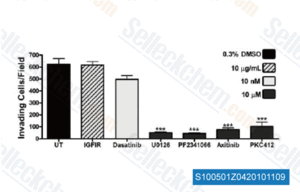
-
Données de [ J Biomol Screen , 2011 , 16, 141-154 ]
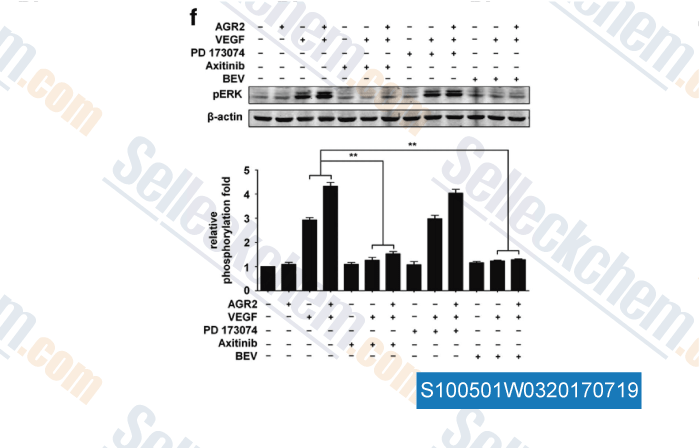
-
, , Oncogene, 2017, 36(36):5098-5109
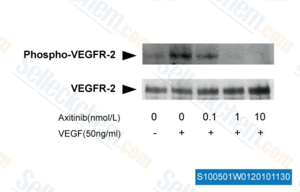
-
, , Dr. Cheri Pasch of UW Madison
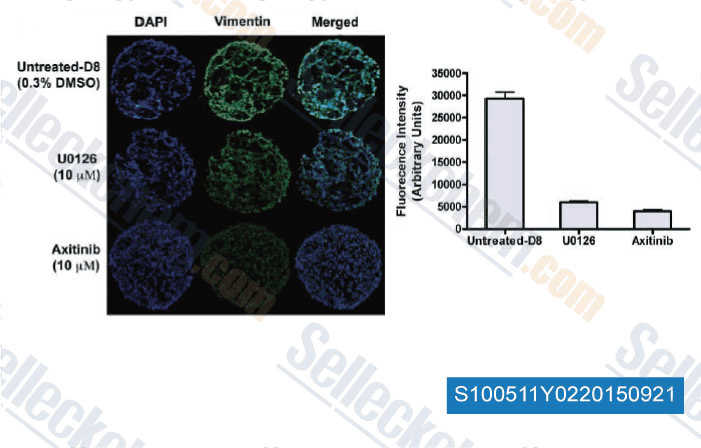
-
Données de [ , , J Biomol Screen, 2011,16: 141-154 ]
Sellecks Axitinib (AG-013736) A été cité par 194 Publications
| Effective targeting of PDGFRA-altered high-grade glioma with avapritinib [ Cancer Cell, 2025, S1535-6108(25)00070-4] | PubMed: 40086436 |
| Luteolin prevents axitinib-induced kidney damage in mice [ Chem Biol Interact, 2025, 418:111628] | PubMed: 40609923 |
| Regulatory feedback between VEGF and ERK pathways controls tip-cell expression during sea urchin skeletogenesis [ Development, 2025, 152(13)dev204684] | PubMed: 40492925 |
| Revealing the Potential of Solamargine for Anti Metastasis and Angiogenesis Inhibition in Nasopharyngeal Carcinoma [ J Inflamm Res, 2025, 18:4879-4898] | PubMed: 40224395 |
| IL1RA+ Myeloid-derived Suppressor Cells Activate Epithelial-mesenchymal Transition to Facilitate Lymphatic and Hepatic Metastasis in Pancreatic Ductal Carcinoma [ J Clin Transl Hepatol, 2025, 13(11):935-948] | PubMed: 41306373 |
| A Novel Cell-Penetrating Peptide-Vascular Endothelial Growth Factor Small Interfering Ribonucleic Acid Complex That Mediates the Inhibition of Angiogenesis by Human Umbilical Vein Endothelial Cells and in an Ex Vivo Mouse Aorta Ring Model [ Biomater Res, 2025, 29:0120] | PubMed: 39780959 |
| Piezo1 regulates meningeal lymphatic vessel drainage and alleviates excessive CSF accumulation [ Nat Neurosci, 2024, 10.1038/s41593-024-01604-8] | PubMed: 38528202 |
| Targeting PDGF signaling of cancer-associated fibroblasts blocks feedback activation of HIF-1α and tumor progression of clear cell ovarian cancer [ Cell Rep Med, 2024, S2666-3791(24)00201-5] | PubMed: 38670097 |
| FLT1 activation in cancer cells promotes PARP-inhibitor resistance in breast cancer [ EMBO Mol Med, 2024, 10.1038/s44321-024-00094-2] | PubMed: 38956205 |
| The molecular basis of Abelson kinase regulation by its αI-helix [ Elife, 2024, 12RP92324] | PubMed: 38588001 |
POLITIQUE DE RETOUR
La politique de retour inconditionnelle de Selleck Chemical garantit une expérience dachat en ligne fluide à nos clients. Si vous nêtes en aucun cas satisfait de votre achat, vous pouvez retourner tout article dans les 7 jours suivant sa réception. En cas de problèmes de qualité du produit, quil sagisse de problèmes liés au protocole ou au produit, vous pouvez retourner tout article dans les 365 jours suivant la date dachat initiale. Veuillez suivre les instructions ci-dessous lors du retour des produits.
EXPÉDITION ET STOCKAGE
Les produits Selleck sont transportés à température ambiante. Si vous recevez le produit à température ambiante, soyez assuré que le service dinspection de la qualité de Selleck a mené des expériences pour vérifier que le placement à température normale pendant un mois naffectera pas lactivité biologique des produits en poudre. Après réception, veuillez stocker le produit conformément aux exigences décrites dans la fiche technique. La plupart des produits Selleck sont stables dans les conditions recommandées.
NON DESTINÉ À UN USAGE HUMAIN, VÉTÉRINAIRE DIAGNOSTIQUE OU THÉRAPEUTIQUE.