
Données techniques
| Formule | C24H26N4O4 |
||||||||||
| Poids moléculaire | 434.49 | Numéro CAS | 1012054-59-9 | ||||||||
| Solubilité (25°C)* | In vitro | DMSO | 44 mg/mL (101.26 mM) | ||||||||
| Water | Insoluble | ||||||||||
| Ethanol | Insoluble | ||||||||||
| In vivo (Ajouter les solvants au produit individuellement et dans l'ordre.) |
|
||||||||||
|
* <1 mg/ml signifie légèrement soluble ou insoluble. * Veuillez noter que Selleck teste la solubilité de tous les composés en interne, et la solubilité réelle peut différer légèrement des valeurs publiées. Ceci est normal et est dû à de légères variations d'un lot à l'autre. * Expédition à température ambiante (les tests de stabilité montrent que ce produit peut être expédié sans aucune mesure de refroidissement.) |
|||||||||||
Préparation des solutions mères
Activité biologique
| Description | Le CUDC-101 est un puissant inhibiteur multi-cibles contre les HDAC, EGFR et HER2 avec des IC50 de 4,4 nM, 2,4 nM et 15,7 nM, et ce composé inhibe les HDAC de classe I/II, mais pas les HDAC de classe III, de type Sir. Phase 1. | |||||||||||
|---|---|---|---|---|---|---|---|---|---|---|---|---|
| Cibles |
|
|||||||||||
| In vitro | Specific for class I and class II HDACs, CUDC-101 does not inhibit class III Sir-type HDACs. This compound displays weak activity against other protein kinases including KDR/VEGFR2, Lyn, Lck, Abl-1, FGFR-2, Flt-3, and Ret with IC50 of 0.85 μM, 0.84 μM, 5.91 μM, 2.89 μM, 3.43 μM, 1.5 μM, abd 3.2 μM, respectively. It displays broad antiproliferative activity in many human cancer cell types with IC50 of 0.04-0.80 μM, exhibiting a higher potency and combinations of vorinostat in most cases. This chemical potently inhibits cancer cell lines. It inhibits the resistant EGFR mutant T790M although its effects are incomplete with an Amax of ~60% of peak enzyme activity after inhibition. This compound treatment increases the acetylation of histone H3 and H4, as well as the acetylation of non-histone substrates of HDAC such as p53 and α-tubulin, in a dose-dependant manner in various cancer cell lines. It also suppresses HER3 expression, Met amplification, and AKT reactivation in tumor cells. |
|||||||||||
| In vivo | Administration of CUDC-101 at 120 mg/kg/day induces tumor regression in the Hep-G2 liver cancer model, which is more efficacious at its maximum tolerated dose (25 mg/kg/day) and vorinostat at an equimolar concentration dose (72 mg/kg/day). This compound inhibits the growth of -sensitive H358 NSCLC xenografts in a dose-dependent manner. It also shows potent inhibition of tumor growth in the -resistant A549 NSCLC xenograft model. This chemical produces significant tumor regression in the -resistant, HER2-negative, EGFR-overexpressing MDA-MB-468 breast cancer model and the EGFR-overexpressing CAL-27 head and neck squamous cell carcinoma (HNSCC) model. Additionally, it inhibits tumor growth in the K-ras mutant HCT116 colorectal and EGFR/HER2 (neu)-expressing HPAC pancreatic cancer models. |
Protocole (de référence)
| Test kinase : |
|
|---|---|
| Test cellulaire : |
|
| Étude animale : |
|
Références
|
Validation du produit par le client

-
Données de [ ACS Med Chem Lett , 2013 , 4(9), 858-62 ]

-
, , Dr. Zhang of Tianjin Medical University
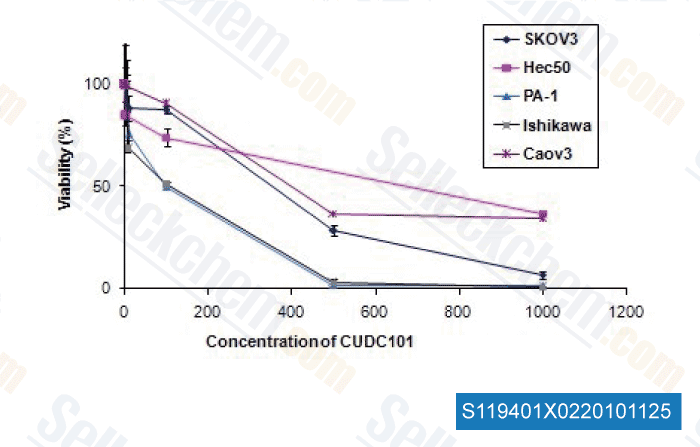
-
, , Dr. Xiangbing Meng of University of Iowa
Selleck's CUDC-101 A été cité par 27 Publications
| HDAC6 inhibitor WT161 downregulates growth factor receptors in breast cancer [ Oncotarget, 5 Jul 2017, 80109-80123] | PubMed: 29113288 |
| Novel 64Cu-Labeled CUDC-101 for in Vivo PET Imaging of Histone Deacetylases [ ACS Medicinal Chemistry Letters, 25 Jul 2013, 858-862] | |
| Modulation of Abnormal Vasoconstriction Through 2-Hydroxyisobutyrylation of Tropomyosin 3 Lys141: Targeting Histone Deacetylase 3 as a Key Approach [ J Am Heart Assoc, 2025, 14(1):e037400] | PubMed: 39719422 |
| Histone 4 lysine 5/12 acetylation enables developmental plasticity of Pristionchus mouth form [ Nat Commun, 2023, 14(1):2095] | PubMed: 37055396 |
| CUDC-907, a dual PI3K/histone deacetylase inhibitor, increases meta-iodobenzylguanidine uptake (123/131I-mIBG) in vitro and in vivo: a promising candidate for advancing theranostics in neuroendocrine tumors [ J Transl Med, 2023, 21(1):604] | PubMed: 37679770 |
| CUDC‑101 is a potential target inhibitor for the EGFR‑overexpression bladder cancer cells [ Int J Oncol, 2023, 10.3892/ijo.2023.5579] | PubMed: 37830158 |
| CUDC-101 is a potential target inhibitor for the EGFR-overexpression bladder cancer cells [ International Journal of Oncology, 2023, 1791] | PubMed: 37830158 |
| Non-oncology drug (meticrane) shows anti-cancer ability in synergy with epigenetic inhibitors and appears to be involved passively in targeting cancer cells [ Front Oncol, 2023, 13:1157366] | PubMed: 37274234 |
| High-throughput screen in vitro identifies dasatinib as a candidate for combinatorial treatment with HER2-targeting drugs in breast cancer [ PLoS One, 2023, 18(1):e0280507] | PubMed: 36706086 |
| Development and implementation of the SUM breast cancer cell line functional genomics knowledge base [ NPJ Breast Cancer, 2020, 6:30] | PubMed: 32715085 |
POLITIQUE DE RETOUR
La politique de retour inconditionnelle de Selleck Chemical garantit une expérience d'achat en ligne fluide à nos clients. Si vous n'êtes en aucun cas satisfait de votre achat, vous pouvez retourner tout article dans les 7 jours suivant sa réception. En cas de problèmes de qualité du produit, qu'il s'agisse de problèmes liés au protocole ou au produit, vous pouvez retourner tout article dans les 365 jours suivant la date d'achat initiale. Veuillez suivre les instructions ci-dessous lors du retour des produits.
EXPÉDITION ET STOCKAGE
Les produits Selleck sont transportés à température ambiante. Si vous recevez le produit à température ambiante, soyez assuré que le service d'inspection de la qualité de Selleck a mené des expériences pour vérifier que le placement à température normale pendant un mois n'affectera pas l'activité biologique des produits en poudre. Après réception, veuillez stocker le produit conformément aux exigences décrites dans la fiche technique. La plupart des produits Selleck sont stables dans les conditions recommandées.
NON DESTINÉ À UN USAGE HUMAIN, VÉTÉRINAIRE DIAGNOSTIQUE OU THÉRAPEUTIQUE.