
Données techniques
| Formule | C33H38N4O6 |
||||||
| Poids moléculaire | 586.68 | Numéro CAS | 97682-44-5 | ||||
| Solubilité (25°C)* | In vitro | DMSO | 25 mg/mL (42.61 mM) | ||||
| Water | Insoluble | ||||||
| Ethanol | Insoluble | ||||||
| In vivo (Ajouter les solvants au produit individuellement et dans l'ordre.) |
|
||||||
|
* <1 mg/ml signifie légèrement soluble ou insoluble. * Veuillez noter que Selleck teste la solubilité de tous les composés en interne, et la solubilité réelle peut différer légèrement des valeurs publiées. Ceci est normal et est dû à de légères variations d'un lot à l'autre. * Expédition à température ambiante (les tests de stabilité montrent que ce produit peut être expédié sans aucune mesure de refroidissement.) |
|||||||
Préparation des solutions mères
Activité biologique
| Description | Irinotecan est un inhibiteur de la topoisomérase I pour les cellules LoVo et HT-29 avec des IC50 de 15,8 μM et 5,17 μM, respectivement. | |
|---|---|---|
| Cibles |
|
|
| In vitro | Irinotecan is activated to SN-38 by carboxylesterases to become able to interact with its target, topoisomerase I. This compound induces similar amounts of cleavable complexes at its IC50 in LoVo cells and HT-29 cell lines. SN-38 induces a concentration-dependent formation of cleavable complexes, which is not significantly different in LoVo cells and HT-29 cell lines. Cell accumulation of this chemical is markedly different, reaching consistently higher levels in HT-29 cells than in LoVo cells. The lactone E-ring of this compound and SN-38 hydrolyses reversibly in aqueous solutions, and the interconversion between the lactone and carboxylate forms is dependent on pH and temperature. Liver is primarily responsible for the activation of this agent to SN-38. At equal concentrations of this drug and SN-38 glucuronide, the rate of beta-glucuronidase-mediated SN-38 production is higher than that formed from this compound in both tumour and normal tissue. It is also converted to SN-38 in intestines, plasma and tumor tissues. This agent is significantly more active in SCLC than in NSCLC cell lines, whereas no significant difference between histological types is observed with SN-38. | |
| In vivo | In COLO 320 xenografts, Irinotecan induces a maximum growth inhibition of 92%. A single dose of this compound significantly increases amounts of topoisomerase I covalently bound to DNA in stomach, duodenum, colon and liver. Concomitantly, the Irinotecan-treated group shows significantly higher amounts of DNA strand breaks in colon mucosa cells compared to the control group. | |
| Caractéristiques | Irinotecan est une prodrogue utilisée pour traiter le cancer colorectal métastatique. |
Protocole (de référence)
| Test cellulaire : |
|
|---|---|
| Étude animale : |
|
Références
|
Validation du produit par le client
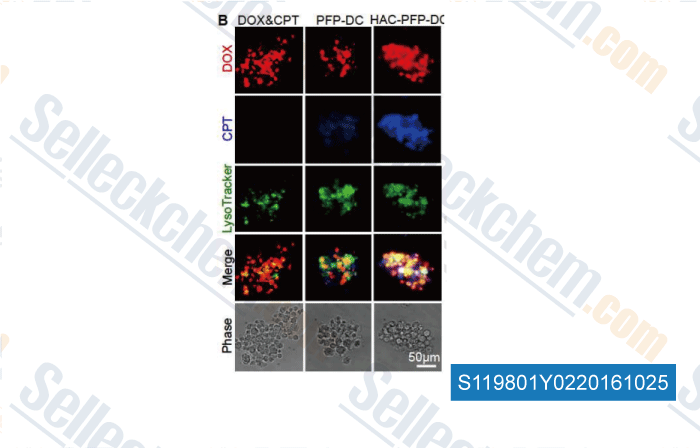
-
, , Biomaterials, 2015, 72:74-89.
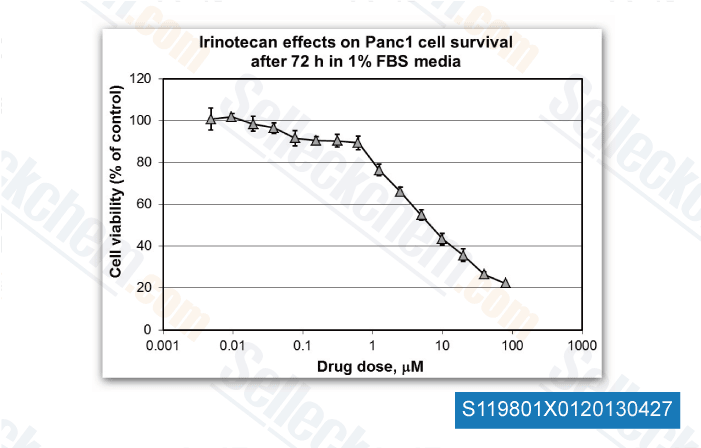
-
Dr. Edita Aksamitiene from Thomas Jefferson University, , Dr. Mikhail Menshikov of Cardiology Research Center
Selleck's Irinotecan (CPT-11) A été cité par 60 Publications
| Identification of novel drug-specific PARP inhibitor resistance mechanisms in ovarian cancer-implications for clinical practice [ Br J Cancer, 2026, 135(2):290-302] | PubMed: 41998207 |
| Vitrification-based tissue-to-organoid cryopreservation workflow for colorectal cancer [ N Biotechnol, 2026, 93:341-350] | PubMed: 42055114 |
| Characterization of the anticancer effect of mebendazole and its interaction with standard cytotoxic drugs in patient tumor cells ex vivo and in an in vivo mouse model [ Oncol Rep, 2026, 55(1)9] | PubMed: 41201043 |
| A pancreatic cancer organoid biobank links multi-omics signatures to therapeutic response and clinical evaluation of statin combination therapy [ Cell Stem Cell, 2025, S1934-5909(25)00265-6] | PubMed: 40812300 |
| A patient-derived T cell lymphoma biorepository uncovers pathogenetic mechanisms and host-related therapeutic vulnerabilities [ Cell Rep Med, 2025, S2666-3791(25)00102-8] | PubMed: 40147445 |
| Targeting of the G9a, DNMT1 and UHRF1 epigenetic complex as an effective strategy against pancreatic ductal adenocarcinoma [ J Exp Clin Cancer Res, 2025, 44(1):13] | PubMed: 39810240 |
| A Novel Modulator of Resistance for Oxaliplatin-Based Therapy for Colorectal Cancer: The ESCRT Family Member VPS4A [ Cells, 2025, 14(12)929] | PubMed: 40558556 |
| Homologous Repair-Deficient Pancreatic Cancer: Refined Targeting of DNA Damage Response is an Effective Therapeutic Strategy [ United Eur Gastroent, 2025, 13(7):1328-1342] | PubMed: 40823818 |
| The Synergistic Effect of PARP Inhibitors and Irinotecan in Small Cell Lung Cancer Cells [ Cancer Res Treat, 2025, 10.4143/crt.2024.728] | PubMed: 39788642 |
| Proteomic profiling identifies upregulation of aurora kinases causing resistance to taxane-type chemotherapy in triple negative breast cancer [ Sci Rep, 2025, 15(1):3211] | PubMed: 39863788 |
POLITIQUE DE RETOUR
La politique de retour inconditionnelle de Selleck Chemical garantit une expérience d'achat en ligne fluide à nos clients. Si vous n'êtes en aucun cas satisfait de votre achat, vous pouvez retourner tout article dans les 7 jours suivant sa réception. En cas de problèmes de qualité du produit, qu'il s'agisse de problèmes liés au protocole ou au produit, vous pouvez retourner tout article dans les 365 jours suivant la date d'achat initiale. Veuillez suivre les instructions ci-dessous lors du retour des produits.
EXPÉDITION ET STOCKAGE
Les produits Selleck sont transportés à température ambiante. Si vous recevez le produit à température ambiante, soyez assuré que le service d'inspection de la qualité de Selleck a mené des expériences pour vérifier que le placement à température normale pendant un mois n'affectera pas l'activité biologique des produits en poudre. Après réception, veuillez stocker le produit conformément aux exigences décrites dans la fiche technique. La plupart des produits Selleck sont stables dans les conditions recommandées.
NON DESTINÉ À UN USAGE HUMAIN, VÉTÉRINAIRE DIAGNOSTIQUE OU THÉRAPEUTIQUE.