
Données techniques
| Formule | C25H31N5O4 |
||||||||||
| Poids moléculaire | 465.54 | Numéro CAS | 938440-64-3 | ||||||||
| Solubilité (25°C)* | In vitro | DMSO | 20 mg/mL (42.96 mM) | ||||||||
| Water | Insoluble | ||||||||||
| Ethanol | Insoluble | ||||||||||
| In vivo (Ajouter les solvants au produit individuellement et dans l'ordre.) |
|
||||||||||
|
* <1 mg/ml signifie légèrement soluble ou insoluble. * Veuillez noter que Selleck teste la solubilité de tous les composés en interne, et la solubilité réelle peut différer légèrement des valeurs publiées. Ceci est normal et est dû à de légères variations d'un lot à l'autre. * Expédition à température ambiante (les tests de stabilité montrent que ce produit peut être expédié sans aucune mesure de refroidissement.) |
|||||||||||
Préparation des solutions mères
Activité biologique
| Description | KU-0063794 est un double inhibiteur puissant et hautement spécifique de mTOR de mTORC1 et mTORC2 avec une IC50 d'environ 10 nM dans les essais sans cellules ; aucun effet sur les PI3K. | ||||
|---|---|---|---|---|---|
| Cibles |
|
||||
| In vitro | Compared with the mTOR inhibitor PP242, KU-0063794 exhibits higher specificity for mTOR, as being inactive against PI3Ks or 76 other kinases. In HEK-293 cells, this compound at 30 nM is sufficient to rapidly ablate S6K1 activity by blocking the phosphorylation of the hydrophobic motif (Thr389) and subsequently the phosphorylation of the T-loop residue (Thr229). In case of IGF1 stimulation of serum-starved HEK-293 cells, 300 nM of this compound is needed to inhibit the S6K1 activity by ~90%. This chemical at 100-300 nM also completely inhibits the amino-acid-induced phosphorylation of S6K1 and S6 protein. Similar to S6K1, it inhibits the phosphorylation of mTORC1 at Ser2448 and mTORC2 at Ser2481 in a dose-dependent and time-dependent manner. In the presence of serum or following IGF1 stimulation, this compound induces a dose-dependent inhibition of the activity and phosphorylation of Akt at Ser473 and unexpected Thr308 as well as the phosphorylation of the Akt substrates PRAS40 at Thr246, GSK3α/GSK3β at Ser21/Ser9 and Foxo-1/3a at Thr24/Thr32. This compound but not rapamycin inhibits SGK1 activity and Ser422 phosphorylation as well as its physiological substrate NDGR1 in a dose-dependent manner, to the same extent as S6K1 and Akt phosphorylation, whereas it dose not inhibit phorbol ester induced ERK or RSK phosphorylation and RSK activation. Compared with rapamycin, this chemical exhibits more significant potency to induce the complete dephosphorylation of 4E-BP1 at Thr37, Thr46 and Ser65. It inhibits cell growth of both wild-type and mLST8-deficient MEFs and induces a G1 cell cycle arrest, more significantly than rapamycin. |
||||
| In vivo | Ku0063794 inhibits tumor growth and mTOR signaling in a preclinical renal cell carcinoma model. However, this compound was not more effective in the animal study. A possible explanation for lack of greater activity in vivo for this chemical. |
Protocole (de référence)
| Test kinase : |
|
|---|---|
| Test cellulaire : |
|
| Étude animale : |
|
Références
|
Validation du produit par le client
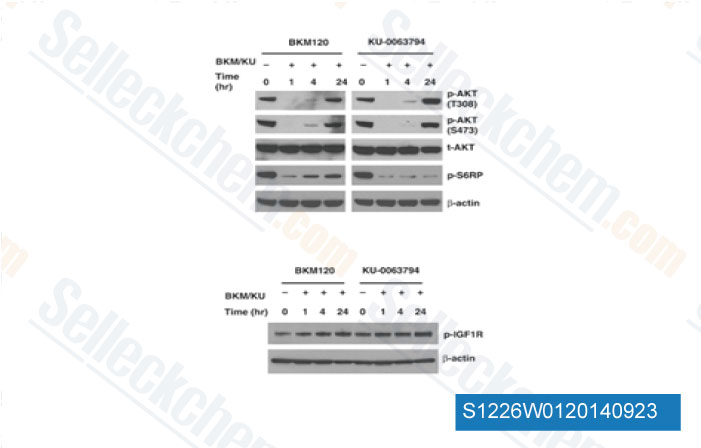
-
Données de [ Oncogene , 2013 , 10.1038/onc.2013.509 ]

-
Données de [ J Biol Chem , 2011 , 286, 39450-6 ]
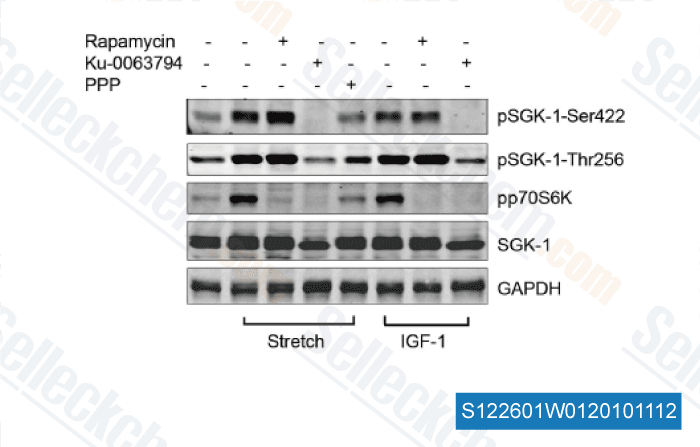
-
Données de [ Circ Res , 2010 , 107, 1265-1274 ]
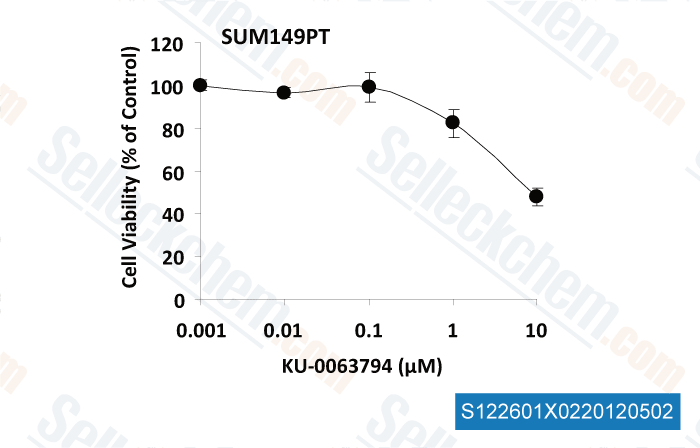
-
, , Dr. Yong-Weon Yi from Georgetown University Medical Center
Selleck's KU-0063794 A été cité par 84 Publications
| SLAP controls mTORC2 integrity via UBE3C-mediated non-degradative mLST8 ubiquitination to suppress colorectal tumorigenesis [ Cell Death Differ, 2026, 33(5):1020-1035] | PubMed: 41398047 |
| Molecular control of PDPNhi macrophage subset induction by ADAP as a host defense in sepsis [ JCI Insight, 2025, e186456] | PubMed: 39903516 |
| mTORC2-driven chromatin cGAS mediates chemoresistance through epigenetic reprogramming in colorectal cancer [ Nat Cell Biol, 2024, 10.1038/s41556-024-01473-0] | PubMed: 39080411 |
| Exploitation of the fibrinolytic system by B-cell acute lymphoblastic leukemia and its therapeutic targeting [ Nat Commun, 2024, 15(1):10059] | PubMed: 39567540 |
| mTORC1 regulates cell survival under glucose starvation through 4EBP1/2-mediated translational reprogramming of fatty acid metabolism [ Nat Commun, 2024, 15(1):4083] | PubMed: 38744825 |
| Resistin secreted by porcine alveolar macrophages leads to endothelial cell dysfunction during Haemophilus parasuis infection [ Virulence, 2023, 14(1):2171636] | PubMed: 36694280 |
| Mechanosensitive mTORC2 independently coordinates leading and trailing edge polarity programs during neutrophil migration [ Mol Biol Cell, 2023, 34(5):ar35] | PubMed: 36857159 |
| Combined Mcl-1 and YAP1/TAZ inhibition for treatment of metastatic uveal melanoma [ Melanoma Res, 2023, 10.1097/CMR.0000000000000911] | PubMed: 37467061 |
| Targeting the REF1/STAT3 axis to treat tuberous sclerosis [ Cardiff University, 2023, ] | PubMed: None |
| Aggresome assembly at the centrosome is driven by CP110-CEP97-CEP290 and centriolar satellites [ Nat Cell Biol, 2022, 24(4):483-496] | PubMed: 35411088 |
POLITIQUE DE RETOUR
La politique de retour inconditionnelle de Selleck Chemical garantit une expérience d'achat en ligne fluide à nos clients. Si vous n'êtes en aucun cas satisfait de votre achat, vous pouvez retourner tout article dans les 7 jours suivant sa réception. En cas de problèmes de qualité du produit, qu'il s'agisse de problèmes liés au protocole ou au produit, vous pouvez retourner tout article dans les 365 jours suivant la date d'achat initiale. Veuillez suivre les instructions ci-dessous lors du retour des produits.
EXPÉDITION ET STOCKAGE
Les produits Selleck sont transportés à température ambiante. Si vous recevez le produit à température ambiante, soyez assuré que le service d'inspection de la qualité de Selleck a mené des expériences pour vérifier que le placement à température normale pendant un mois n'affectera pas l'activité biologique des produits en poudre. Après réception, veuillez stocker le produit conformément aux exigences décrites dans la fiche technique. La plupart des produits Selleck sont stables dans les conditions recommandées.
NON DESTINÉ À UN USAGE HUMAIN, VÉTÉRINAIRE DIAGNOSTIQUE OU THÉRAPEUTIQUE.