Dacinostat (LAQ824)

N° de catalogueS1095 Lot :S109502

Imprimer

Données techniques

Formule

C22H25N3O3

Poids moléculaire 379.459 Numéro CAS 404951-53-7
Solubilité (25°C)* In vitro DMSO 76 mg/mL (200.28 mM)
Water Insoluble
Ethanol Insoluble
In vivo (Ajouter les solvants au produit individuellement et dans lordre.)
Homogeneous suspension
CMC-NA
≥5mg/ml Taking the 1 mL working solution as an example, add 5 mg of this product to 1 ml of CMC-Na solution, mix evenly to obtain a homogeneous suspension with a final concentration of 5 mg/ml.
Clear solution
4% DMSO 40% PEG300 56%saline

Validé par les laboratoires Selleck. Si vous avez besoin dajustements à cette formulation, contactez notre équipe commerciale pour des tests personnalisés.

3.760mg/ml (9.91mM) Taking the 1 mL working solution as an example, add 40 μL of 94 mg/ml clarified DMSO stock solution to 400 μL of PEG300, mix evenly to clarify it; then continue to add 560 μL of saline to adjust the volume to 1 mL. The mixed solution should be used immediately for optimal results. 
* <1 mg/ml signifie légèrement soluble ou insoluble.
* Veuillez noter que Selleck teste la solubilité de tous les composés en interne, et la solubilité réelle peut différer légèrement des valeurs publiées. Ceci est normal et est dû à de légères variations dun lot à lautre.
* Expédition à température ambiante (les tests de stabilité montrent que ce produit peut être expédié sans aucune mesure de refroidissement.)

Préparation des solutions mères

Activité biologique

Description Dacinostat (LAQ824, NVP-LAQ824) est un nouvel inhibiteur de la HDAC avec une IC50 de 32 nM et est connu pour activer le promoteur p21.
Cibles
p21 HDAC
(Cell-free assay)
32 nM
In vitro Dacinostat (LAQ824) active l'expression du gène codant pour l'inhibiteur du cycle cellulaire p21 en activant le promoteur p21 avec 50 % de l'activation maximale du promoteur (AC50) de 0,30 μM. Il inhibe la croissance cellulaire des lignées de carcinome pulmonaire non à petites cellules H1299 et de cellules de cancer du côlon HCT116 avec des IC50 respectives de 0,15 μM et 0,01 μM. L'effet antiprolifératif de ce composé est sélectif envers les lignées de cellules tumorales, n'induisant qu'un arrêt de croissance dans les fibroblastes normaux. De plus, il induit une augmentation dose-dépendante de la protéine p21 dans les cellules A549 et une augmentation de l'état hypophosphorylé du suppresseur de tumeurs Rb. Une étude récente montre que LAQ824 induit des changements de chromatine au niveau du promoteur du gène IL-10 qui conduisent à un recrutement accru des répresseurs transcriptionnels HDAC11 et PU.1 et inhibe la production d'IL-10 dans les macrophages murins BALB/c.
In vivo Dacinostat (LAQ824) produit des effets inhibiteurs sur la croissance tumorale de manière dose-dépendante sans cytotoxicité générale dans les xénogreffes de tumeurs du côlon humain et HCT116 chez la souris nude lorsqu'il est administré à 100 mg/kg.

Protocole (de référence)

Test kinase :[1]
  • Essai d'histone désacétylase in vitro

    Les enzymes HDAC sont partiellement purifiées à partir de lysat cellulaire H1299 par chromatographie d'échange d'ions en utilisant la colonne Q Sepharose Fast Flow. Les complexes enzymatiques sont collectés à partir de 500 mg de lysat cellulaire total par immunoprécipitation avec un anticorps polyclonal cdk2 ou un anticorps monoclonal cdk1/cdc2. Les immunoprécipités sont remis en suspension dans un tampon kinase (50 mM Hepes, pH 8, 10 mM MgCl2, 2,5 mM EDTA, 1 mM dithiothréitol, 20 mM ATP, 10 mM β-glycérophosphate, 0,1 mM NaVO4, 1 mM fluorure de sodium, 50 mM ATP, 10 μCi de [γ-32P]ATP) avec 1 μg de substrat protéique recombinant pRb (cdk2) ou 10 ml de mélange d'histones H1 contenant 20 μg de substrat (cdc2). Les histones Rb et H1 phosphorylées sont résolues par électrophorèse et quantifiées à l'aide d'un PhosphorImager. Ce composé, Dacinostat (LAQ824), est utilisé dans l'essai.

Test cellulaire :[1]
  • Lignées cellulaires

    H1299, HCT116, DU145, PC3 and MDA435 cells

  • Concentrations

    0-10 μM

  • Temps dincubation

    48 hours

  • Méthode

    Cell proliferation is measured using an adaptation of published procedures (3-(4,5-dimethylthiazol-2-yl)-5-(3-carboxymethoxy-phenyl)-2-(4-sulfonyl)-2H-tetrazolium assay). The cells are seeded in 12-well dishes and cultured in RPMI 1640 containing 10% FBS. To examine the growth inhibition by Dacinostat (LAQ824), the cells are cultured in the presence of various concentrations of this compound (up to 1,000 ng/mL). Viable cell numbers are determined by trypan blue dye exclusion, counted in a Nesbauer-type hemocytometer for 0 hour, 24 hours, and 48 hours. The same amount of ethanol is added to the RPMI 1640 medium as the control experiment. All experiments are performed in duplicate and repeated 3 times The average background value (treatment with medium alone) is subtracted from each experimental well; triplicate values are averaged for each compound dilution. The following formulas are used to calculate the percentage of growth: If X0, %Growth=(X-T0)/T0*100; If X>T0, %Growth=(X-T0)/(GC-T0)*100. where T0 is the average value of T0 − background, GC is the average value of untreated cells (in triplicate) − background, and X is the average value of compound-treated cells (in triplicate)-background. The “% Growth” is plotted against compound concentration and used to calculate the IC50 using the linear regression techniques between data points to predict the concentration of compounds at 50% inhibition.

Étude animale :[1]
  • Modèles animaux

    HCT116 cells is injected s.c. into the right axillary (lateral) region of outbred athymic (nu/nu) female mice.

  • Posologies

    ≤100 mg/kg

  • Administration

    Administered via i.v.

Références

  • https://pubmed.ncbi.nlm.nih.gov/14744786/
  • https://pubmed.ncbi.nlm.nih.gov/21368229/

Validation du produit par le client

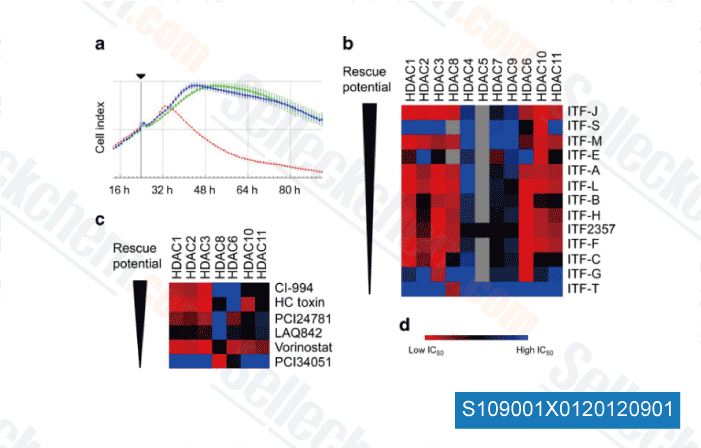
<p>Class I selective HDACi have the highest INS-1 rescue potential . INS-1 cells were monitored using the real-time xCELLigence system h and the impedance (cell adhesion) was measured as a surrogate of cell viability (cell index) as described in the Methods. (a ) The impedance of duplicates of control (green line), cytokine-exposed (red line) and cytokine+ITF-J-exposed INS-1 cells (blue line) was followed from the start of exposure (indicated by the arrow). Heat maps of 13 different ITF HDAC inhibitor compounds ( b )orsix different commercial HDAC inhibitor compounds (c) were made based on their IC50 values towards selected HDACs . The HDACi inhibitors are ranked after rescue potential according to ESM Tables 1, 2 .( c) Values are corrected for differences in potency since they varied from 33.3 (CI-994) to 0.041 (LAQ824). (d ) Colour code for both heat maps: low IC50 values coloured red, intermediate IC50 values coloured black and high IC50 values coloured blue; grey indicates undetermined IC50.</p>

Données de [ Diabetologia , 2012 , 55(9), 2421-31 ]
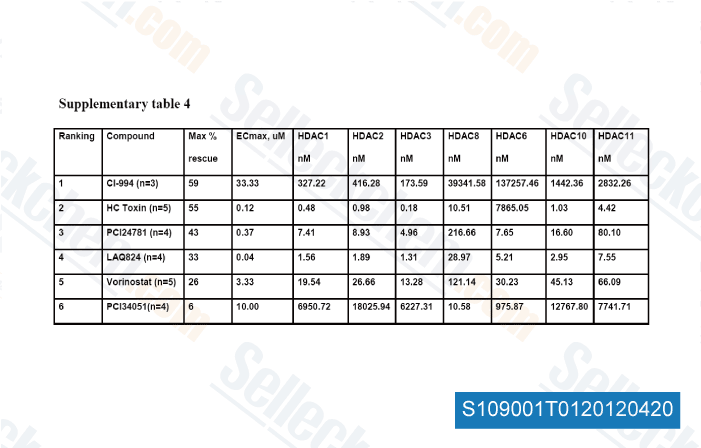
<p>Analyses of efficacy, potency and IC50 of HDAC inhibitors point toward HDACs 1–3 as relevant candidates for beta cell protection. Ranking and raw data on ITF drugs (Table 3) and commercial HDAC inhibitors (Table 4) underlying the heat maps of Fig. 1 (A and B). The HDAC inhibitor compounds were tested using a HDAC activity kit and recombinant proteins to determine IC50 values on each individual HDAC (right part of the table). Each drug was further tested using Real-Time Cell Analysis (RTCA) to score their maximal effective concentration (ECmax) as well as the corresponding rescue percentage of cytokine treated INS-1 cells. The drugs were ranked according to % rescue. * DMSO alone controls were included in each experiment, but not shown here. The results indicate that the highest concentrations of DMSO used here (1:1,000) were slightly potentiating the proliferation of the cells. The effects observed in this group of compounds were ascribed to the DMSO.?</p>

Données de [ Diabetologia , 2012 , 55(9), 2421-2431 ]
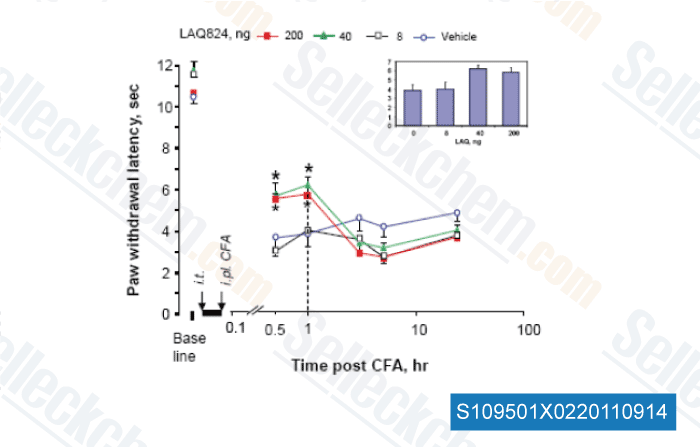
<p>Mice received intrathecally injected vehicle or  LAQ824 at indicated dose 30 min before unilateral injection of CFA. Paw withdrawal latency was measured before injections as baseline, and after CFA injections as hyperalgesia response.</p><div><div> </div></div><p> </p>

Données de [ Mol Pain , 2010 , 6, 51 ]
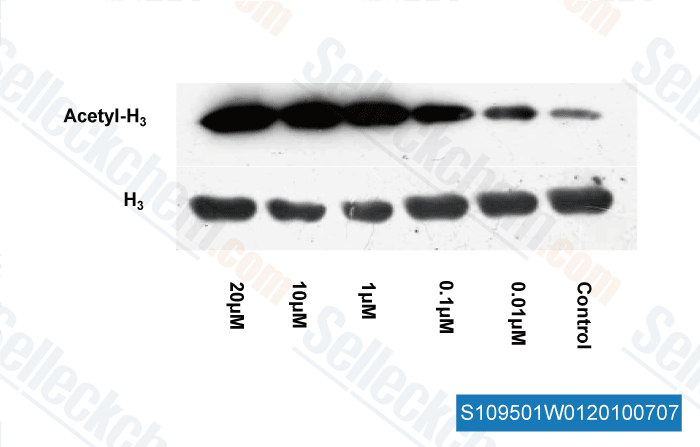
<p>Western blot analysis of Acetyl-H3 and H3. 0-10μM LAQ824 was added.</p><div><div> </div></div><p> </p>

, 2010 , Dr. Zhang of Tianjin Medical University

Sellecks Dacinostat (LAQ824) A été cité par 22 Publications

Inhibition of Notch Signaling Enhances Antitumor Activity of Histone Deacetylase Inhibitor LAQ824 [ Int J Mol Sci, 2023, 24(17)13660] PubMed: 37686467
Single-cell profiling-guided combination therapy of c-Fos and histone deacetylase inhibitors in diffuse large B-cell lymphoma [ Clin Transl Med, 2022, 12(5):e798] PubMed: 35522945
Histone Deacetylase Inhibitors as a Therapeutic Strategy to Eliminate Neoplastic "Stromal" Cells from Giant Cell Tumors of Bone [ Cancers (Basel), 2022, 14(19)4708] PubMed: 36230631
Locus specific epigenetic modalities of random allelic expression imbalance [ Nat Commun, 2021, 12(1):5330] PubMed: 34504093
Continuous Activity Assay for HDAC11 Enabling Reevaluation of HDAC Inhibitors [ ACS Omega, 2019, 4(22):19895-19904] PubMed: 31788622
Epigenetic Reprogramming with Antisense Oligonucleotides Enhances the Effectiveness of Androgen Receptor Inhibition in Castration-Resistant Prostate Cancer [ Cancer Res, 2018, 78(20):5731-5740] PubMed: 30135193
[ Cell Death Dis, 2018, ] PubMed: 29988031
Hippo signaling dysfunction induces cancer cell addiction to YAP [ Oncogene, 2018, 37(50):6414-6424] PubMed: 30068939
Identification of novel multi-stage histone deacetylase (HDAC) inhibitors that impair Schistosoma mansoni viability and egg production [ Parasit Vectors, 2018, 11(1):668] PubMed: 30587243
Measuring Histone Deacetylase Inhibition in the Brain [ Curr Protoc Pharmacol, 2018, 81(1):e41] PubMed: 29927058

POLITIQUE DE RETOUR
La politique de retour inconditionnelle de Selleck Chemical garantit une expérience dachat en ligne fluide à nos clients. Si vous nêtes en aucun cas satisfait de votre achat, vous pouvez retourner tout article dans les 7 jours suivant sa réception. En cas de problèmes de qualité du produit, quil sagisse de problèmes liés au protocole ou au produit, vous pouvez retourner tout article dans les 365 jours suivant la date dachat initiale. Veuillez suivre les instructions ci-dessous lors du retour des produits.

EXPÉDITION ET STOCKAGE
Les produits Selleck sont transportés à température ambiante. Si vous recevez le produit à température ambiante, soyez assuré que le service dinspection de la qualité de Selleck a mené des expériences pour vérifier que le placement à température normale pendant un mois naffectera pas lactivité biologique des produits en poudre. Après réception, veuillez stocker le produit conformément aux exigences décrites dans la fiche technique. La plupart des produits Selleck sont stables dans les conditions recommandées.

NON DESTINÉ À UN USAGE HUMAIN, VÉTÉRINAIRE DIAGNOSTIQUE OU THÉRAPEUTIQUE.