
Données techniques
| Formule | C32H34Cl2N4O4S |
||||||
| Poids moléculaire | 641.61 | Numéro CAS | 477575-56-7 | ||||
| Solubilité (25°C)* | In vitro | DMSO | 128 mg/mL (199.49 mM) | ||||
| Water | Insoluble | ||||||
| Ethanol | Insoluble | ||||||
| In vivo (Ajouter les solvants au produit individuellement et dans l'ordre.) |
|
||||||
|
* <1 mg/ml signifie légèrement soluble ou insoluble. * Veuillez noter que Selleck teste la solubilité de tous les composés en interne, et la solubilité réelle peut différer légèrement des valeurs publiées. Ceci est normal et est dû à de légères variations d'un lot à l'autre. * Expédition à température ambiante (les tests de stabilité montrent que ce produit peut être expédié sans aucune mesure de refroidissement.) |
|||||||
Préparation des solutions mères
Activité biologique
| Description | PHA-665752 est un inhibiteur puissant, sélectif et ATP-compétitif de c-Met avec une IC50 de 9 nM dans les essais sans cellules, >50 fois plus sélectif pour c-Met que les RTK ou STK. | ||||||
|---|---|---|---|---|---|---|---|
| Cibles |
|
||||||
| In vitro | PHA-665752 significantly inhibits c-Met kinase activity with Ki of 4 nM, and exhibits >50-fold selectivity for c-Met compared with various tyrosine and serine-threonine kinases. This compound potently inhibits the HGF-stimulated c-Met autophosphorylation with IC50 of 25-50 nM. It also significantly blocks HGF- and c-Met-dependent functions such as cell motility and cell proliferation with IC50 of 40-50 nM and 18-42 nM, respectively. In addition, this chemical potently inhibits HGF-stimulated or constitutive phosphorylation of mediators of downstream of c-Met such as Gab-1, ERK, Akt, STAT3, PLC-γ, and FAK in multiple tumor cell lines. It inhibits cell growth in TPR-MET-transformed BaF3 cells with IC50 of <60 nM, and inhibits constitutive cell motility and migration by 92.5% at 0.2 μM. Inhibition of c-Met by this compound (0.2 μM) also induces cell apoptosis of 33.1% and G1 cell cycle arrest with cells in G1 phase increasing from 42.4% to 77.0%. It can cooperate with rapamycin to inhibit cell growth of TPR-MET-transformed BaF3 cells and non-small cell lung cancer H441 cells. | ||||||
| In vivo | Administration of PHA-665752 induces a dose-dependent tumor growth inhibition of S114 xenografts by 20 %, 39% and 68%, at dose of 7.5, 15, and 30 mg/kg/day, respectively. This compound treatment significantly reduces the tumor growth of NCI-H69, NCI-H441 and A549 in mouse xenografts by 99%, 75%, and 59%, respectively. It also significantly inhibits angiogenesis by >85%, due to decreasing the production of vascular endothelial growth factor and increasing the production of the angiogenesis inhibitor thrombospondin-1. |
Protocole (de référence)
| Test kinase :[1] |
|
|---|---|
| Test cellulaire :[1] |
|
| Étude animale :[1] |
|
Références
|
Validation du produit par le client
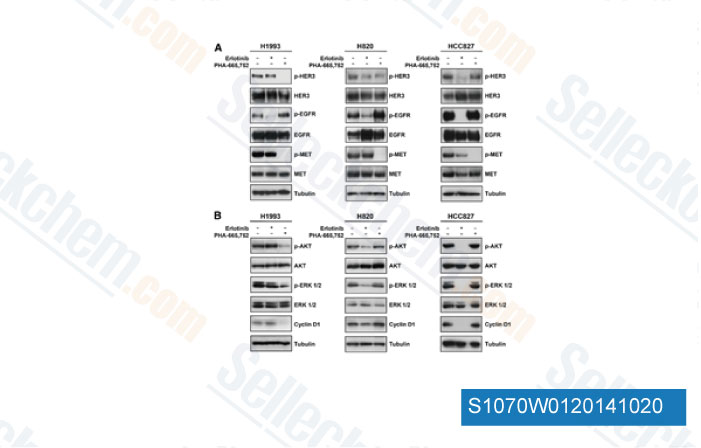
-
Données de [ Clin Cancer Res , 2014 , 20, 4806-15 ]
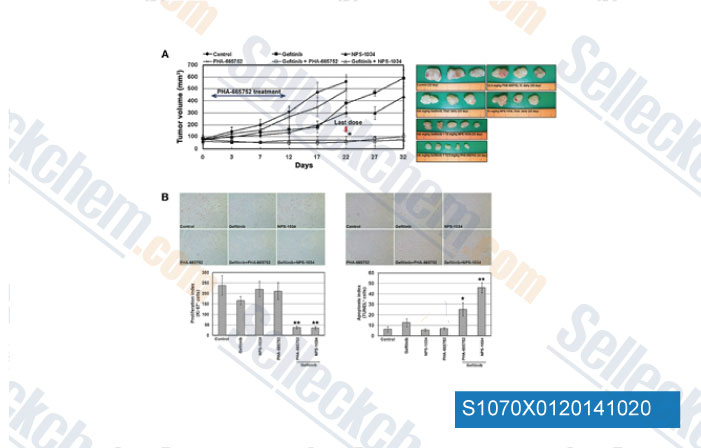
-
Données de [ Cancer Res , 2014 , 74, 253-62 ]
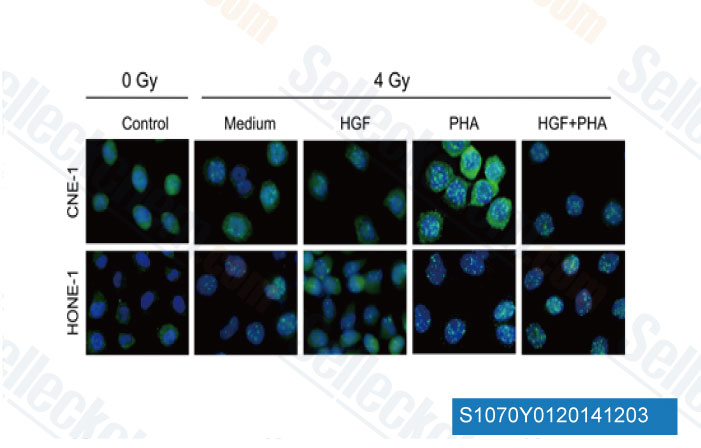
-
Données de [ Biochem Biophys Res Commun , 2014 , 449(1), 49-54 ]
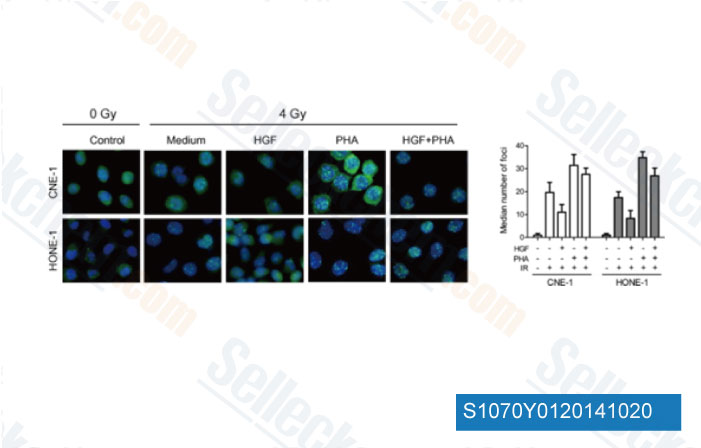
-
Données de [ Biochem Biophys Res Commun , 2014 , 449, 49-54 ]
Selleck's PHA-665752 A été cité par 100 Publications
| Inhibition of TFF3 synergizes with c-MET inhibitors to decrease the CSC-like phenotype and metastatic burden in ER+HER2+ mammary carcinoma [ Cell Death Dis, 2025, 16(1):76] | PubMed: 39920140 |
| Macrophage Subpopulation Promotes Skeletal Muscle Regeneration Through HGF/MET Signaling-Mediated Skeletal Muscle Stem Cell Proliferation [ Aging Cell, 2025, e70042.] | PubMed: 40132988 |
| Overcoming MET-targeted drug resistance in MET-amplified lung cancer by aurora kinase B inhibition [ Biochim Biophys Acta Mol Cell Res, 2025, 1872(7):120001] | PubMed: 40499687 |
| MET receptor serves as a promising target in melanoma brain metastases [ Acta Neuropathol, 2024, 147(1):44] | PubMed: 38386085 |
| LncRNA CHROMR/miR-27b-3p/MET axis promotes the proliferation, invasion, and contributes to rituximab resistance in diffuse large B-cell lymphoma [ J Biol Chem, 2024, 300(3):105762] | PubMed: 38367665 |
| Single targeting of MET in EGFR-mutated and MET-amplified non-small cell lung cancer [ Br J Cancer, 2023, 128(12):2186-2196] | PubMed: 37059804 |
| Cancer-Associated Fibroblasts Promote Radioresistance of Breast Cancer Cells via the HGF/c-Met Signaling Pathway [ Int J Radiat Oncol Biol Phys, 2023, 116(3):640-654] | PubMed: 36586496 |
| MET Receptor Tyrosine Kinase Inhibition Reduces Interferon-Gamma (IFN-γ)-Stimulated PD-L1 Expression through the STAT3 Pathway in Melanoma Cells [ Cancers (Basel), 2023, 15(13)3408] | PubMed: 37444518 |
| Cabozantinib inhibits HBV-RNA transcription by decreasing STAT3 binding to the enhancer region of cccDNA [ Hepatol Commun, 2023, 10.1097/HC9.0000000000000313] | PubMed: 37938099 |
| Dual-targeting therapy against HER3/MET in human colorectal cancers [ Cancer Med, 2023, 10.1002/cam4.5673] | PubMed: 36751113 |
POLITIQUE DE RETOUR
La politique de retour inconditionnelle de Selleck Chemical garantit une expérience d'achat en ligne fluide à nos clients. Si vous n'êtes en aucun cas satisfait de votre achat, vous pouvez retourner tout article dans les 7 jours suivant sa réception. En cas de problèmes de qualité du produit, qu'il s'agisse de problèmes liés au protocole ou au produit, vous pouvez retourner tout article dans les 365 jours suivant la date d'achat initiale. Veuillez suivre les instructions ci-dessous lors du retour des produits.
EXPÉDITION ET STOCKAGE
Les produits Selleck sont transportés à température ambiante. Si vous recevez le produit à température ambiante, soyez assuré que le service d'inspection de la qualité de Selleck a mené des expériences pour vérifier que le placement à température normale pendant un mois n'affectera pas l'activité biologique des produits en poudre. Après réception, veuillez stocker le produit conformément aux exigences décrites dans la fiche technique. La plupart des produits Selleck sont stables dans les conditions recommandées.
NON DESTINÉ À UN USAGE HUMAIN, VÉTÉRINAIRE DIAGNOSTIQUE OU THÉRAPEUTIQUE.