
Données techniques
| Formule | C15H20O3 |
||||||||||
| Poids moléculaire | 248.32 | Numéro CAS | 20554-84-1 | ||||||||
| Solubilité (25°C)* | In vitro | DMSO | 50 mg/mL (201.35 mM) | ||||||||
| Ethanol | 50 mg/mL (201.35 mM) | ||||||||||
| Water | Insoluble | ||||||||||
| In vivo (Ajouter les solvants au produit individuellement et dans lordre.) |
|
||||||||||
|
* <1 mg/ml signifie légèrement soluble ou insoluble. * Veuillez noter que Selleck teste la solubilité de tous les composés en interne, et la solubilité réelle peut différer légèrement des valeurs publiées. Ceci est normal et est dû à de légères variations dun lot à lautre. * Expédition à température ambiante (les tests de stabilité montrent que ce produit peut être expédié sans aucune mesure de refroidissement.) |
|||||||||||
Préparation des solutions mères
Activité biologique
| Description | Le (-)-Parthenolide, un inhibiteur de la voie du Nuclear Factor-κB, épuise spécifiquement la protéine HDAC1 sans affecter les autres HDAC de classe I/II; Il favorise également l'ubiquitination de MDM2 et active les fonctions cellulaires de p53. | ||||
|---|---|---|---|---|---|
| Cibles |
|
||||
| In vitro | Le Parthénolide (PTL), une lactone sesquiterpène purifiée à partir des pousses de la grande camomille, inhibe l'activité de l'ubiquitine-peptidase spécifique 7 (USP7) et déubiquitine et stabilise la β-caténine, qui est le facteur de transcription clé de la voie de signalisation Wnt, suggérant que le PTL est un agent anticancéreux prometteur ciblant la signalisation aberrante USP7/Wnt. |
||||
| In vivo | Le Parthénolide (PN), un inhibiteur de P65, augmente significativement le volume des tumeurs dans un modèle murin de xénogreffe sous-cutanée de cancer gastrique (CG), ce qui peut être inversé par la gastrine. |
Protocole (de référence)
| Test cellulaire : |
|
|---|---|
| Étude animale : |
|
Références
|
Validation du produit par le client
-Parthenolide-S234101W0220161110.gif)
-
, , Harvard University, 2014.
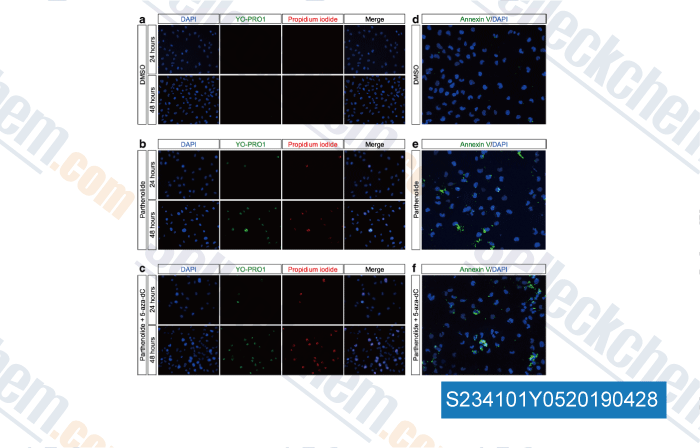
-
Données de [ , , Cell Oncol (Dordr), 2017, 40(3):263-279 ]
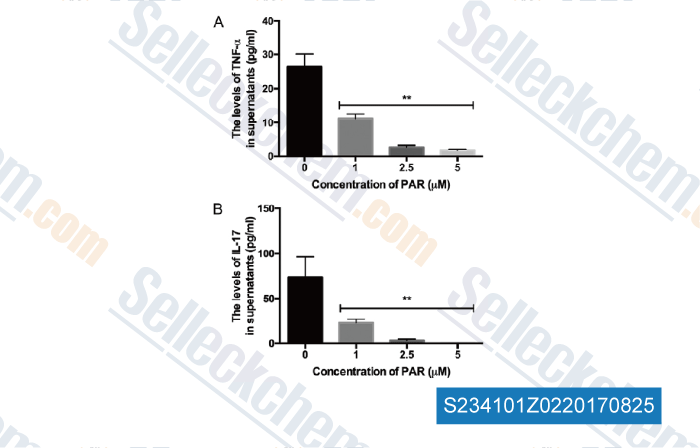
-
Données de [ , , J Neuroimmunol, 2017, 305:154-161 ]
Sellecks (-)-Parthenolide A été cité par 27 Publications
| Ketogenic diet and β-hydroxybutyrate inhibit HDAC1 to preserve vascular smooth muscle cell function in thoracic aortic aneurysm [ J Adv Res, 2025, S2090-1232(25)00353-4] | PubMed: 40398746 |
| Synergistic activity of S63845 and parthenolide to overcome acquired resistance to MEK1/2 inhibitor in melanoma cells: Mechanisms and therapeutic potential [ Biomed Pharmacother, 2025, 188:118183] | PubMed: 40424823 |
| Development of translational read-through-inducing drugs as novel therapeutic options for patients with Fanconi anemia [ Cell Death Discov, 2025, 11(1):286] | PubMed: 40544182 |
| TNFSF14-HVEM/LTβR Exacerbates Keratinocyte Abnormalities and IMQ-Induced Psoriatic Skin Inflammation via Activating NF-κB/TWIST1 Signalling Pathway [ J Cell Mol Med, 2025, 29(15):e70774] | PubMed: 40768619 |
| Astaxanthin suppresses the malignant behaviors of nasopharyngeal carcinoma cells by blocking PI3K/AKT and NF-κB pathways via miR-29a-3p [ Genes Environ, 2024, 46(1):10] | PubMed: 38649975 |
| Parthenolide Targets NLRP3 to Treat Inflammasome-Related Diseases [ Int Immunopharmacol, 2023, 119:110229.] | PubMed: 37167640 |
| Connexin43 is associated with the progression of clear cell renal carcinoma and is regulated by tangeretin to sygergize with tyrosine kinase inhibitors [ Transl Oncol, 2023, 35:101712] | PubMed: 37354638 |
| Histone deacetylase 1 controls cardiomyocyte proliferation during embryonic heart development and cardiac regeneration in zebrafish [ PLoS Genet, 2021, 17(11):e1009890] | PubMed: 34723970 |
| Reduced Mitochondrial Apoptotic Priming Drives Resistance to BH3 Mimetics in Acute Myeloid Leukemia [ Cancer Cell, 2020, 38(6):872-890.e6] | PubMed: 33217342 |
| Lack of FGF21 promotes NASH-HCC transition via hepatocyte-TLR4-IL-17A signaling [ Theranostics, 2020, 10(22):9923-9936] | PubMed: 32929325 |
POLITIQUE DE RETOUR
La politique de retour inconditionnelle de Selleck Chemical garantit une expérience dachat en ligne fluide à nos clients. Si vous nêtes en aucun cas satisfait de votre achat, vous pouvez retourner tout article dans les 7 jours suivant sa réception. En cas de problèmes de qualité du produit, quil sagisse de problèmes liés au protocole ou au produit, vous pouvez retourner tout article dans les 365 jours suivant la date dachat initiale. Veuillez suivre les instructions ci-dessous lors du retour des produits.
EXPÉDITION ET STOCKAGE
Les produits Selleck sont transportés à température ambiante. Si vous recevez le produit à température ambiante, soyez assuré que le service dinspection de la qualité de Selleck a mené des expériences pour vérifier que le placement à température normale pendant un mois naffectera pas lactivité biologique des produits en poudre. Après réception, veuillez stocker le produit conformément aux exigences décrites dans la fiche technique. La plupart des produits Selleck sont stables dans les conditions recommandées.
NON DESTINÉ À UN USAGE HUMAIN, VÉTÉRINAIRE DIAGNOSTIQUE OU THÉRAPEUTIQUE.