
Données techniques
| Formule | C21H23N7O2S.HCl |
||||||
| Poids moléculaire | 473.98 | Numéro CAS | 635702-64-6 | ||||
| Solubilité (25°C)* | In vitro | DMSO | 95 mg/mL (200.43 mM) | ||||
| Water | 95 mg/mL (200.43 mM) | ||||||
| Ethanol | Insoluble | ||||||
| In vivo (Ajouter les solvants au produit individuellement et dans lordre.) |
|
||||||
|
* <1 mg/ml signifie légèrement soluble ou insoluble. * Veuillez noter que Selleck teste la solubilité de tous les composés en interne, et la solubilité réelle peut différer légèrement des valeurs publiées. Ceci est normal et est dû à de légères variations dun lot à lautre. * Expédition à température ambiante (les tests de stabilité montrent que ce produit peut être expédié sans aucune mesure de refroidissement.) |
|||||||
Préparation des solutions mères
Activité biologique
| Description | Pazopanib HCl est un nouvel inhibiteur multi-cibles de VEGFR1, VEGFR2, VEGFR3, PDGFR, FGFR, c-Kit et c-Fms avec une IC50 de 10 nM, 30 nM, 47 nM, 84 nM, 74 nM, 140 nM et 146 nM dans des essais acellulaires, respectivement. Pazopanib induit la mort cellulaire autophagique de Type II. | |||||||||||
|---|---|---|---|---|---|---|---|---|---|---|---|---|
| Cibles |
|
|||||||||||
| In vitro | Pazopanib inhibe puissamment la phosphorylation de VEGFR2 induite par le VEGF dans les cellules HUVEC avec une IC50 de 8 nM. Pazopanib montre une inhibition de croissance dose-dépendante dans toutes les lignées cellulaires de sarcome synovial, y compris les cellules SYO-1 et HS-SY-II. La prolifération des cellules SYO-1 et HS-SY-II est inhibée même à 1 µg/mL de Pazopanib et est complètement abolie à 5 µg/mL. Pazopanib induit un arrêt en phase G1, et supprime ainsi la croissance des cellules de sarcome synovial. La phosphorylation des Akts, GSK-3β, JNKs, p70 S6 Kinase et mTOR est supprimée dans les cellules SYO-1 traitées avec Pazopanib par rapport à celle des cellules traitées par véhicule. Pazopanib entre 20 m g/mL et 22,5 m g/mL montre une réduction croissante de la viabilité des cellules RPE. | |||||||||||
| In vivo | Les souris traitées avec 30 mg/kg ou 100 mg/kg de Pazopanib révèlent une diminution significative de la charge tumorale par rapport aux souris traitées avec le véhicule ou 10 mg/kg de Pazopanib. Le traitement avec Pazopanib est bien toléré et il n'y a pas de différence significative dans le poids corporel entre les souris de chaque groupe. | |||||||||||
| Caractéristiques | Un inhibiteur multi-kinase. |
Protocole (de référence)
| Test kinase : |
|
|---|---|
| Test cellulaire : |
|
| Étude animale : |
|
Références
|
Validation du produit par le client
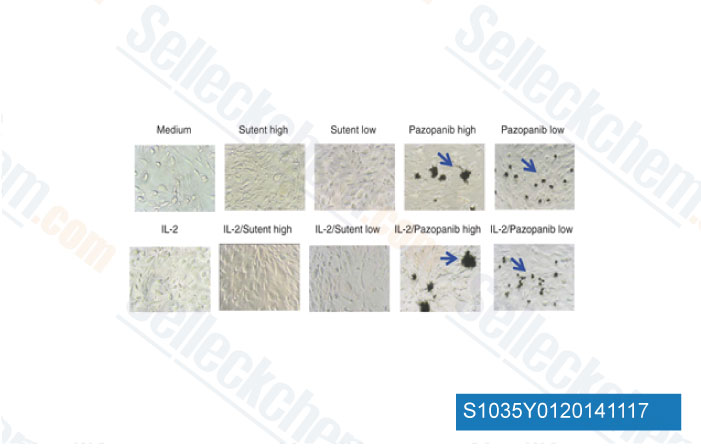
-
Données de [ Expert Opin Pharmacother , 2014 , 15(11), 1489-99 ]
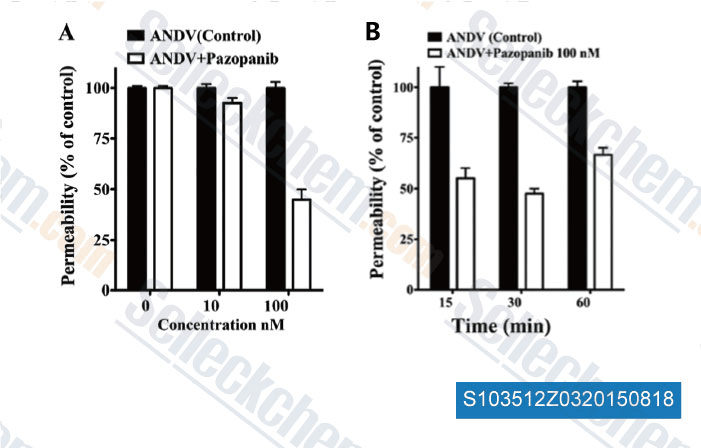
-
Données de [ , , J Virol, 2011, 85(5): 2296-303 ]
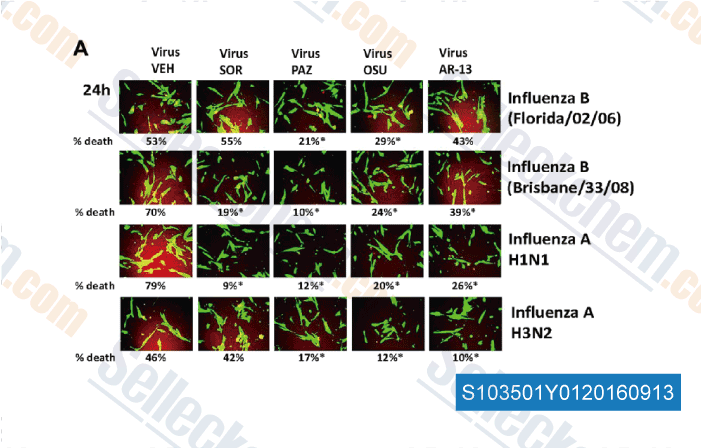
-
Données de [ , , J Cell Physiol, 2016, 231(10):2286-302. ]
Sellecks Pazopanib HCl A été cité par 57 Publications
| Patient-derived rhabdomyosarcoma cells recapitulate the genetic and transcriptomic landscapes of primary tumors [ iScience, 2024, 27(10):110862] | PubMed: 39319271 |
| Cutoff value of IC50 for drug sensitivity in patient-derived tumor organoids in colorectal cancer [ iScience, 2023, 26(7):107116] | PubMed: 37426352 |
| Therapeutic and immunomodulatory potential of pazopanib in malignant phyllodes tumor [ NPJ Breast Cancer, 2022, 8(1):44] | PubMed: 35365682 |
| Establishment and Characterization of NCC-PMP1-C1: A Novel Patient-Derived Cell Line of Metastatic Pseudomyxoma Peritonei [ J Pers Med, 2022, 12(2)258] | PubMed: 35207746 |
| Establishment and characterization of NCC-UPS4-C1: a novel cell line of undifferentiated pleomorphic sarcoma from a patient with Li-Fraumeni syndrome [ Hum Cell, 2022, 10.1007/s13577-022-00671-y] | PubMed: 35118583 |
| Preclinical Evaluation of Ixabepilone in Combination with VEGF Receptor and PARP Inhibitors in Taxane-Sensitive and Taxane-Resistant MDA-MB-231 Breast Cancer Cells [ J Pharm Sci, 2022, 111(8):2180-2190] | PubMed: 35700798 |
| Pazopanib restricts small cell lung cancer proliferation via reactive oxygen species-mediated endoplasmic reticulum stress [ Thorac Cancer, 2022, 13(17):2421-2428] | PubMed: 35866204 |
| Proteogenomic characterization identifies clinically relevant subgroups of intrahepatic cholangiocarcinoma [ Cancer Cell, 2021, S1535-6108(21)00659-0] | PubMed: 34971568 |
| Integrated transcriptional-phenotypic analysis captures systemic immunomodulation following antiangiogenic therapy in renal cell carcinoma patients [ Clin Transl Med, 2021, 11(6):e434] | PubMed: 34185403 |
| Synergistic PIM kinase and proteasome inhibition as a therapeutic strategy for MYC-overexpressing triple-negative breast cancer [ Cell Chem Biol, 2021, S2451-9456(21)00400-1] | PubMed: 34525344 |
POLITIQUE DE RETOUR
La politique de retour inconditionnelle de Selleck Chemical garantit une expérience dachat en ligne fluide à nos clients. Si vous nêtes en aucun cas satisfait de votre achat, vous pouvez retourner tout article dans les 7 jours suivant sa réception. En cas de problèmes de qualité du produit, quil sagisse de problèmes liés au protocole ou au produit, vous pouvez retourner tout article dans les 365 jours suivant la date dachat initiale. Veuillez suivre les instructions ci-dessous lors du retour des produits.
EXPÉDITION ET STOCKAGE
Les produits Selleck sont transportés à température ambiante. Si vous recevez le produit à température ambiante, soyez assuré que le service dinspection de la qualité de Selleck a mené des expériences pour vérifier que le placement à température normale pendant un mois naffectera pas lactivité biologique des produits en poudre. Après réception, veuillez stocker le produit conformément aux exigences décrites dans la fiche technique. La plupart des produits Selleck sont stables dans les conditions recommandées.
NON DESTINÉ À UN USAGE HUMAIN, VÉTÉRINAIRE DIAGNOSTIQUE OU THÉRAPEUTIQUE.