
Données techniques
| Formule | C37H42F2N8O4 |
||||||
| Poids moléculaire | 700.78 | Numéro CAS | 171228-49-2 | ||||
| Solubilité (25°C)* | In vitro | DMSO | 100 mg/mL (142.69 mM) | ||||
| Water | Insoluble | ||||||
| Ethanol | Insoluble | ||||||
| In vivo (Ajouter les solvants au produit individuellement et dans lordre.) |
|
||||||
|
* <1 mg/ml signifie légèrement soluble ou insoluble. * Veuillez noter que Selleck teste la solubilité de tous les composés en interne, et la solubilité réelle peut différer légèrement des valeurs publiées. Ceci est normal et est dû à de légères variations dun lot à lautre. * Expédition à température ambiante (les tests de stabilité montrent que ce produit peut être expédié sans aucune mesure de refroidissement.) |
|||||||
Préparation des solutions mères
Activité biologique
| Description | Posaconazole est un inhibiteur principalement du CYP3A4, mais il n'inhibe pas l'activité des autres enzymes CYP; C'est aussi un inhibiteur de la stérol C14ɑ déméthylase avec une IC50 de 0,25 μM. Ce composé a une demi-vie d'élimination terminale médiane de 15 à 35 heures. | ||
|---|---|---|---|
| Cibles |
|
||
| In vitro | Posaconazole a une puissante activité trypanocide. L'amiodarone agit en synergie avec ce composé. Il affecte également et perturbe l'homéostasie du Ca2+ chez T. cruzi. Ce produit chimique bloque la biosynthèse de l'ergostérol, qui est essentiel à la survie du parasite. Il a un effet clair, dose-dépendant sur la prolifération des stades épimastigotes (extracellulaires), avec une concentration minimale inhibitrice de 20 nM et une IC50 de 14 nM. Contre la forme amastigote intracellulaire cliniquement pertinente du parasite, ce composé est encore plus puissant. Il a des valeurs de concentration minimale inhibitrice et d'IC50 de 3 nM et 0,25 nM. Il est actif contre les isolats de Candida et Aspergillus spp. qui présentent une résistance au Fluconazole, au Voriconazole et à l'Amphotéricine B et est beaucoup plus actif que les autres triazoles contre les zygomycètes. |
||
| In vivo | Le traitement des animaux infectés avec de l'amiodarone seule réduit la parasitémie, augmente la survie 60 jours post-infection (0% pour les contrôles non traités contre 40% pour les animaux traités à l'amiodarone) et, lorsqu'elle est administrée en association avec Posaconazole, retarde le développement de la parasitémie. La coadministration de ce composé et de Boost Plus augmente l'exposition au médicament par rapport à l'administration de ce composé seul à jeun. La nourriture, en particulier les repas riches en matières grasses, augmente significativement la biodisponibilité de ce composé. L'exposition systémique à ce composé augmente de 4 et 2,6 fois lorsqu'il est consommé avec un repas riche en matières grasses et un repas sans matières grasses, respectivement. Ce composé et l'amiodarone peuvent constituer une thérapie anti-T. cruzi efficace avec peu d'effets secondaires. À des doses deux fois par jour de ≥15 mg/kg de poids corporel, ce composé prolonge la survie des souris et réduit la charge tissulaire. |
||
| Caractéristiques | Actuellement, le candidat le plus avancé pour le traitement de la maladie de Chagas. |
Protocole (de référence)
| Test cellulaire : |
|
|---|---|
| Étude animale : |
|
Références
|
Validation du produit par le client
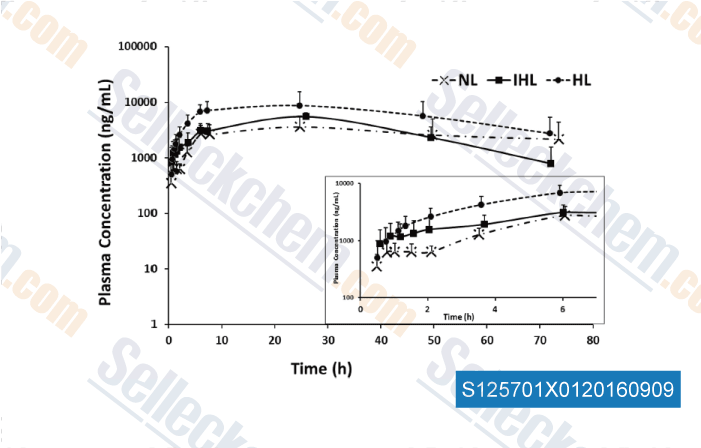
-
Données de [ , , Eur J Pharm Sci, 2016, 91:190-195. ]
Sellecks Posaconazole A été cité par 28 Publications
| Pyrvinium Pamoate Synergizes with Azoles in vitro and in vivo to Exert Antifungal Efficacy Against Candida auris and Other Candida Species [ Infect Drug Resist, 2025, 18:783-789] | PubMed: 39958982 |
| Interactions between antifungals and everolimus against Cryptococcus neoformans [ Front Cell Infect Microbiol, 2023, 13:1131641] | PubMed: 37026056 |
| The Synergistic Effect of Tacrolimus (FK506) or Everolimus and Azoles Against Scedosporium and Lomentospora Species In Vivo and In Vitro [ Front Cell Infect Microbiol, 2022, 12:864912] | PubMed: 35493742 |
| Synergistic effect of pyrvinium pamoate and posaconazole against Cryptococcus neoformans in vitro and in vivo [ Front Cell Infect Microbiol, 2022, 12:1074903] | PubMed: 36569209 |
| Terconazole, an Azole Antifungal Drug, Increases Cytotoxicity in Antimitotic Drug-Treated Resistant Cancer Cells with Substrate-Specific P-gp Inhibitory Activity [ Int J Mol Sci, 2022, 23(22)13809] | PubMed: 36430288 |
| A Preliminary in vitro and in vivo Evaluation of the Effect and Action Mechanism of 17-AAG Combined With Azoles Against Azole-Resistant Candida spp [ Front Microbiol, 2022, 13:825745] | PubMed: 35875545 |
| The synergistic effect of minocycline and azole antifungal drugs against Scedosporium and Lomentospora species [ BMC Microbiol, 2022, 22(1):21] | PubMed: 35016611 |
| The Role of Isavuconazonium Sulphate for the Treatment of Blastomycosis: A Case Series and Antifungal Susceptibility [ Open Forum Infect Dis, 2022, 9(7):ofac220] | PubMed: 35821730 |
| In Vitro and In Vivo Interactions of TOR Inhibitor AZD8055 and Azoles against Pathogenic Fungi [ Microbiol Spectr, 2022, 10(1):e0200721] | PubMed: 35019705 |
| Antifungal Activity of Minocycline and Azoles Against Fluconazole-Resistant Candida Species [ Front Microbiol, 2021, 12:649026] | PubMed: 34054751 |
POLITIQUE DE RETOUR
La politique de retour inconditionnelle de Selleck Chemical garantit une expérience dachat en ligne fluide à nos clients. Si vous nêtes en aucun cas satisfait de votre achat, vous pouvez retourner tout article dans les 7 jours suivant sa réception. En cas de problèmes de qualité du produit, quil sagisse de problèmes liés au protocole ou au produit, vous pouvez retourner tout article dans les 365 jours suivant la date dachat initiale. Veuillez suivre les instructions ci-dessous lors du retour des produits.
EXPÉDITION ET STOCKAGE
Les produits Selleck sont transportés à température ambiante. Si vous recevez le produit à température ambiante, soyez assuré que le service dinspection de la qualité de Selleck a mené des expériences pour vérifier que le placement à température normale pendant un mois naffectera pas lactivité biologique des produits en poudre. Après réception, veuillez stocker le produit conformément aux exigences décrites dans la fiche technique. La plupart des produits Selleck sont stables dans les conditions recommandées.
NON DESTINÉ À UN USAGE HUMAIN, VÉTÉRINAIRE DIAGNOSTIQUE OU THÉRAPEUTIQUE.