
Données techniques
| Formule | C24H18F2N2O5 |
||||||
| Poids moléculaire | 452.41 | Numéro CAS | 936727-05-8 | ||||
| Solubilité (25°C)* | In vitro | DMSO | 90 mg/mL (198.93 mM) | ||||
| Ethanol | 4 mg/mL (8.84 mM) | ||||||
| Water | Insoluble | ||||||
| In vivo (Ajouter les solvants au produit individuellement et dans lordre.) |
|
||||||
|
* <1 mg/ml signifie légèrement soluble ou insoluble. * Veuillez noter que Selleck teste la solubilité de tous les composés en interne, et la solubilité réelle peut différer légèrement des valeurs publiées. Ceci est normal et est dû à de légères variations dun lot à lautre. * Expédition à température ambiante (les tests de stabilité montrent que ce produit peut être expédié sans aucune mesure de refroidissement.) |
|||||||
Préparation des solutions mères
Activité biologique
| Description | Le Lumacaftor (VX-809, VRT 826809) agit pour corriger les mutations du CFTR courantes dans la mucoviscidose en augmentant la maturation du CFTR mutant (F508del-CFTR), EC50 de 0,1 μM dans les cellules thyroïdiennes de rat Fisher. Phase 3. | ||
|---|---|---|---|
| Cibles |
|
||
| In vitro | Le Lumacaftor (VX-809) agit au niveau du RE pour permettre à une fraction du F508del-CFTR d'adopter une forme correctement repliée, de sortir du RE et de se mobiliser vers la surface cellulaire pour un fonctionnement normal. Dans les cellules thyroïdiennes de rat Fischer (FRT) exprimant le F508del-CFTR, le traitement par ce composé améliore significativement la maturation du F508del-CFTR de 7,1 fois avec une EC50 de 0,1 μM, et améliore le transport du chlorure médié par le F508del-CFTR d'environ 5 fois avec une EC50 de 0,5 μM, tandis que le VRT-768 a des valeurs d'EC50 plus élevées de 7,9 μM et 16 μM, respectivement. Dans les cellules HEK-293 exprimant le F508del-CFTR, il (3 μM) augmente la sortie du F508del-CFTR du RE de 6 fois, atteignant des niveaux comparables à 34 % du CFTR. Dans les cellules épithéliales bronchiques humaines primaires (HBE) avec la mutation F508del-CFTR, l'agent augmente la maturation du CFTR et améliore la sécrétion de chlorure avec des EC50 de 350 nM et 81 nM, respectivement, plus efficace que le Corr-4a et le VRT-325. Le F508del-CFTR corrigé par lui présente une probabilité d'ouverture de canal unique de 0,39 similaire à celle du CFTR normal de 0,40. Contrairement au VX-770, ce n'est pas un potentialisateur du CFTR, car une addition aiguë n'a aucun effet sur la fonction du F508del-CFTR. Contrairement au VRT-325 et au Corr-4a, il n'améliore pas le traitement des formes normales ou mutantes de hERG ou de P-gp, ainsi que d'autres protéines mal localisées causant des maladies, y compris le mutant α1-antitrypsine Z (E342K-α1-AT) ou la N370S-β-glucosidase, suggérant qu'il est spécifique au CFTR. Il, en combinaison avec le VRT-325 ou le Corr-4a, a un effet additif sur le transport du chlorure médié par le CFTR dans les F508del-HBE cultivées. |
||
| In vivo | Lumacaftor (VX-809; VRT 826809) est un modulateur du CFTR qui corrige le repliement et le trafic de la protéine CFTR. |
||
| Caractéristiques | Spécificité et efficacité plus élevées par rapport à d'autres médicaments contre les défauts du CFTR. |
Protocole (de référence)
| Test kinase : |
|
|---|---|
| Test cellulaire : |
|
| Étude animale : |
|
Références
|
Validation du produit par le client
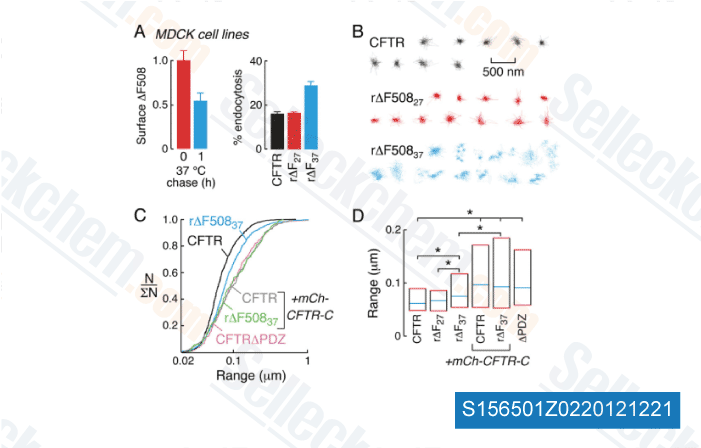
-
Données de [ J Biol Chem , 2012 , 287, 43630-8 ]
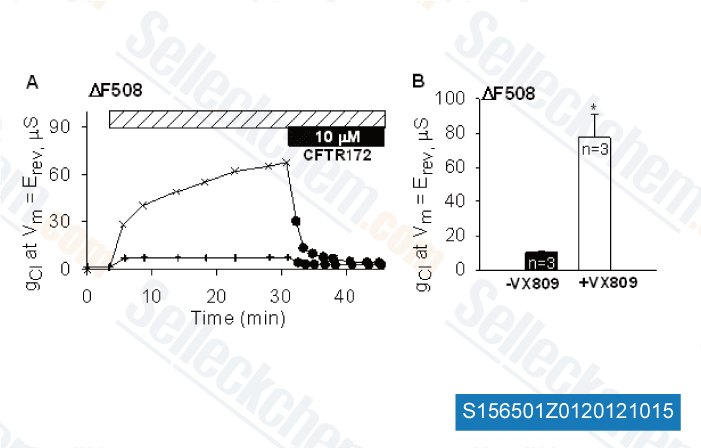
-
, , Xuehong Liu of Oregon Health & Science University
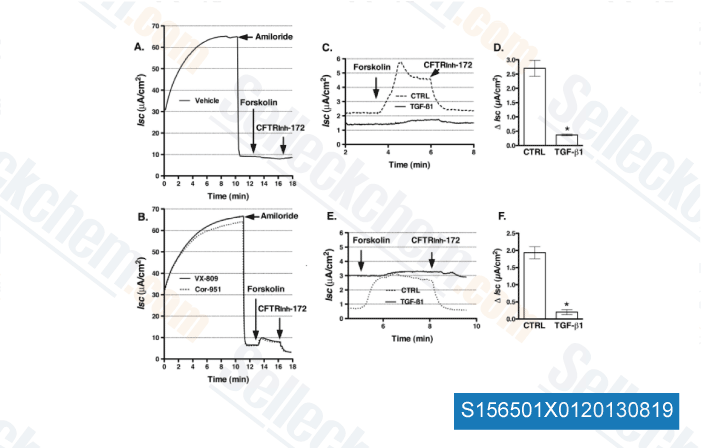
-
,

-
Données de [ , , Mol Pharm, 2018, 15(3):759-767 ]
Sellecks VX-809 (Lumacaftor) A été cité par 240 Publications
| ACE-tRNAs are a platform technology for suppressing nonsense mutations that cause cystic fibrosis [ Nucleic Acids Res, 2025, 53(13)gkaf675] | PubMed: 40650978 |
| In silico, in vitro and ex vivo characterization of cystic fibrosis transmembrane conductance regulator pathogenic variants localized in the fourth intracellular loop and their rescue by modulators [ Br J Pharmacol, 2025, 10.1111/bph.70176] | PubMed: 40831301 |
| Global functional genomics reveals GRK5 as a cystic fibrosis therapeutic target synergistic with current modulators [ iScience, 2025, 28(3):111942] | PubMed: 40040803 |
| Human Induced Lung Organoids: A Promising Tool for Cystic Fibrosis Drug Screening [ Int J Mol Sci, 2025, 26(2)437] | PubMed: 39859153 |
| Nasal cells as a bronchial cell surrogate for pre-clinical assessment of drug response in cystic fibrosis [ Front Pharmacol, 2025, 16:1651122] | PubMed: 40978488 |
| Inhibitors of the ubiquitin‑proteasome system rescue cellular levels and ion transport function of pathogenic pendrin (SLC26A4) protein variants [ Int J Mol Med, 2025, 55(5)69] | PubMed: 40052591 |
| The Inhibition of the Membrane-Bound Transcription Factor Site-1 Protease (MBTP1) Alleviates the p.Phe508del-Cystic Fibrosis Transmembrane Conductance Regulator (CFTR) Defects in Cystic Fibrosis Cells [ Cells, 2024, 13(2)185] | PubMed: 38247876 |
| Comprehensive Assessment of CFTR Modulators' Therapeutic Efficiency for N1303K Variant [ Int J Mol Sci, 2024, 25(5)2770] | PubMed: 38474016 |
| Estimation of Chloride Channel Residual Function and Assessment of Targeted Drugs Efficiency in the Presence of a Complex Allele [L467F;F508del] in the CFTR Gene [ Int J Mol Sci, 2024, 25(19)10424] | PubMed: 39408749 |
| The F508del-CFTR trafficking correctors elexacaftor and tezacaftor are CFTR-independent Ca2+-mobilizing agonists normalizing abnormal Ca2+ levels in human airway epithelial cells [ Respir Res, 2024, 25(1):436] | PubMed: 39702307 |
POLITIQUE DE RETOUR
La politique de retour inconditionnelle de Selleck Chemical garantit une expérience dachat en ligne fluide à nos clients. Si vous nêtes en aucun cas satisfait de votre achat, vous pouvez retourner tout article dans les 7 jours suivant sa réception. En cas de problèmes de qualité du produit, quil sagisse de problèmes liés au protocole ou au produit, vous pouvez retourner tout article dans les 365 jours suivant la date dachat initiale. Veuillez suivre les instructions ci-dessous lors du retour des produits.
EXPÉDITION ET STOCKAGE
Les produits Selleck sont transportés à température ambiante. Si vous recevez le produit à température ambiante, soyez assuré que le service dinspection de la qualité de Selleck a mené des expériences pour vérifier que le placement à température normale pendant un mois naffectera pas lactivité biologique des produits en poudre. Après réception, veuillez stocker le produit conformément aux exigences décrites dans la fiche technique. La plupart des produits Selleck sont stables dans les conditions recommandées.
NON DESTINÉ À UN USAGE HUMAIN, VÉTÉRINAIRE DIAGNOSTIQUE OU THÉRAPEUTIQUE.