
Données techniques
| Formule | C20H15ClN4.2HCl |
||||||
| Poids moléculaire | 419.73 | Numéro CAS | 212141-51-0 | ||||
| Solubilité (25°C)* | In vitro | DMSO | 21.25 mg/mL (50.62 mM) | ||||
| Water | 10 mg/mL (23.82 mM) | ||||||
| Ethanol | 6 mg/mL (14.29 mM) | ||||||
| In vivo (Ajouter les solvants au produit individuellement et dans lordre.) |
|
||||||
|
* <1 mg/ml signifie légèrement soluble ou insoluble. * Veuillez noter que Selleck teste la solubilité de tous les composés en interne, et la solubilité réelle peut différer légèrement des valeurs publiées. Ceci est normal et est dû à de légères variations dun lot à lautre. * Expédition à température ambiante (les tests de stabilité montrent que ce produit peut être expédié sans aucune mesure de refroidissement.) |
|||||||
Préparation des solutions mères
Activité biologique
| Description | Vatalanib 2HCl (PTK787, ZK 222584, cpg-79787) est un inhibiteur de VEGFR2/KDR avec un IC50 de 37 nM dans un essai acellulaire, moins puissant contre VEGFR1/Flt-1, 18 fois contre VEGFR3/Flt-4. Phase 3. | |||||||||||
|---|---|---|---|---|---|---|---|---|---|---|---|---|
| Cibles |
|
|||||||||||
| In vitro | Vatalanib inhibe également Flk, c-Kit et PDGFRβ avec des IC50 de 270 nM, 730 nM et 580 nM, respectivement. De plus, Vatalanib montre un effet anti-prolifération en inhibant l'incorporation de thymidine induite par le VEGF dans les HUVEC avec un IC50 de 7,1 nM, et supprime de manière dose-dépendante la survie et la migration des cellules endothéliales induites par le VEGF dans la même gamme de doses sans effet cytotoxique ou antiprolifératif sur les cellules qui n'expriment pas les récepteurs VEGF. Une étude récente montre que Vatalanib inhibe significativement la croissance des cellules de carcinome hépatocellulaire et améliore l'apoptose induite par l'IFN/5-FU en augmentant les niveaux de protéines de Bax et en réduisant Bcl-xL et Bcl-2. | |||||||||||
| In vivo | Vatalanib induit une inhibition dose-dépendante de la réponse angiogénique au VEGF et au PDGF dans un modèle d'implant de facteur de croissance et un modèle d'angiogenèse induite par des cellules tumorales après une administration orale quotidienne (25-100 mg/kg). Dans la même gamme de doses, Vatalanib inhibe également la croissance et les métastases de plusieurs carcinomes humains chez les souris nues sans effet significatif sur les cellules sanguines circulantes ou les leucocytes de la moelle osseuse. |
Protocole (de référence)
| Test kinase :[1] |
|
|---|---|
| Test cellulaire :[1] |
|
| Étude animale :[1] |
|
Références
|
Validation du produit par le client
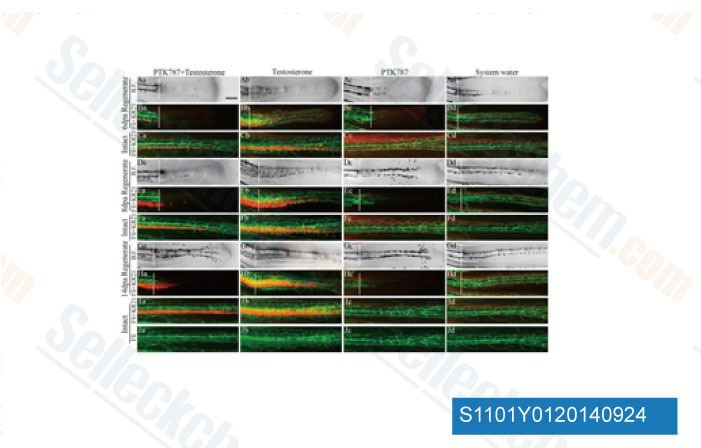
-
Données de [ Development , 2013 , 140, 4323-34 ]
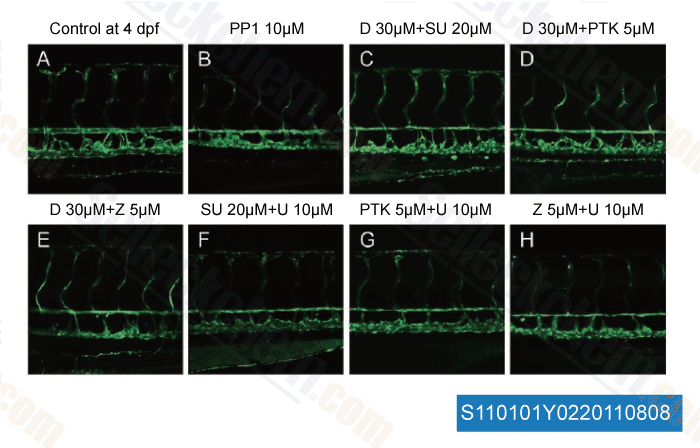
-
Données de [ Cell Res , 2011 , 21, 1080-1087 ]
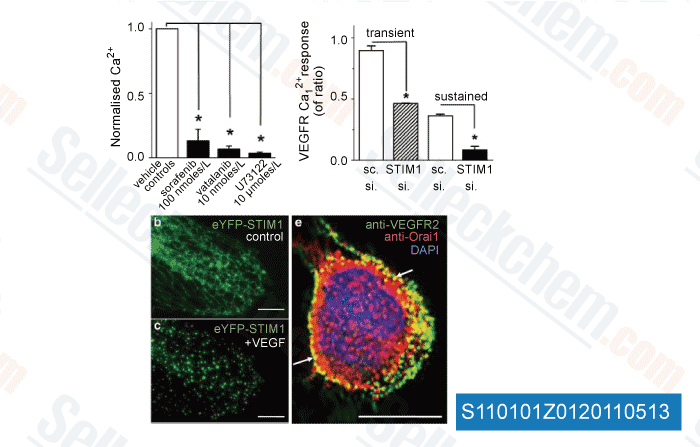
-
Données de [ Circ Res , 2011 , 108, 1190-1198 ]
Sellecks Vatalanib (PTK787) 2HCl A été cité par 55 Publications
| Galectin-3-integrin α5β1 phase separation disrupted by advanced glycation end-products impairs diabetic wound healing in rodents [ Nat Commun, 2025, 16(1):7287] | PubMed: 40775187 |
| Development of an Automated Morphometric Approach to Assess Vascular Outcomes following Exposure to Environmental Chemicals in Zebrafish [ Environ Health Perspect, 2024, 132(5):57001] | PubMed: 38701112 |
| Nudifloside, a Secoiridoid Glucoside Derived from Callicarpa nudiflora, Inhibits Endothelial-to-Mesenchymal Transition and Angiogenesis in Endothelial Cells by Suppressing Ezrin Phosphorylation [ J Cancer, 2024, 15(9):2448-2459] | PubMed: 38577590 |
| Platform combining statistical modeling and patient-derived organoids to facilitate personalized treatment of colorectal carcinoma [ J Exp Clin Cancer Res, 2023, 42(1):79] | PubMed: 37013646 |
| Inhibition of VEGFR2 and EGFR signaling cooperatively suppresses the proliferation of oral squamous cell carcinoma [ Cancer Med, 2023, 12(15):16416-16430] | PubMed: 37341071 |
| Temporal mapping and pharmacological manipulation of signaling architecture of Tyrosine kinases in Traumatic Brain Injury (TBI) [ oparu, 2023, 10.18725/OPARU-47820] | PubMed: None |
| Investigation of the pharmacological effect and mechanism of mountain-cultivated ginseng and garden ginseng in cardiovascular diseases based on network pharmacology and zebrafish experiments [ Front Pharmacol, 2022, 13:920979] | PubMed: 36120313 |
| In Vitro Angiogenesis Inhibition and Endothelial Cell Growth and Morphology [ Int J Mol Sci, 2022, 23(8)4277] | PubMed: 35457095 |
| Establishment and Characterization of NCC-PMP1-C1: A Novel Patient-Derived Cell Line of Metastatic Pseudomyxoma Peritonei [ J Pers Med, 2022, 12(2)258] | PubMed: 35207746 |
| Establishment and characterization of NCC-UPS4-C1: a novel cell line of undifferentiated pleomorphic sarcoma from a patient with Li-Fraumeni syndrome [ Hum Cell, 2022, 10.1007/s13577-022-00671-y] | PubMed: 35118583 |
POLITIQUE DE RETOUR
La politique de retour inconditionnelle de Selleck Chemical garantit une expérience dachat en ligne fluide à nos clients. Si vous nêtes en aucun cas satisfait de votre achat, vous pouvez retourner tout article dans les 7 jours suivant sa réception. En cas de problèmes de qualité du produit, quil sagisse de problèmes liés au protocole ou au produit, vous pouvez retourner tout article dans les 365 jours suivant la date dachat initiale. Veuillez suivre les instructions ci-dessous lors du retour des produits.
EXPÉDITION ET STOCKAGE
Les produits Selleck sont transportés à température ambiante. Si vous recevez le produit à température ambiante, soyez assuré que le service dinspection de la qualité de Selleck a mené des expériences pour vérifier que le placement à température normale pendant un mois naffectera pas lactivité biologique des produits en poudre. Après réception, veuillez stocker le produit conformément aux exigences décrites dans la fiche technique. La plupart des produits Selleck sont stables dans les conditions recommandées.
NON DESTINÉ À UN USAGE HUMAIN, VÉTÉRINAIRE DIAGNOSTIQUE OU THÉRAPEUTIQUE.