
Données techniques
| Formule | C21H25ClN6O2 |
||||||
| Poids moléculaire | 428.92 | Numéro CAS | 1143532-39-1 | ||||
| Solubilité (25°C)* | In vitro | DMSO | 86 mg/mL (200.5 mM) | ||||
| Ethanol | 20 mg/mL (46.62 mM) | ||||||
| Water | Insoluble | ||||||
| In vivo (Ajouter les solvants au produit individuellement et dans l'ordre.) |
|
||||||
|
* <1 mg/ml signifie légèrement soluble ou insoluble. * Veuillez noter que Selleck teste la solubilité de tous les composés en interne, et la solubilité réelle peut différer légèrement des valeurs publiées. Ceci est normal et est dû à de légères variations d'un lot à l'autre. * Expédition à température ambiante (les tests de stabilité montrent que ce produit peut être expédié sans aucune mesure de refroidissement.) |
|||||||
Préparation des solutions mères
Activité biologique
| Description | Le Capivasertib (AZD5363) inhibe puissamment toutes les isoformes de Akt (Akt1/Akt2/Akt3) avec des IC50 de 3 nM/8 nM/8 nM dans des essais acellulaires, de manière similaire à P70S6K/PKA et avec une activité plus faible envers ROCK1/2. Phase 2. | ||||||||
|---|---|---|---|---|---|---|---|---|---|
| Cibles |
|
||||||||
| In vitro | Capivasertib (AZD5363) is a potent Akt inhibitor with IC50 of 3 nM, 8 nM and 8 nM for Akt1, Akt2 and Akt3, respectively. It inhibits phosphorylation of AKT substrates in cells with a potency of approximately 0.3 to 0.8 μM. This compound inhibits the proliferation of 41 of 182 solid and hematologic tumor cell lines with a potency of < 3 μM. Activating mutations in PIK3CA, loss or inactivation of tumor suppressor PTEN, or HER2 amplification all are significantly predictive of responsiveness to AZD5363. Additionally, correlation is also seen between the RAS mutation status of cell lines and resistance to it. |
||||||||
| In vivo | Oral dosing of Capivasertib (AZD5363) (100, 300 mg/kg) to nude mice causes dose- and time-dependent reduction of PRAS40, GSK3β, and S6 phosphorylation in BT474c xenografts, reversible increases in blood glucose concentrations, and dose-dependent decreases in 2[18F]fluoro-2-deoxy-d-glucose (18F-FDG) uptake in U87-MG xenografts. Chronic oral dosing of this compound (130, 200, and 300 mg/kg) causes dose-dependent growth inhibition of xenografts derived from various tumor types, including HER2+ breast cancer models. |
||||||||
| Caractéristiques | Tolérabilité préclinique modérée et caractéristiques PD d'un inhibiteur d'Akt. Profil distinct des autres inhibiteurs d'Akt en développement clinique. |
Protocole (de référence)
| Test kinase : |
|
|---|---|
| Test cellulaire : |
|
| Étude animale : |
|
Références
|
Validation du produit par le client
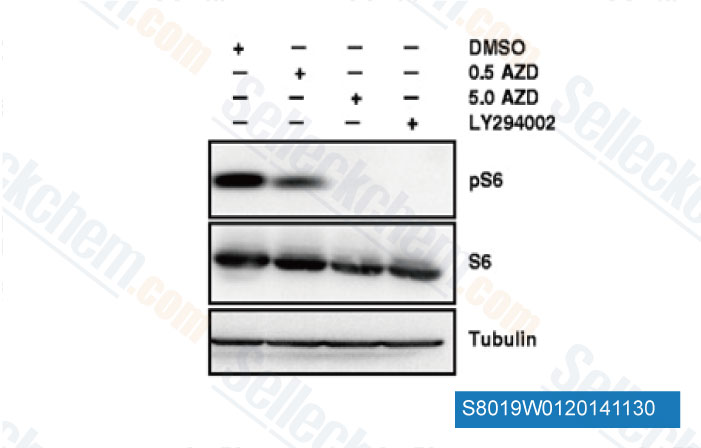
-
Données de [ Cell Commun Signal , 2014 , 12(1), 61 ]
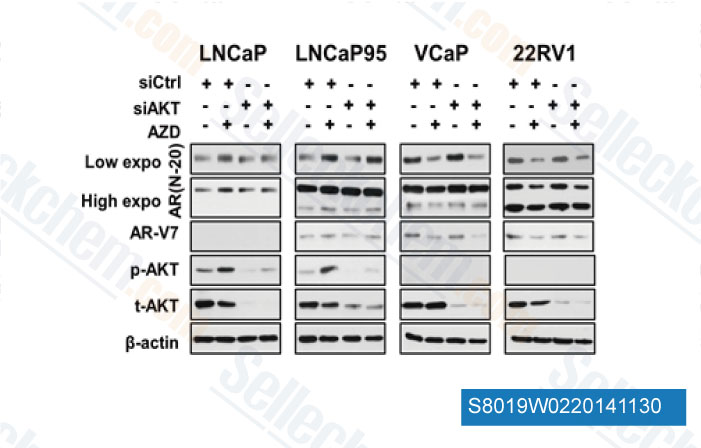
-
Données de [ PLoS One , 2014 , 9(10), e108780 ]

-
Données de [ , , Clin Cancer Res, 2016, 22(4):1018-27 ]
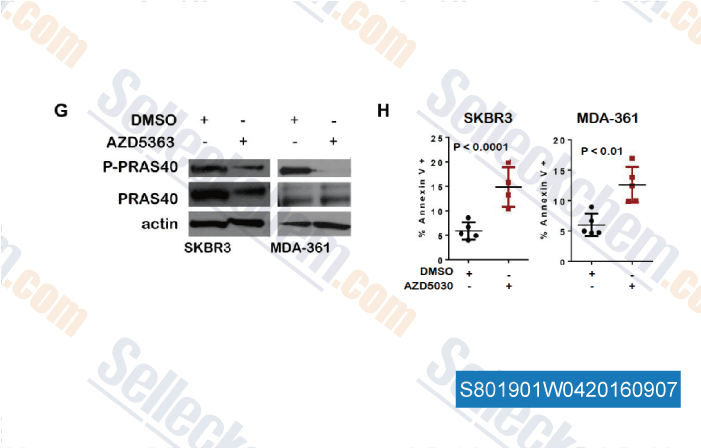
-
Données de [ , , Cancer Res, 2016, 76(16):4752-64. ]
Selleck's AZD5363 (Capivasertib) A été cité par 159 Publications
| Macrophage-derived amphiregulin induces myofibroblast transition in adipogenic lineage precursors near Staphylococcus aureus abscess in bone marrow [ Nat Commun, 2025, 16(1):8409] | PubMed: 40998791 |
| Combined inhibition of KAT6A/B and Menin reverses estrogen receptor-driven gene expression programs in breast cancer [ Cell Rep Med, 2025, 6(7):102192] | PubMed: 40516531 |
| A bedside-to-bench translational analysis of NF1 alterations and CDK4/6 inhibitor resistance in hormone receptor-positive metastatic breast cancer [ EBioMedicine, 2025, 118:105828] | PubMed: 40578027 |
| FABP4 expression in neutrophils as a predictor of sepsis and SI-ARDS based on BALF transcriptome and peripheral blood validation [ Chin Med J (Engl), 2025, 10.1097/CM9.0000000000003447] | PubMed: 40169352 |
| Intratumor heterogeneity in KRAS signaling shapes treatment resistance [ iScience, 2025, 28(2):111662] | PubMed: 39898020 |
| Functional Analysis of the PI3K/AKT/mTOR Pathway Inhibitor, Gedatolisib, Plus Fulvestrant with and Without Palbociclib in Breast Cancer Models [ Int J Mol Sci, 2025, 26(12)5844] | PubMed: 40565304 |
| Synergistic Efficacy of Gedatolisib and Darolutamide in Prostate Cancer to Overcome Resistance to Androgen-Targeted Therapy [ Int J Mol Sci, 2025, 26(24)11810] | PubMed: 41778397 |
| Low-Dose Perifosine, a Phase II Phospholipid Akt Inhibitor, Selectively Sensitizes Drug-Resistant ABCB1-Overexpressing Cancer Cells [ Biomol Ther (Seoul), 2025, 33(1):170-181] | PubMed: 39632683 |
| 3-O-acetylrubiarbonol B preferentially targets EGFR and MET over rubiarbonol B to inhibit NSCLC cell growth [ PLoS One, 2025, 20(9):e0329706] | PubMed: 40920675 |
| ZO-2 is a scaffold at the centriole and mitotic spindle poles that enhances microtubule stability and supports the proper development of mitotic spindles and cilia [ Cell Tissue Res, 2025, 10.1007/s00441-025-03992-0] | PubMed: 40728639 |
POLITIQUE DE RETOUR
La politique de retour inconditionnelle de Selleck Chemical garantit une expérience d'achat en ligne fluide à nos clients. Si vous n'êtes en aucun cas satisfait de votre achat, vous pouvez retourner tout article dans les 7 jours suivant sa réception. En cas de problèmes de qualité du produit, qu'il s'agisse de problèmes liés au protocole ou au produit, vous pouvez retourner tout article dans les 365 jours suivant la date d'achat initiale. Veuillez suivre les instructions ci-dessous lors du retour des produits.
EXPÉDITION ET STOCKAGE
Les produits Selleck sont transportés à température ambiante. Si vous recevez le produit à température ambiante, soyez assuré que le service d'inspection de la qualité de Selleck a mené des expériences pour vérifier que le placement à température normale pendant un mois n'affectera pas l'activité biologique des produits en poudre. Après réception, veuillez stocker le produit conformément aux exigences décrites dans la fiche technique. La plupart des produits Selleck sont stables dans les conditions recommandées.
NON DESTINÉ À UN USAGE HUMAIN, VÉTÉRINAIRE DIAGNOSTIQUE OU THÉRAPEUTIQUE.