
Données techniques
| Formule | C18H26ClN3.2H3O4P |
|||
| Poids moléculaire | 515.86 | Numéro CAS | 50-63-5 | |
| Solubilité (25°C)* | In vitro | Water | 100 mg/mL (193.85 mM) | |
| DMSO | Insoluble | |||
| Ethanol | Insoluble | |||
|
* <1 mg/ml signifie légèrement soluble ou insoluble. * Veuillez noter que Selleck teste la solubilité de tous les composés en interne, et la solubilité réelle peut différer légèrement des valeurs publiées. Ceci est normal et est dû à de légères variations dun lot à lautre. * Expédition à température ambiante (les tests de stabilité montrent que ce produit peut être expédié sans aucune mesure de refroidissement.) |
||||
Préparation des solutions mères
Activité biologique
| Description | Chloroquine diphosphate est un agent antipaludéen et antirhumatismal de type 4-aminoquinoléine, agissant également comme un activateur de l'ATM. La Chloroquine est également un inhibiteur des toll-like receptors (TLRs). | |||||
|---|---|---|---|---|---|---|
| Cibles |
|
|||||
| In vitro | La Chloroquine est un agent chimiothérapeutique pour le traitement clinique du paludisme. La Chloroquine est capable de se lier à l'ADN et d'inhiber la réplication de l'ADN et la synthèse de l'ARN, ce qui entraîne la mort cellulaire. L'effet de la Chloroquine peut également être lié à la formation d'un complexe toxique hème-Chloroquine. La Chloroquine inhibe la dégradation de l'hémoglobine des trophozoïtes en augmentant le pH vacuolaire et en inhibant l'activité de la phospholipase vacuolaire, des protéases vacuolaires et de l'hème polymérase. La Chloroquine possède des propriétés antirhumatismales définies. La Chloroquine a des effets immunomodulateurs, supprimant la production/libération du facteur de nécrose tumorale et de l'interleukine 6. De plus, la Chloroquine exerce des effets antiviraux directs, inhibant les étapes pH-dépendantes de la réplication de plusieurs virus, y compris les membres des flavivirus, rétrovirus et coronavirus. Ses effets les mieux étudiés sont ceux contre la réplication du VIH. La Chloroquine peut s'accumuler à l'intérieur du phagolysosome macrophagique par piégeage ionique où elle exerce une puissante activité antifongique contre Histoplasma capsulatum et Cryptococcus neoformans par des mécanismes distincts. La Chloroquine inhibe la croissance de H. capsulatum par privation de fer pH-dépendante, tandis qu'elle est directement toxique pour C. neoformans. |
|||||
| In vivo | La Chloroquine a des effets inhibiteurs et promoteurs de tumeurs dans le cancer du sein triple négatif. |
Protocole (de référence)
| Test cellulaire : |
|
|---|---|
| Étude animale : |
|
Références
|
Validation du produit par le client
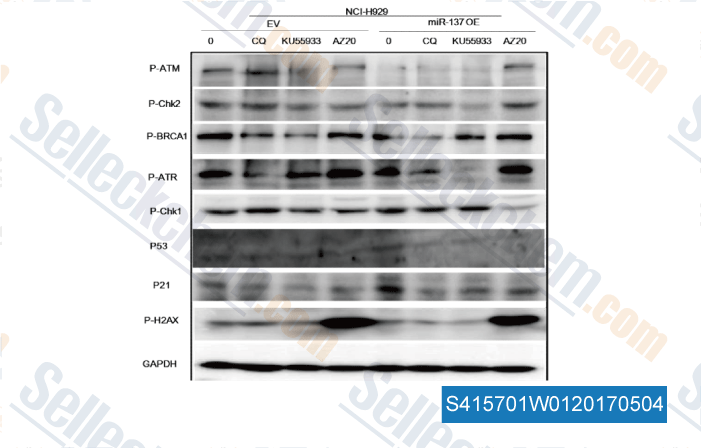
-
, , Leukemia, 2017, 31(5):1123-1135
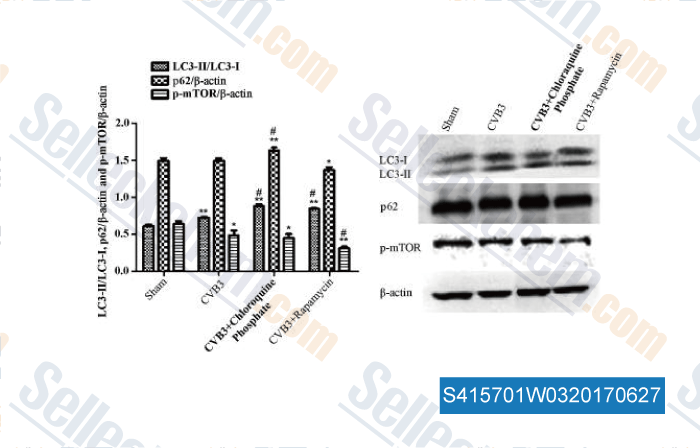
-
, , Int J Mol Med, 2017, 40(1):182-192
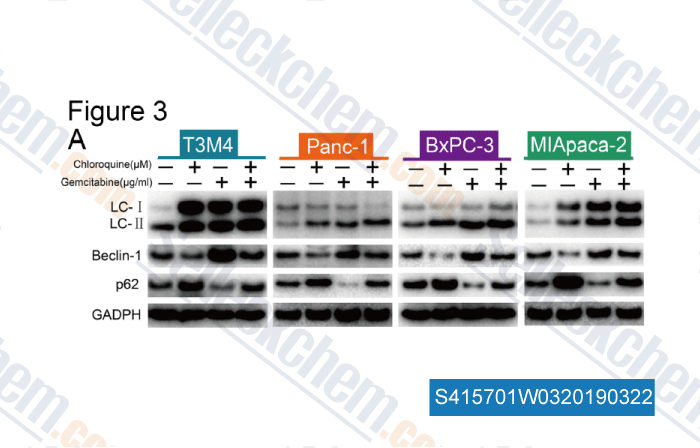
-
Données de [ , , Cancer Lett, 2018, 436:129-138 ]
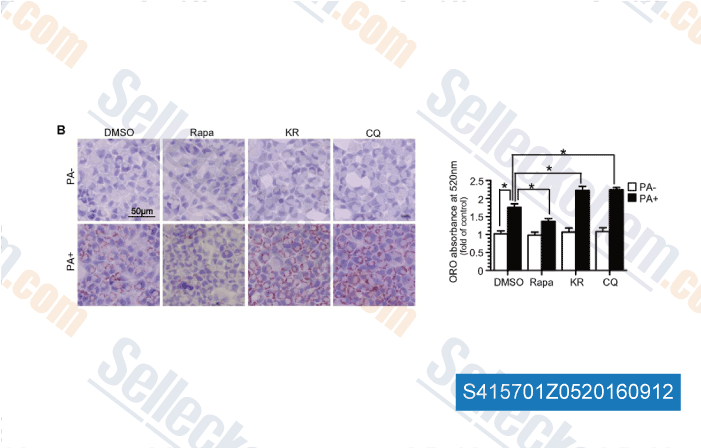
-
Données de [ , , Cell Signal, 2016, 28(8):1086-98. ]
Sellecks Chloroquine diphosphate A été cité par 215 Publications
| Melatonin ameliorates zearalenone-induced ovarian damage in mice through antioxidative effects [ Front Vet Sci, 2025, 12:1587391] | PubMed: 40860911 |
| Noncanonical function of folate through folate receptor 1 during neural tube formation [ Nat Commun, 2024, 15(1):1642] | PubMed: 38388461 |
| Macroautophagy/autophagy promotes resistance to KRASG12D-targeted therapy through glutathione synthesis [ Cancer Lett, 2024, 604:217258] | PubMed: 39276914 |
| Shaoyao-Gancao Decoction, a famous Chinese medicine formula, protects against APAP-induced liver injury by promoting autophagy/mitophagy [ Phytomedicine, 2024, 135:156053] | PubMed: 39326138 |
| KIFC1 depends on TRIM37-mediated ubiquitination of PLK4 to promote centrosome amplification in endometrial cancer [ Cell Death Discov, 2024, 10(1):419] | PubMed: 39349439 |
| Inducing Receptor Degradation as a Novel Approach to Target CC Chemokine Receptor 2 (CCR2) [ Int J Mol Sci, 2024, 25(16)8984] | PubMed: 39201670 |
| Targeting autophagy as a therapeutic strategy in pediatric acute lymphoblastic leukemia [ Sci Rep, 2024, 14(1):4000] | PubMed: 38369625 |
| A high-throughput response to the SARS-CoV-2 pandemic [ SLAS Discov, 2024, 29(5):100160] | PubMed: 38761981 |
| Lysosomes mediate the mitochondrial UPR via mTORC1-dependent ATF4 phosphorylation [ Cell Discov, 2023, 9(1):92] | PubMed: 37679337 |
| Genome homeostasis defects drive enlarged cells into senescence [ Mol Cell, 2023, 10.1016/j.molcel.2023.10.018] | PubMed: 37977116 |
POLITIQUE DE RETOUR
La politique de retour inconditionnelle de Selleck Chemical garantit une expérience dachat en ligne fluide à nos clients. Si vous nêtes en aucun cas satisfait de votre achat, vous pouvez retourner tout article dans les 7 jours suivant sa réception. En cas de problèmes de qualité du produit, quil sagisse de problèmes liés au protocole ou au produit, vous pouvez retourner tout article dans les 365 jours suivant la date dachat initiale. Veuillez suivre les instructions ci-dessous lors du retour des produits.
EXPÉDITION ET STOCKAGE
Les produits Selleck sont transportés à température ambiante. Si vous recevez le produit à température ambiante, soyez assuré que le service dinspection de la qualité de Selleck a mené des expériences pour vérifier que le placement à température normale pendant un mois naffectera pas lactivité biologique des produits en poudre. Après réception, veuillez stocker le produit conformément aux exigences décrites dans la fiche technique. La plupart des produits Selleck sont stables dans les conditions recommandées.
NON DESTINÉ À UN USAGE HUMAIN, VÉTÉRINAIRE DIAGNOSTIQUE OU THÉRAPEUTIQUE.