
Données techniques
| Formule | C27H28F3N7O3 |
||||||
| Poids moléculaire | 555.55 | Numéro CAS | 1374640-70-6 | ||||
| Solubilité (25°C)* | In vitro | DMSO | 100 mg/mL (180.0 mM) | ||||
| Water | Insoluble | ||||||
| Ethanol | Insoluble | ||||||
| In vivo (Ajouter les solvants au produit individuellement et dans lordre.) |
|
||||||
|
* <1 mg/ml signifie légèrement soluble ou insoluble. * Veuillez noter que Selleck teste la solubilité de tous les composés en interne, et la solubilité réelle peut différer légèrement des valeurs publiées. Ceci est normal et est dû à de légères variations dun lot à lautre. * Expédition à température ambiante (les tests de stabilité montrent que ce produit peut être expédié sans aucune mesure de refroidissement.) |
|||||||
Préparation des solutions mères
Activité biologique
| Description | Rociletinib (CO-1686, AVL-301) est un inhibiteur irréversible et sélectif des mutants de l'EGFR avec un Ki de 21,5 nM et 303,3 nM pour EGFRL858R/T790M et EGFRWT dans des essais sans cellules, respectivement. Ce composé est en phase 2. | ||||
|---|---|---|---|---|---|
| Cibles |
|
||||
| In vitro | Le Rociletinib (CO-1686) inhibe le p-EGFR avec des IC50 allant de 62 à 187 nM dans les cellules exprimant l'EGFR mutant, tandis qu'il inhibe la phosphorylation de l'EGFR avec un IC50 de > 2 000 nM dans les trois cellules exprimant l'EGFR WT. Ce composé inhibe sélectivement la croissance des cellules NSCLC exprimant l'EGFR mutant avec des GI50 allant de 7 à 32 nM, et induit l'apoptose. Les lignées cellulaires NSCLC résistantes au CO-1686 présentent des signes de transition épithélio-mésenchymateuse et une sensibilité accrue aux inhibiteurs d'AKT. | ||||
| In vivo | Le Rociletinib (CO-1686) provoque une inhibition de la croissance tumorale dose-dépendante et significative dans tous les modèles mutants de l'EGFR ainsi que chez les souris transgéniques exprimant l'EGFRL858R humain et l'EGFRL858R/T790M. |
Protocole (de référence)
| Test kinase :[1] |
|
|---|---|
| Test cellulaire :[1] |
|
| Étude animale :[1] |
|
Références
|
Validation du produit par le client
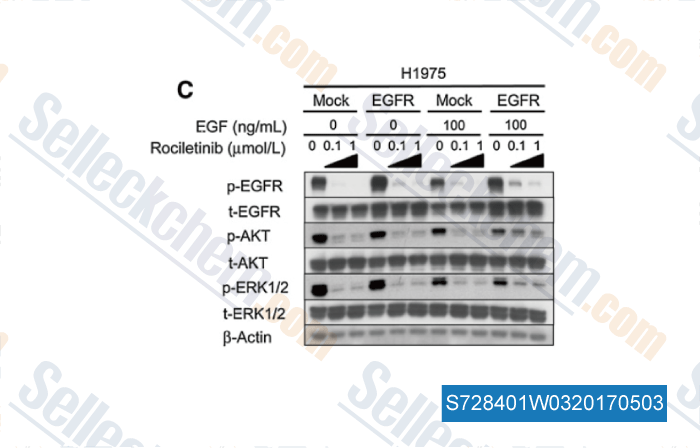
-
, , Cancer Res, 2017, 77(8):2078-2089
-S728402Y0120150901.gif)
-
Données de [ , , Cancer Discov, 2015, 5(7): 713-22 ]
-S728402W0120150901.gif)
-
Données de [ , , Cancer Discov, 2015, 5(7): 713-22 ]
-S728402W0220150831.gif)
-
Données de [ , , Clin Cancer Res, 2015, 10.1158/1078-0432.CCR-15-0560 ]
Sellecks Rociletinib (CO-1686) A été cité par 38 Publications
| Patient-derived rhabdomyosarcoma cells recapitulate the genetic and transcriptomic landscapes of primary tumors [ iScience, 2024, 27(10):110862] | PubMed: 39319271 |
| Establishment and Characterization of NCC-PMP1-C1: A Novel Patient-Derived Cell Line of Metastatic Pseudomyxoma Peritonei [ J Pers Med, 2022, 12(2)258] | PubMed: 35207746 |
| Establishment and characterization of NCC-UPS4-C1: a novel cell line of undifferentiated pleomorphic sarcoma from a patient with Li-Fraumeni syndrome [ Hum Cell, 2022, 10.1007/s13577-022-00671-y] | PubMed: 35118583 |
| Targeting Aurora B kinase prevents and overcomes resistance to EGFR inhibitors in lung cancer by enhancing BIM- and PUMA-mediated apoptosis [ Cancer Cell, 2021, S1535-6108(21)00383-4] | PubMed: 34388376 |
| Overexpression of BIRC6 driven by EGF-JNK-HECTD1 signaling is a potential therapeutic target for triple-negative breast cancer [ Mol Ther Nucleic Acids, 2021, 26:798-812] | PubMed: 34729249 |
| Trametinib overcomes KRAS-G12V-induced osimertinib resistance in a leptomeningeal carcinomatosis model of EGFR-mutant lung cancer [ Cancer Sci, 2021, 112(9):3784-3795] | PubMed: 34145930 |
| Establishment and characterization of the NCC-GCTB4-C1 cell line: a novel patient-derived cell line from giant cell tumor of bone [ Hum Cell, 2021, 10.1007/s13577-021-00639-4] | PubMed: 34731453 |
| Establishment and characterization of NCC-MFS4-C1: a novel patient-derived cell line of myxofibrosarcoma [ Hum Cell, 2021, 34(6):1911-1918] | PubMed: 34383271 |
| Establishment and characterization of novel patient-derived cell lines from giant cell tumor of bone [ Hum Cell, 2021, 10.1007/s13577-021-00579-z] | PubMed: 34304386 |
| Comprehensive pharmacogenomic characterization of gastric cancer. [ Genome Med, 2020, 18;12(1):17] | PubMed: 32070411 |
POLITIQUE DE RETOUR
La politique de retour inconditionnelle de Selleck Chemical garantit une expérience dachat en ligne fluide à nos clients. Si vous nêtes en aucun cas satisfait de votre achat, vous pouvez retourner tout article dans les 7 jours suivant sa réception. En cas de problèmes de qualité du produit, quil sagisse de problèmes liés au protocole ou au produit, vous pouvez retourner tout article dans les 365 jours suivant la date dachat initiale. Veuillez suivre les instructions ci-dessous lors du retour des produits.
EXPÉDITION ET STOCKAGE
Les produits Selleck sont transportés à température ambiante. Si vous recevez le produit à température ambiante, soyez assuré que le service dinspection de la qualité de Selleck a mené des expériences pour vérifier que le placement à température normale pendant un mois naffectera pas lactivité biologique des produits en poudre. Après réception, veuillez stocker le produit conformément aux exigences décrites dans la fiche technique. La plupart des produits Selleck sont stables dans les conditions recommandées.
NON DESTINÉ À UN USAGE HUMAIN, VÉTÉRINAIRE DIAGNOSTIQUE OU THÉRAPEUTIQUE.