
Données techniques
| Formule | C20H19F2N3O5 |
||||||
| Poids moléculaire | 419.38 | Numéro CAS | 1051375-16-6 | ||||
| Solubilité (25°C)* | In vitro | DMSO | 83 mg/mL (197.91 mM) | ||||
| Water | Insoluble | ||||||
| Ethanol | Insoluble | ||||||
| In vivo (Ajouter les solvants au produit individuellement et dans l'ordre.) |
|
||||||
|
* <1 mg/ml signifie légèrement soluble ou insoluble. * Veuillez noter que Selleck teste la solubilité de tous les composés en interne, et la solubilité réelle peut différer légèrement des valeurs publiées. Ceci est normal et est dû à de légères variations d'un lot à l'autre. * Expédition à température ambiante (les tests de stabilité montrent que ce produit peut être expédié sans aucune mesure de refroidissement.) |
|||||||
Préparation des solutions mères
Activité biologique
| Description | Le dolutégravir est un inhibiteur de l'intégrase du VIH liant deux métaux, avec une IC50 de 2,7 nM dans un essai sans cellules, et une activité modeste contre les mutants signatures Y143R, Q148K, N155H et G140S/Q148H résistants au raltégravir. | ||
|---|---|---|---|
| Cibles |
|
||
| In vitro | Dolutegravir (GSK1349572) shows a potent inhibitory effect on nine clinical isolates from integrase inhibitor-naive HIV-2-infected patients with EC50 ranging from 0.2 nM to 1.4 nM. In vitro, it inhibits recombinant HIV-1 integrase-catalyzed strand transfer with an IC50 of 2.7 nM. Furthermore, this compound potently inhibits HIV replication in cells such as peripheral blood mononuclear cells (PBMCs), MT-4 cells, and CIP4 cells infected with a self-inactivating PHIV lentiviral vector, with EC50 values of 0.51 nM, 0.71 nM, and 2.2 nM, respectively. In vitro, it also exhibits potent activity against five different nonnucleoside reverse transcription inhibitor-resistant or nucleoside reverse transcription inhibitor-resistant viruses, with EC50 ranging from 1.3 nM to 2.1 nM. Similarly to its activity against wild-type virus, it shows equivalent efficacy against two protease inhibitor-resistant viruses, with EC50 values of 0.36 nM and 0.37 nM, respectively. |
||
| In vivo | Dolutegravir (GSK1349572), a first-line antiretroviral drug (ARV) used in combination therapy for HIV-1, inhibits MMP activity and has the potential to affect prenatal and postnatal neurodevelopment. |
||
| Caractéristiques | Un inhibiteur de transfert de brin de l'Integrase du VIH de nouvelle génération et à liaison à deux métaux. |
Protocole (de référence)
| Test kinase : |
|
|---|---|
| Test cellulaire : |
|
| Étude animale : |
|
Références
|
Validation du produit par le client
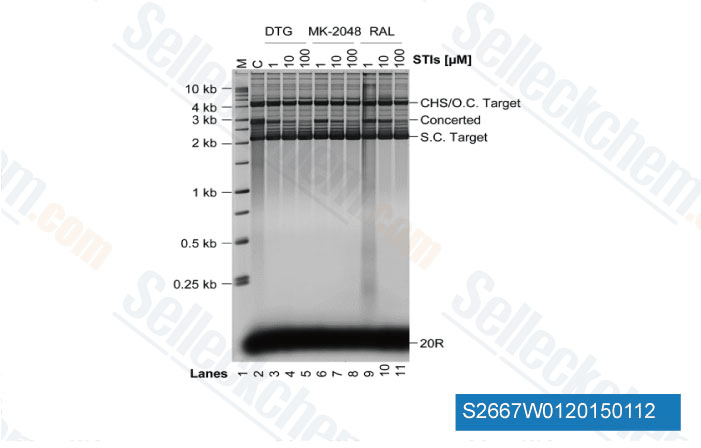
-
Données de [ J Biol Chem , 2014 , 289(28), 19648-58 ]
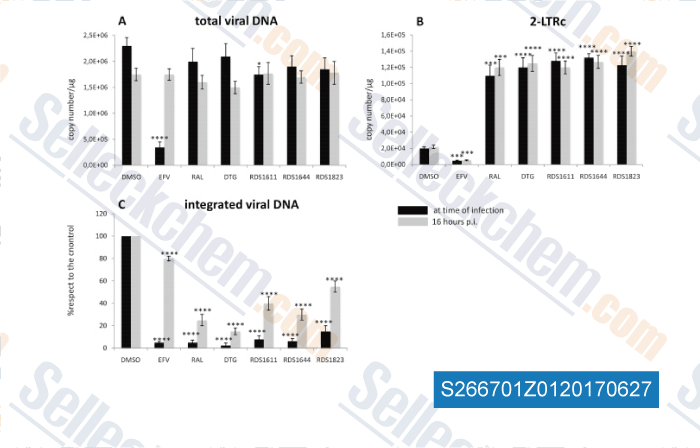
-
Données de [ , , Antiviral Res, 2016, 134:236-243 ]
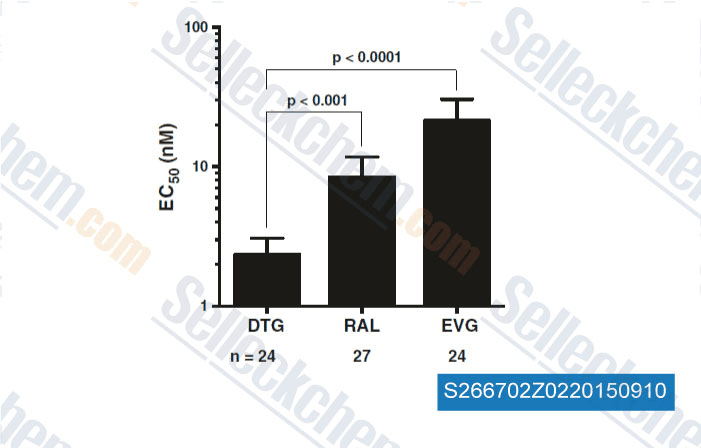
-
Données de [ , , Retrovirology, 2015, 10.1186/s12977-015-0146-8 ]
Selleck's GSK1349572 (Dolutegravir) A été cité par 42 Publications
| Ultra-long-actingremovabledrugdeliverysystemforHIVtreatmentandprevention [ NatureCommunications, October8, 2018, 4156] | |
| ActivationofPERK-ATF4-CHOPpathwayasanoveltherapeuticapproachforefficienteliminationofHTLV-1-infectedcells [ BloodAdvances, May12, 2020, 1845-1858] | |
| EffectsofInjectionVolumeandRouteofAdministrationonDolutegravirInSituFormingImplantPharmacokinetics [ Pharmaceutics, March11, 2022, 615] | |
| Invitroactivityofdolutegraviragainstwild-typeandintegraseinhibitor-resistantHIV-2 [ Retrovirology, February5, 2015, 10] | |
| ExvivoantiretroviralpotencyofnewerintegrasestrandtransferinhibitorscabotegravirandbictegravirinHIV-1non-Bsubtypes [ AIDS, February20, 2018, 469-476] | |
| Timed chromatin invasion during mitosis governs prototype foamy virus integration site selection and infectivity [ Nucleic Acids Res, 2025, 53(10)gkaf449] | PubMed: 40448500 |
| Cognate antigen engagement induces HIV-1 expression in latently infected CD4+ T cells from people on long-term antiretroviral therapy [ Immunity, 2024, 57(12):2928-2944.e6] | PubMed: 39612916 |
| HMGB1 Expression Levels Correlate with Response to Immunotherapy in Non-Small Cell Lung Cancer [ Lung Cancer, 2024, 15:55-67] | PubMed: 38741920 |
| Overexpression of TRPV1 activates autophagy in human lens epithelial cells under hyperosmotic stress through Ca2+-dependent AMPK/mTOR pathway [ Int J Ophthalmol, 2024, 17(3):420-434] | PubMed: 38721513 |
| Biological and Structural Analyses of New Potent Allosteric Inhibitors of HIV-1 Integrase [ Antimicrob Agents Chemother, 2023, 67(7):e0046223] | PubMed: 37310224 |
POLITIQUE DE RETOUR
La politique de retour inconditionnelle de Selleck Chemical garantit une expérience d'achat en ligne fluide à nos clients. Si vous n'êtes en aucun cas satisfait de votre achat, vous pouvez retourner tout article dans les 7 jours suivant sa réception. En cas de problèmes de qualité du produit, qu'il s'agisse de problèmes liés au protocole ou au produit, vous pouvez retourner tout article dans les 365 jours suivant la date d'achat initiale. Veuillez suivre les instructions ci-dessous lors du retour des produits.
EXPÉDITION ET STOCKAGE
Les produits Selleck sont transportés à température ambiante. Si vous recevez le produit à température ambiante, soyez assuré que le service d'inspection de la qualité de Selleck a mené des expériences pour vérifier que le placement à température normale pendant un mois n'affectera pas l'activité biologique des produits en poudre. Après réception, veuillez stocker le produit conformément aux exigences décrites dans la fiche technique. La plupart des produits Selleck sont stables dans les conditions recommandées.
NON DESTINÉ À UN USAGE HUMAIN, VÉTÉRINAIRE DIAGNOSTIQUE OU THÉRAPEUTIQUE.