
Données techniques
| Formule | C27H29NO11.HCl |
||||||
| Poids moléculaire | 579.98 | Numéro CAS | 25316-40-9 | ||||
| Solubilité (25°C)* | In vitro | DMSO | 100 mg/mL (172.41 mM) | ||||
| Water | 100 mg/mL (172.41 mM) | ||||||
| Ethanol | Insoluble | ||||||
| In vivo (Ajouter les solvants au produit individuellement et dans l'ordre.) |
|
||||||
|
* <1 mg/ml signifie légèrement soluble ou insoluble. * Veuillez noter que Selleck teste la solubilité de tous les composés en interne, et la solubilité réelle peut différer légèrement des valeurs publiées. Ceci est normal et est dû à de légères variations d'un lot à l'autre. * Expédition à température ambiante (les tests de stabilité montrent que ce produit peut être expédié sans aucune mesure de refroidissement.) |
|||||||
Préparation des solutions mères
Activité biologique
| Description | Doxorubicin Hydrochloride est un agent antibiotique et un inhibiteur de la DNA Topoisomerase II avec une CI50 de 2,67 μM contre la DNA Topoisomerase II humaine. Ce composé réduit la phosphorylation basale de AMPK et est utilisé dans le traitement concomitant des patients infectés par le HIV, mais présente un risque élevé de réactivation du HBV. Ce produit peut précipiter lorsqu'il est dissous dans une solution de PBS. Il est recommandé de préparer la solution mère dans de l'eau pure et de la diluer avec de l'eau pure ou une solution saline pour obtenir la solution de travail. Il peut être utilisé pour induire des modèles animaux de maladie rénale.Les solutions sont instables et doivent être préparées fraîches. | ||
|---|---|---|---|
| Cibles |
|
||
| In vitro | Doxorubicin, an antibiotic anthracycline, is commonly considered to exert its anti-tumor activity at two fundamental levels, altering DNA and producing free radicals to trigger apoptosis of cancer cells through DNA damage. Doxorubicin can block the synthesis of DNA by intercalating into the DNA strand, and inhibits DNA topoisomerase II (TOP2). Doxorubicin is most effective when cells are rapidly proliferating and expressing high levels of TOP2. Additionally, Doxorubicin can trigger apoptosis by producing ceramide (which prompts apoptosis by activating p53 or other downstream pathways such as JNK), the degradation of Akt by serine threonine proteases, the mitochondrial release of cytochrome c, increased FasL (death receptor Fas/CD95 ligand) mRNA production, and a greater production of free radicals. Pre-treatment with GSNO (nitrosoglutathione) suppresses the resistance in the doxorubicin-resistant breast cancer cell line MCF7/Dx, accompanied by enhanced protein glutathionylation and accumulation of doxorubicin in the nucleus. Doxorubicin induced G2/M checkpoint arrest are attributed to elevated cyclin G2 (CycG2) expression and phospho-modification of proteins in the ataxia telangiectasia mutated (ATM) and ATM and Rad3-related (ATR) signaling pathways. Doxorubicin inhibits AMP-activated protein kinase (AMPK), resulting in SIRT1 dysfunction, p53 accumulation, and increased cell death in mouse embryonic fibroblasts (MEFs) and cardiomyocytes, which can be further sensitized by pre-inhibition of AMPK. Doxorubicin elicits a marked heat shock response, and that either inhibition or silencing of heat shock proteins enhance the Doxorubicin apoptotic effect in neuroblastoma cells. Nanomolar Doxorubicin treatment of neuroblastoma cells causes dose-dependent over-ubiquitination of a specific set of proteins in the absence of measurable inhibition of proteasome, and loss of activity of ubiquitinated enzymes such as lactate dehydrogenase and α-enolase, the protein ubiquination patterns of which is similar to those with proteasome inhibitor, indicating that Doxorubicin may also exert its effect by damaging proteins. |
||
| In vivo | In vivo, Doxorubicin in combination with adenoviral MnSOD (AdMnSOD) plus 1,3-bis(2-chloroethyl)-1-nitrosourea (BCNU) has the greatest effect in decreasing the volumes of MB231 tumors and prolonging survival of mice. Although its use is limited by the chronic and acute toxic side effects it produces, Doxorubicin is essential in treating breast and oesophageal carcinomas, solid tumours in childhood, osteosarcomas, Kaposi's sarcoma, soft tissue sarcomas, and Hodgkin and non-Hodgkin lymphomas. |
Protocole (de référence)
| Test cellulaire : |
|
|---|---|
| Étude animale : |
|
Références
|
Validation du produit par le client
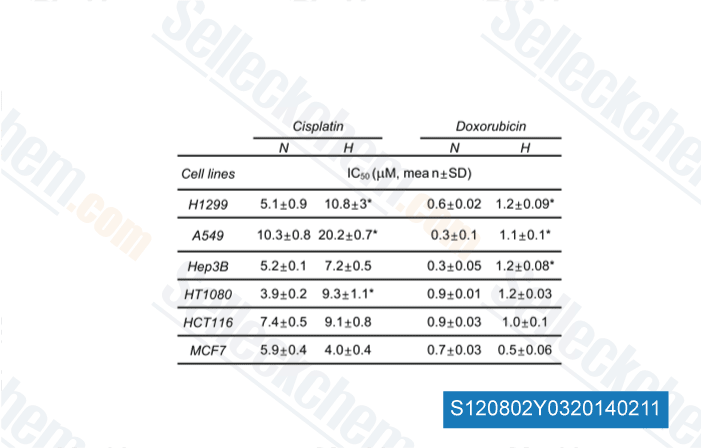
-
Données de [ Cancer Res , 2014 , 74, 298-308 ]
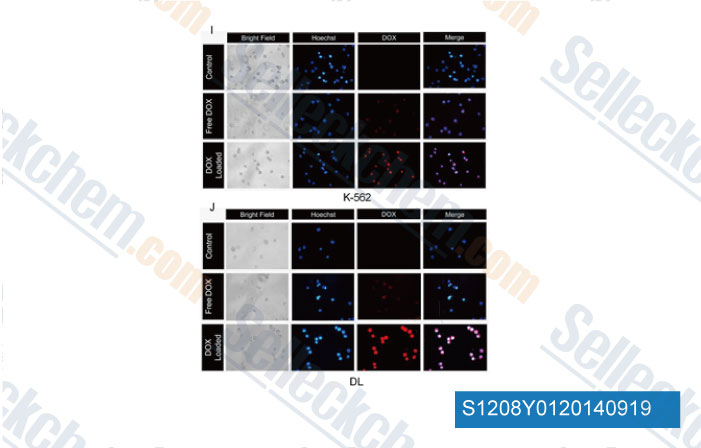
-
Données de [ PLoS One , 2014 , 9, e94309 ]
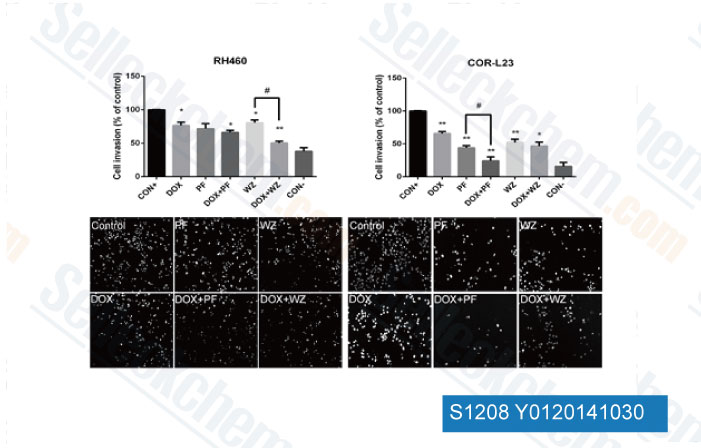
-
, 2014 , Dr Milica Pesic from Institute for Biological Research
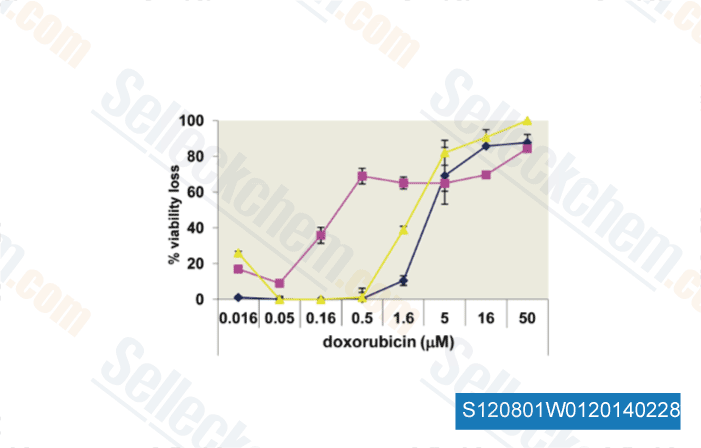
-
Données de [ PLoS One , 2013 , 8(1), e54595 ]
Selleck's Doxorubicin (Adriamycin) Hydrochloride A été cité par 1038 Publications
| Tritrichomonas muris sensitizes the intestinal epithelium to doxorubicin-induced apoptosis [ American Journal of Physiology-Gastrointestinal and Liver Physiology, May 1, 2025, G594-G609] | PubMed: 39149272 |
| Indirect targeting of MYC and direct targeting in combination with chemotherapies are more effective than direct mono-targeting in triple negative breast cancer [ Translational Oncology, January 2025, 102204] | PubMed: 39631207 |
| Targeting ACSS2 activity suspends the formation of chemoresistance through suppressed histone H3 acetylation in human breast cancer [ Research Square, February 21, 2024, nan] | |
| Hyperglutaminolysis drives senescence and aging through arginine-mTORC1 axis activation [ Signal Transduct Target Ther, 2026, 11(1):64] | PubMed: 41708609 |
| Polθ activity modulates sensitivity to standard therapies in DNMT3A-deficient leukemia [ Cell Rep Med, 2026, 7(3):102687] | PubMed: 41850232 |
| Regularized Single-Cell Imaging Enables Generalizable AI Models for Stain-Free Cell Viability Screening [ Small Methods, 2026, 10(4):e01369] | PubMed: 41574984 |
| NPM1 phosphorylation-mediated telomere maintenance via stabilization of POLD3 in ALT-positive osteosarcoma: unraveling mechanisms and therapeutic opportunities [ Theranostics, 2026, 16(8):4224-4244] | PubMed: 41695477 |
| Targeting senescence-like tumor-associated macrophages sensitizes chemotherapy in triple-negative breast cancer [ Cell Oncol (Dordr), 2026, 49(2)61] | PubMed: 41870812 |
| The OtR tumor recurrence and metastasis model reveals doxorubicin-induced tumor shrinkage doesnt guarantee prolonged survival [ Animal Models and Experimental Medicine, 2026, Online ahead of print] | PubMed: 41492919 |
| Protocol to quantify cell-surface vimentin on senescent human chondrocytes and other cell types via a cell-based ELISA [ STAR Protoc, 2026, 7(2):104451] | PubMed: 41865378 |
POLITIQUE DE RETOUR
La politique de retour inconditionnelle de Selleck Chemical garantit une expérience d'achat en ligne fluide à nos clients. Si vous n'êtes en aucun cas satisfait de votre achat, vous pouvez retourner tout article dans les 7 jours suivant sa réception. En cas de problèmes de qualité du produit, qu'il s'agisse de problèmes liés au protocole ou au produit, vous pouvez retourner tout article dans les 365 jours suivant la date d'achat initiale. Veuillez suivre les instructions ci-dessous lors du retour des produits.
EXPÉDITION ET STOCKAGE
Les produits Selleck sont transportés à température ambiante. Si vous recevez le produit à température ambiante, soyez assuré que le service d'inspection de la qualité de Selleck a mené des expériences pour vérifier que le placement à température normale pendant un mois n'affectera pas l'activité biologique des produits en poudre. Après réception, veuillez stocker le produit conformément aux exigences décrites dans la fiche technique. La plupart des produits Selleck sont stables dans les conditions recommandées.
NON DESTINÉ À UN USAGE HUMAIN, VÉTÉRINAIRE DIAGNOSTIQUE OU THÉRAPEUTIQUE.