
Données techniques
| Formule | C34H33N3O5 |
||||||||||
| Poids moléculaire | 563.64 | Numéro CAS | 143664-11-3 | ||||||||
| Solubilité (25°C)* | In vitro | DMSO | 41 mg/mL (72.74 mM) | ||||||||
| Water | Insoluble | ||||||||||
| Ethanol | Insoluble | ||||||||||
| In vivo (Ajouter les solvants au produit individuellement et dans lordre.) |
|
||||||||||
|
* <1 mg/ml signifie légèrement soluble ou insoluble. * Veuillez noter que Selleck teste la solubilité de tous les composés en interne, et la solubilité réelle peut différer légèrement des valeurs publiées. Ceci est normal et est dû à de légères variations dun lot à lautre. * Expédition à température ambiante (les tests de stabilité montrent que ce produit peut être expédié sans aucune mesure de refroidissement.) |
|||||||||||
Préparation des solutions mères
Activité biologique
| Description | Elacridar (GF120918, GW120918, GG918, GW0918) est un puissant inhibiteur de P-gp (MDR-1) et de BCRP. | ||
|---|---|---|---|
| Cibles |
|
||
| In vitro | Elacridar (GF120918) inhibe le marquage de la P-glycoprotéine (P-gp) par la [3H]azidopine avec une IC50 de 0,16 μM. Dans les cellules Caki-1 et ACHN, il (2,5 μM) inhibe significativement la croissance cellulaire. L'activité de la P-glycoprotéine est inhibée par ce composé. Sa combinaison conduit à une réduction significative de l'expression de la sous-famille B membre 2 (ABCG2) de l'ABC dans les cellules 786-O. |
||
| In vivo | Elacridar (GF120918) augmente les concentrations plasmatiques et cérébrales et les rapports cerveau/plasma chez les souris de type sauvage lorsqu'il est co-administré par voie orale (100 mg/kg, p.o.), égalant les niveaux chez les souris Abcb1a/1b; Abcg2-/-. Chez les souris Friend leukemia virus strain B, le coefficient de partition cerveau-plasma (Kp, cerveau) de ce composé est de 0,82, 0,43 et 4,31 après traitement intraveineux (2,5 mg/kg), intrapéritonéal (100 mg/kg) et oral (100 mg/kg), respectivement. Chez les souris Mrp4(-/-), il inhibe totalement le transport médié par P-gp, sans effets significatifs sur le transport médié par Bcrp1. |
Protocole (de référence)
| Test kinase : |
|
|---|---|
| Test cellulaire : |
|
| Étude animale : |
|
Références
|
Validation du produit par le client
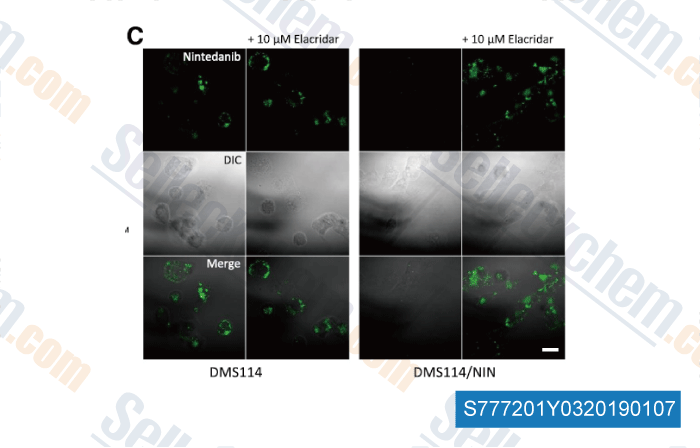
-
Données de [ , , J Exp Clin Cancer Res, 2017, 36(1):122 ]
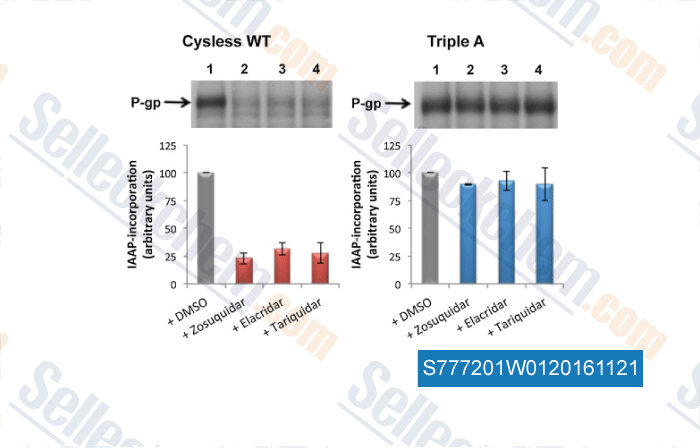
-
Données de [ , , Biochem Pharmacol, 2016, 101:40-53. ]
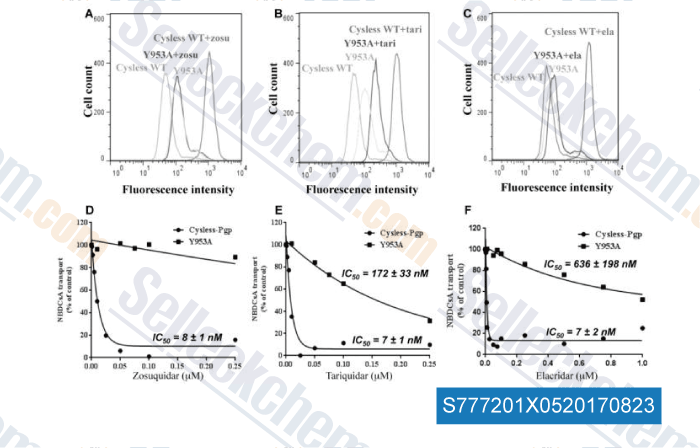
-
Données de [ , , Biochem Pharmacol, 2016, 101:40-53 ]
Sellecks Elacridar (GF120918) A été cité par 30 Publications
| Identification of the Notch ligand DLK1 as an immunotherapeutic target and regulator of tumor cell plasticity and chemoresistance in adrenocortical carcinoma [ Nat Commun, 2025, 16(1):5511] | PubMed: 40595495 |
| Screening a living biobank identifies cabazitaxel as a strategy to combat acquired taxol resistance in high-grade serous ovarian cancer [ Cell Rep Med, 2025, 6(6):102160] | PubMed: 40466638 |
| Synthesis of carbon dots from spent coffee grounds: transforming waste into potential biomedical tools [ Nanoscale, 2025, 17(16):9947-9962] | PubMed: 40067158 |
| Nbeal2 Inactivation Triggers Abl1 Stabilisation and Dysregulated Subcellular Localisation of the Multi-Drug-Resistant Protein MDR1 (ABCB1) in Mast Cells [ Immunology, 2025, NONE] | PubMed: 41111259 |
| Targeting SUMOylation in ovarian cancer: Sensitivity, resistance, and the role of MYC [ iScience, 2025, 28(6):112555] | PubMed: 40487451 |
| Elacridar Inhibits BCRP Protein Activity in 2D and 3D Cell Culture Models of Ovarian Cancer and Re-Sensitizes Cells to Cytotoxic Drugs [ Int J Mol Sci, 2025, 26(12)5800] | PubMed: 40565261 |
| The Role of Elacridar, a P-gp Inhibitor, in the Re-Sensitization of PAC-Resistant Ovarian Cancer Cell Lines to Cytotoxic Drugs in 2D and 3D Cell Culture Models [ Int J Mol Sci, 2025, 26(3)1124] | PubMed: 39940891 |
| Overcoming ABCB1 mediated multidrug resistance in castration resistant prostate cancer [ Cell Death Dis, 2024, 15(8):558] | PubMed: 39090086 |
| Targeting the glutamine metabolism to suppress cell proliferation in mesenchymal docetaxel-resistant prostate cancer [ Oncogene, 2024, 43(26):2038-2050] | PubMed: 38750263 |
| Abcg2a is the functional homolog of human ABCG2 expressed at the zebrafish blood-brain barrier [ Fluids Barriers CNS, 2024, 21(1):27] | PubMed: 38491505 |
POLITIQUE DE RETOUR
La politique de retour inconditionnelle de Selleck Chemical garantit une expérience dachat en ligne fluide à nos clients. Si vous nêtes en aucun cas satisfait de votre achat, vous pouvez retourner tout article dans les 7 jours suivant sa réception. En cas de problèmes de qualité du produit, quil sagisse de problèmes liés au protocole ou au produit, vous pouvez retourner tout article dans les 365 jours suivant la date dachat initiale. Veuillez suivre les instructions ci-dessous lors du retour des produits.
EXPÉDITION ET STOCKAGE
Les produits Selleck sont transportés à température ambiante. Si vous recevez le produit à température ambiante, soyez assuré que le service dinspection de la qualité de Selleck a mené des expériences pour vérifier que le placement à température normale pendant un mois naffectera pas lactivité biologique des produits en poudre. Après réception, veuillez stocker le produit conformément aux exigences décrites dans la fiche technique. La plupart des produits Selleck sont stables dans les conditions recommandées.
NON DESTINÉ À UN USAGE HUMAIN, VÉTÉRINAIRE DIAGNOSTIQUE OU THÉRAPEUTIQUE.